Your Phone Is Your Entire Life Now
Flight tickets. Hotel reservations. Boarding passes. Banking apps. Maps. Translation. Money. Itineraries. Two-factor authentication for literally everything. It is all in your pocket. And that is fine. Until it ain't.
This one is about the scenario nobody thinks about until it slaps them in the face: you lose your phone abroad and suddenly you cannot log into anything. At all.
The Nightmare Scenario
So picture this. You are somewhere gorgeous and remote. Maybe a beach in Southeast Asia. Maybe a mountain town in South America. Maybe a European city where a seagull just yoinked your phone off a cafe table because apparently that is a thing now. Maybe a monkey in Bali decided your iPhone looks tasty. Maybe some dude just straight up pickpocketed you. Does not matter how. Phone is gone.
Deep breath. It is just a phone. You can buy a new one. You find the nearest sketchy electronics shop, grab the cheapest Android they got, pick up a local SIM card. Back in business, baby.
Except you are absolutely not.
You try to log into your email. Sends a verification code to your phone number. The one you just lost. Cool. You try your cloud storage. Wants to verify via email. The email you cannot get into. Your airline account? Two-factor auth via an authenticator app. The one that was on your old phone. Your bank? Same story but with extra bureaucracy.
So now you are standing in some shop in a foreign country, holding a brand new phone that can do precisely nothing, because every single account you own is locked behind a verification method that no longer exists in the physical world.
Welcome to the 2FA lockout spiral. Population: you, confused.

Why 2FA Becomes Your Enemy
Look, 2FA is great. For real. Everyone should use it. It keeps your accounts from getting hijacked, and in a world where passwords get leaked on any given Sunday, 2FA is one of the few things standing between you and someone draining your savings from a basement in who-knows-where.
But here is what nobody talks about: 2FA assumes you always have access to your second factor. Your phone number, your authenticator app, your email. Lose one, the chain starts cracking. Lose your phone while traveling, and you might lose all three at once. Fun times.
- SMS verification goes to a number you no longer have
- Authenticator apps (Google Authenticator, Microsoft Authenticator, Authy) were on the device that is gone, along with all those QR seeds you definitely did not back up
- Email verification wants another 2FA method to log in first, which, yeah
- Banking apps are tied to specific devices and phone numbers, because banks gonna bank
Every account points to another account for recovery, and they all point back to the phone you do not have. It is a beautifully designed circle of nope.

The Backup SIM Trick
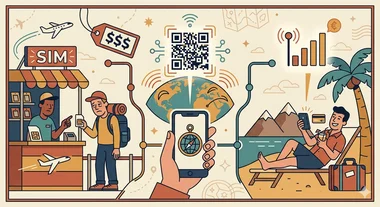
I have not found a perfect solution for this. If you got one, genuinely, hit me up. But the closest thing to a lifeline I came up with is embarrassingly simple: a backup SIM card.
Here is the deal. You have a second phone number that is registered as a backup 2FA method on your most critical accounts. That SIM card is not in your phone. It is somewhere else entirely. Phone disappears, you still got the number.
What you need:
- A free prepaid SIM with no monthly fees. You are not tryna pay for something you hope to never use
- Some credit on it so it can actually receive and send SMS when you pop it in
- Global roaming support so it works wherever you happen to be when everything goes sideways. Yes, roaming charges will be brutal, but you only need it for like five verification codes, not for doomscrolling Instagram
- Stored separately from your phone. This is the whole point. If they both vanish together, congratulations, you played yourself
The crucial bit: your email providers need to support a second phone number for 2FA. Good news, both Outlook.com and Gmail let you do this. You add your backup number as an alternative verification method. That is your safety net right there.
How I Set It Up
Nothing fancy. No gadgets. No expensive service. Just a SIM card and a paperclip.
- I got a free prepaid SIM from a provider with zero monthly fees. Threw some credit on it, enough for a bunch of SMS. I wire about 10 cents of credit to it every month so it stays active and doesn't get automatically disconnected without me noticing
- That SIM is paperclipped to the inside of my passport. The passport I hopefully never lose at the same time as my phone. If I somehow manage to lose both at once, email access is the least of my problems and I will have a very entertaining story for later
- The number from that SIM is added as a backup 2FA phone number on my Outlook.com and Gmail accounts
- The SIM supports global roaming. The per-message cost is ridiculous but I genuinely do not care. I am not using this thing to chat. I need it for maybe five verification codes in a worst-case scenario that hopefully never happens
If things go south:
- Buy a cheap phone somewhere. Anything. A 30 dollar Android from a random shop, whatever
- Pull the backup SIM outta the passport
- Pop it in
- Log into email using the backup number for 2FA
- From there, get back into airline accounts, hotel bookings, cloud storage, and whatever else you need to un-wreck your trip
That is literally it. No apps, no internet needed for the initial SMS step, no 47-step recovery wizard.

Published April 2026.