Vertical Scale and Hotpot Energy
Built at the confluence of the Yangtze and Jialing rivers, carved into steep hills, layered with highways, bridges, rail lines, staircases, platforms and towers, Chongqing feels like it wasn't planned as it just accumulated. It rises and folds, dives underground, and then reappears somewhere unexpected.
Many travelers pass through on their way to a Yangtze River cruise. But hopefully, you will stay a little bit longer. Chongqing deserves attention. Its cyberpunk skyline, intense street life and famously spicy hotpot make it an experience rather than a stopover. This is not a place you casually stroll through. It is a vertical event.

Geographically, it sits at the edge of the Sichuan Basin. Historically, it served as China's wartime capital during the Second Sino-Japanese War. It lays strategically, was heavily bombed, and remained resilient. You can almost feel the toughness. Beyond the city, the municipality holds two UNESCO World Heritage Sites: the Dazu Rock Carvings and the Wulong Karst, both reachable as day trips.
Chongqing is not polished Shanghai nor imperial Beijing. Chongqing is just raw scale, humidity, neon, spice, and an infrastructure pushed to extremes.
Chongqing does not ease you in
When you step outside from your air conditioned hotel room, you get hit by thick air. Not polluted thick. Hot and humid thick. The kind that sits on your skin. The city rises in every direction. You can see towers on cliffs, bridges above bridges, and roads above roads. And when you look up, you have no idea if you're looking at level 25 or underground level -5.
Maps stop making sense here. I remember checking walking directions and thinking: 600 meters, easy. It wasn't.

It was 600 meters, plus an escalator, plus an endless winding staircase. And plus a detour, of course, because the street I was aiming for was actually 20 meters above me, above 2 other streets. Chongqing is vertical cardio.
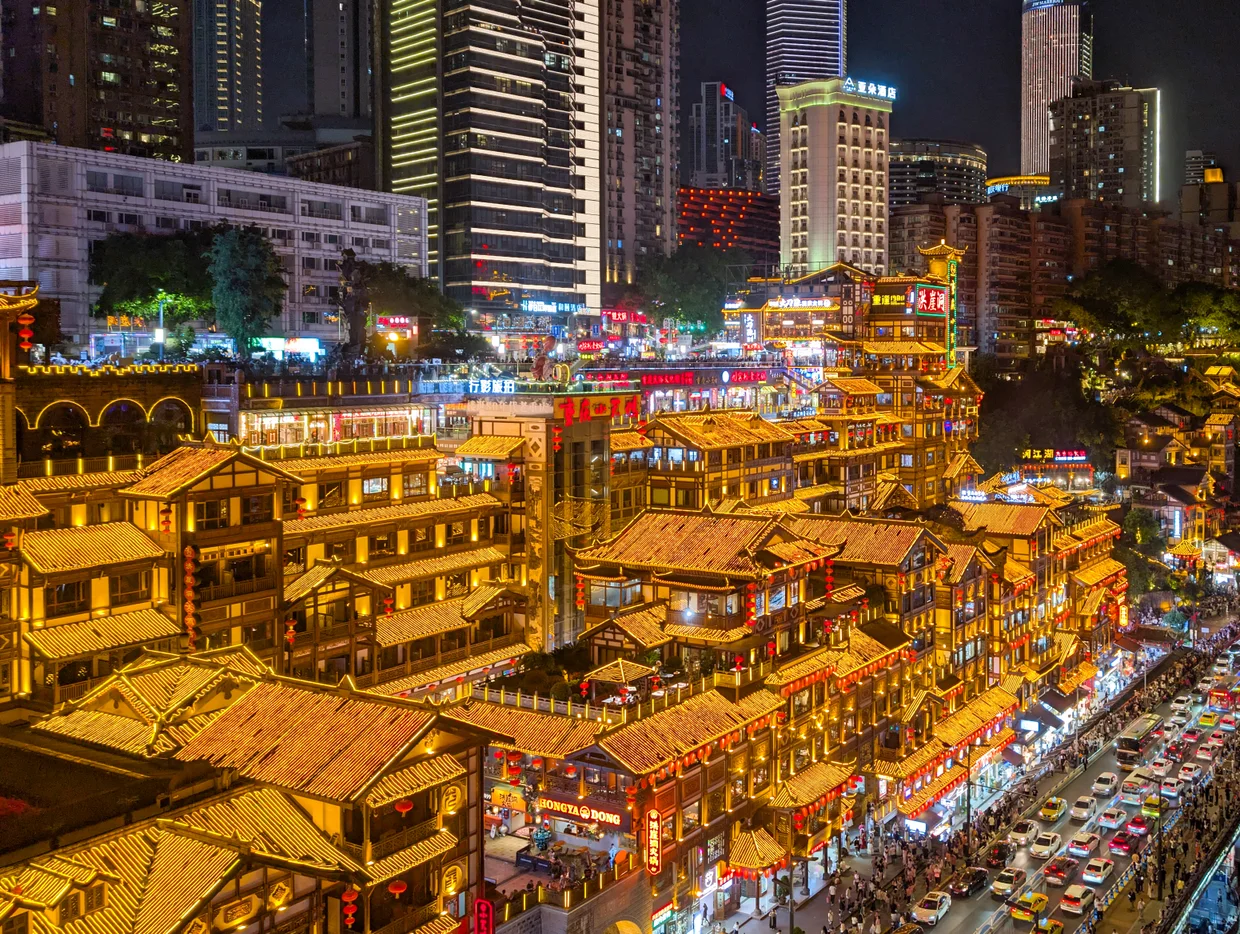
Hongya Cave
I stayed at a hotel in a pedestrian area in Jiefangbei, Chongqing's Central Business District (CBD). The first night, I walked toward Hongya Cave.
You've seen the photos. Everyone has. It looks like a glowing cliffside palace from a fantasy film. In real life, it's even brighter and much, much louder.
There are people everywhere. I'm not talking "a lot of tourists". I'm talking masses of people, like at a sold out concert. People are pushing, complaining, posing for pictures. Tripods blocking half the walkway, half the street. Police is trying to manage, people complain even more, discuss, shout.
Vendors are selling glowing toys. Kids are running around with sugar-coated fruit skewers, and I wonder how they don't get lost. The smell of grilled meat mixing with river air is everywhere.

At some point you're finally inside. It's mostly shops with souvenirs and snacks. You shouldn't go there for authenticity. You go there for the visual overload, for the experience.
But then when you step back to the riverside or to the bridge perpendicular to the "cave", and look up at the stacked wooden balconies glowing gold against the dark water, you understand why it became iconic.
It feels theatrical, almost exaggerated. And I still don't know what it actually is. Or why it is. But I like it. It's a little bit kitsch.
When I was there, they had a drone show above the river. Maybe it was a special day, maybe that was the reason for this crazy amount of people. But maybe it was just a usual Tuesday.
Multiple Dimensions
One afternoon I tried to "just walk around." Bad idea. Bad idea because I'm not good with heat and humidity, and because I need an escape plan (like a place with AC, a metro, an uber/Grab/whatever).
But in Chongqing, having an escape plan is somewhat unrealistic (unless you know the city). It's a little bit like the plan in The Rock. You know it's too crazy to succeed, so you just skip it altogether and see what happens.
And then you turn a corner and suddenly you're on a pedestrian bridge 10 floors above a road. Then you descend into a tunnel. Then you exit a shopping mall without ever entering it. At least not consciously.
At some point I genuinely wasn't sure which ground level I was on. It's Inception turned city.

Traffic is constant. Not chaotic in a reckless way, but dense. Endless flow. Cars, buses, scooters. The sound never fully disappears.
And yet, strangely, there are pockets of calm. Wide roads with almost no traffic, huge spaces to rest your eyes on. Small parks squeezed between towers. Elderly people playing cards. In the evening you see groups doing synchronized dance to all sorts of music.
Chongqing is loud overall. But it has micro-quiet.
Biggest City in The World
At some point, someone will tell you that Chongqing is the biggest city on earth. And someone else will tell you that it's not. Who is right? Well, both are right and both are wrong.
Here's the thing: The definition of "city" is not universal. It depends on administrative boundaries, population density, urban area, and other factors. So when you hear "biggest city in the world," it can mean different things to different people. The term city alone won't help.

UNICEF defines a city as an urban area with a population of at least 300,000 people. By that definition, Chongqing is definitely a city. But it doesn't necessarily make it the biggest city in the world. There are, more or less, 3 more specific, defined terms for a city: City proper, Urban area and Metropolitan area.
For Chongqing, this translates to:
- City proper: 32 million people (unchallenged no. 1)
- Urban area: 12 million people (v. 37 million in Tokyo)
- Metropolitan area: 32 million people (v. 110 million in Beijing)
So, if it is about the city proper, Chongqing is the biggest city and will very likely stay it for a while.
But let's ignore the technicalities for a minute and just look at the size in comparison: The city proper is a municipality the size of Austria. Yes, the country, not the township in Minnesota. Or, if that helps, roughly the size of Portugal, bigger than the BeNeLux.
To be fair: This definition includes vast rural areas, mountains, farmland, small towns, rivers, and entire counties that feel very far removed from the hyper-dense skyline around Jiefangbei.
So when you hear "biggest city in the world," what you're actually hearing is an administrative definition. The dense, urban core where you'll spend your time? That's still huge. But it's not 32 million people walking through the same streets.
The Train Through the Building
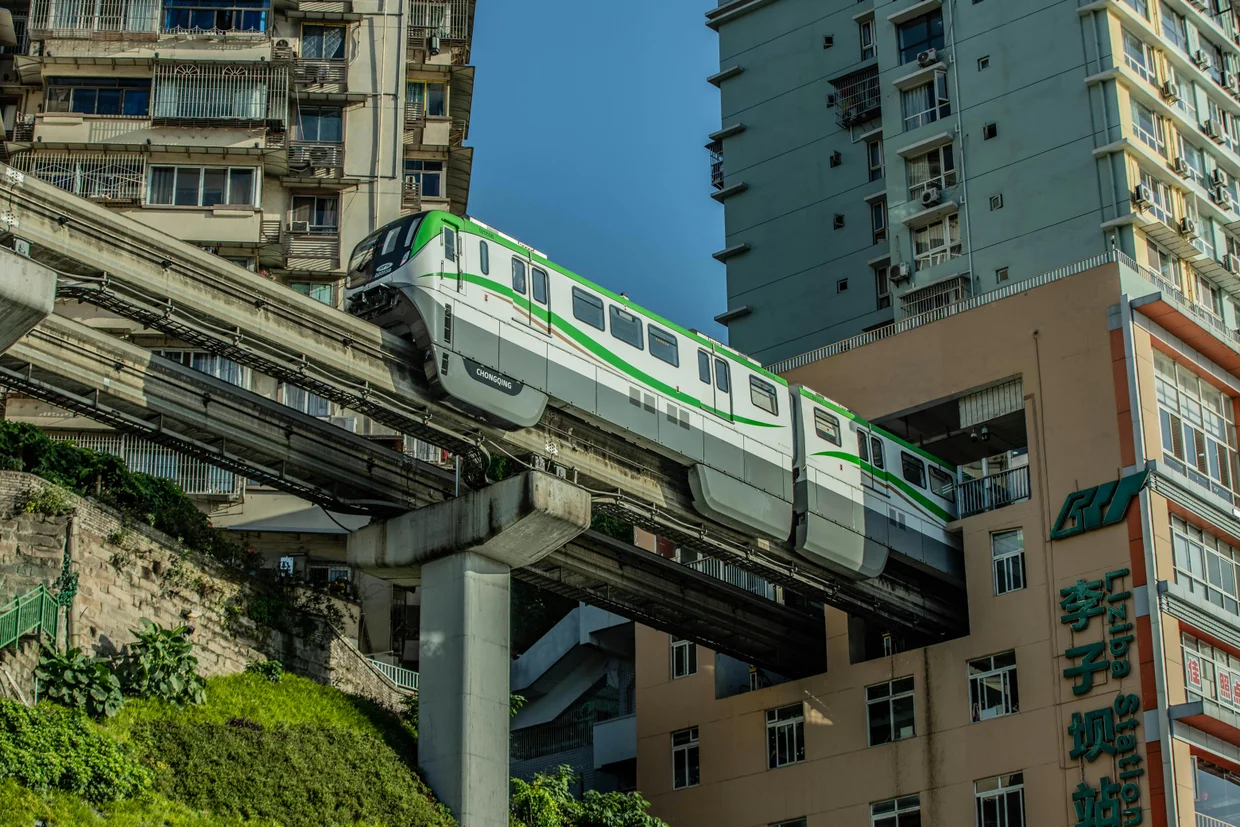
Liziba Station is the TikTok-famous one (that's actually the reason why I even knew this city exists), where the metro runs through a residential building. Yes, through. But, to be a little bit philosophical: it's not.
Here's the catch: It's Line 2 of the Chongqing Rail Transit system. And it was there first. The building came later and was designed around the track, not retrofitted.
So from "their" perspective, the train isn't running through the building. The building is accumulating around it. It's the Chuck Norris push-up.
There's a small viewing platform outside where people gather for the predictable but still satisfying moment when the train slides into the concrete frame.

Food That Fights Back
I like spicy food, I like chilis, I like pepper. I've been warned of some food in some parts of the world. No one warned me about Chongqing. And no one told me that Sichuan pepper is not pepper but, in fact, a numbing monster. The locals call the flavor mala: numbing and spicy at the same time. It is everywhere. Hotpot restaurants line entire streets, and the smell of chili oil follows you through every neighborhood.
Chongqing hot pot. If you're someone who answers "yes, I like it a little bit spicy" when asked at a restaurant at home, then don't come here to eat "the" local dish. If you do it anyway, you will beg to have practiced spiciness.
The pot arrives red. Aggressively red. The chili oil shimmering on top, I swear, it formed a face that had this wicked, sinister look like the devilish emoji. The peppercorns floating around were like a warning, like bird stickers on huge windows so you don't jump straight into this temptative broth.

Then the first bite: Nice. Exactly the spiciness that I like. Perfect! Second bite: I must have caught a piece of an extra spicy chili. Third bite: Something is wrong here, I think there's not enough oxygen in the restaurant. Fifth bite: Full face numbness. Someone please call ... I forgot the number!
You start sweating without realizing it. Forehead, neck, back. You feel that everyone is looking at and laughing about you (no one actually cares about you). You don't know if you should give up and take the embarrassment, potentially insulting the cook, or keep going. Or maybe you just wait until the "hot" cools down (it won't).
If you're into elegant dining, this is not it. It's immersive. A full body experience. An out of body experience.
And it fits the city's personality perfectly. No subtlety, just full commitment. You get what you paid for.
What to Do
There are many things to experience, to see and to do in Chongqing. This here is just my personal highlight. For a more comprehensive and detailed overview, visit my dedicated what to do in Chongqing page.
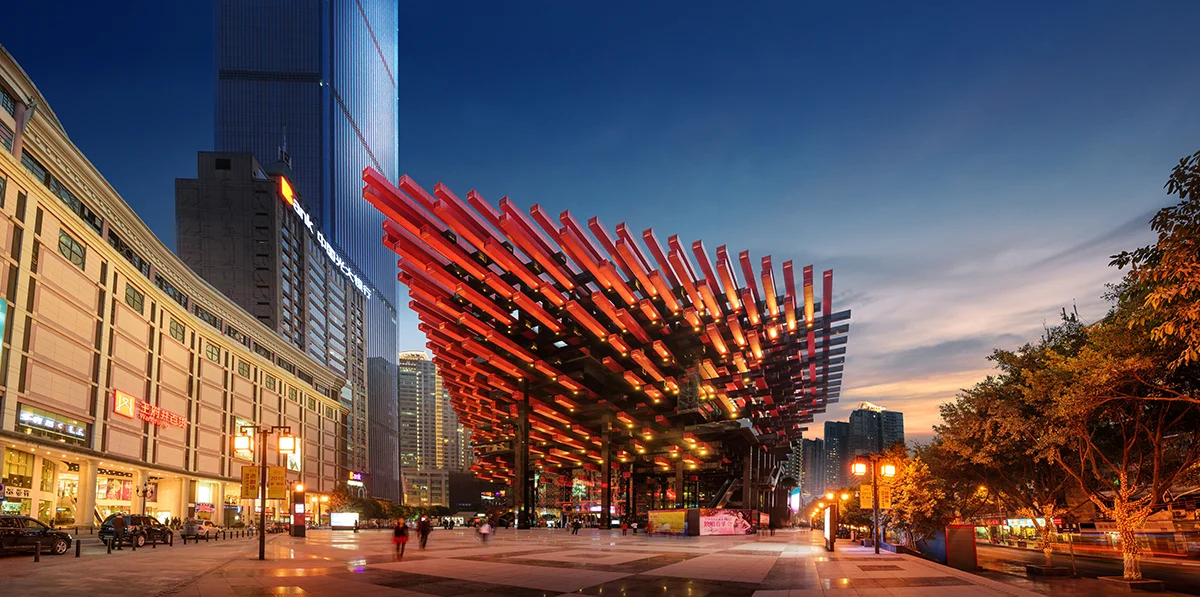
Chongqing Art Museum
Located in Yuzhong District, the Chongqing Art Museum focuses on traditional Chinese painting, printmaking, and small-scale sculpture. The building is especially known for its bold exterior:... see more
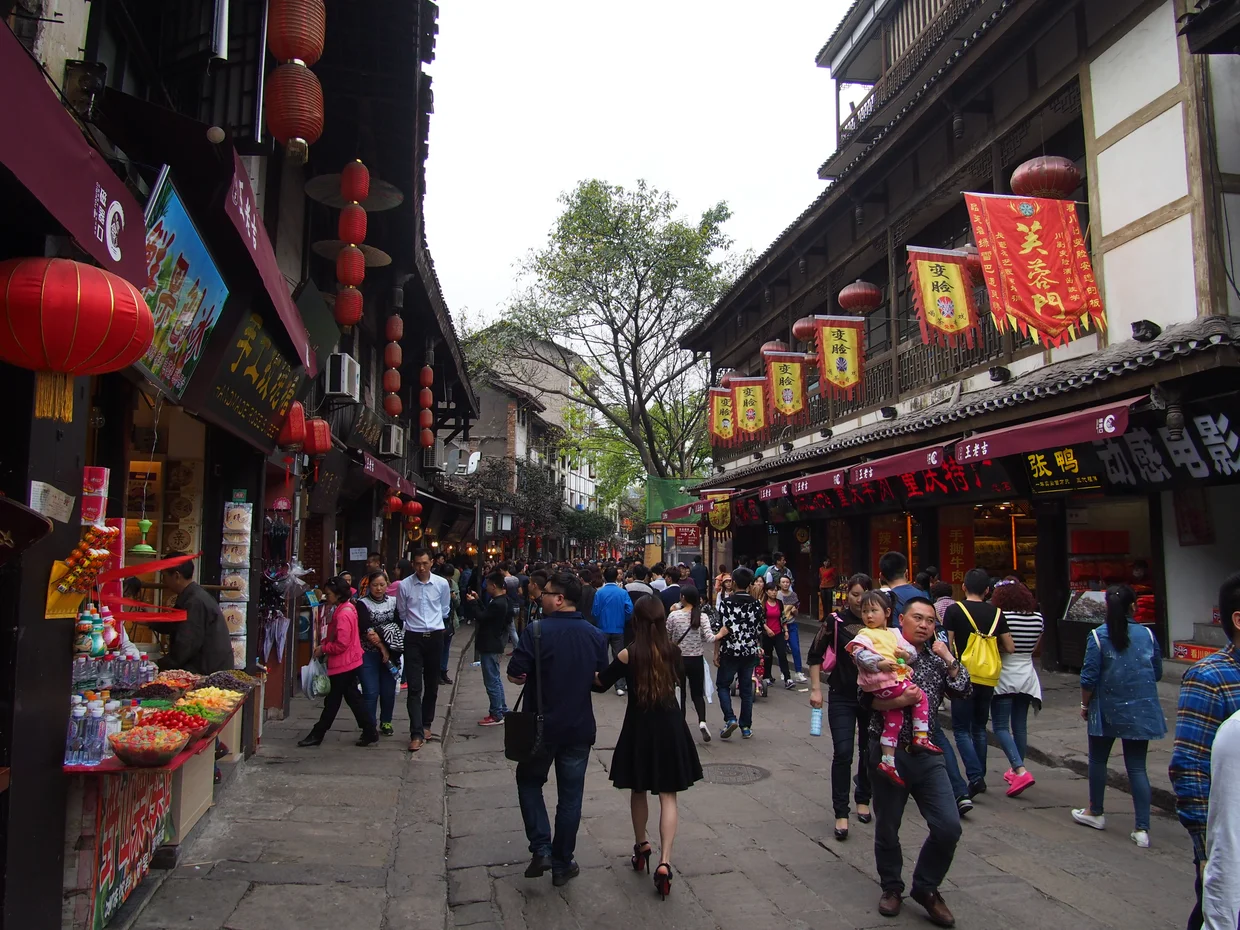
Ciqikou Ancient Town
Ciqikou is a well-preserved ancient town from the Ming and Qing dynasties, built along the Jialing River. Its narrow stone alleyways are lined with traditional wooden buildings housing tea houses,... see more
Hongya Cave
Hongya Cave is a multi-story stilted building complex clinging to a cliff above the Jialing River. At night, the structure is fully lit and reflects dramatically off the water below. Probably the most... see more
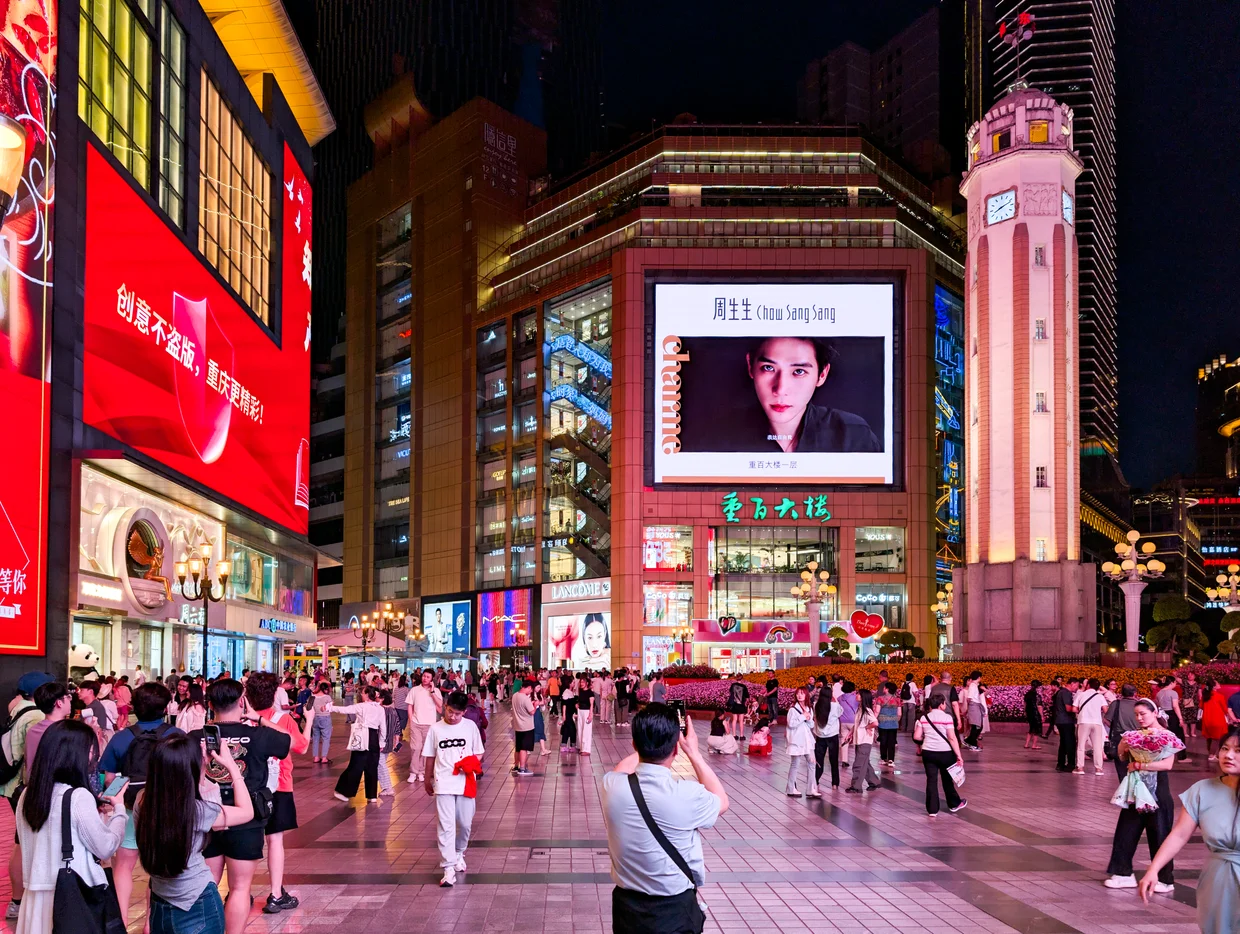
Jiefangbei
Jiefangbei, or the Liberation Monument, is the symbolic center of Chongqing, a clock tower built in 1945 surrounded by one of the city's busiest pedestrian shopping districts. As a monument it is... see more
Yangtze River Cable Car
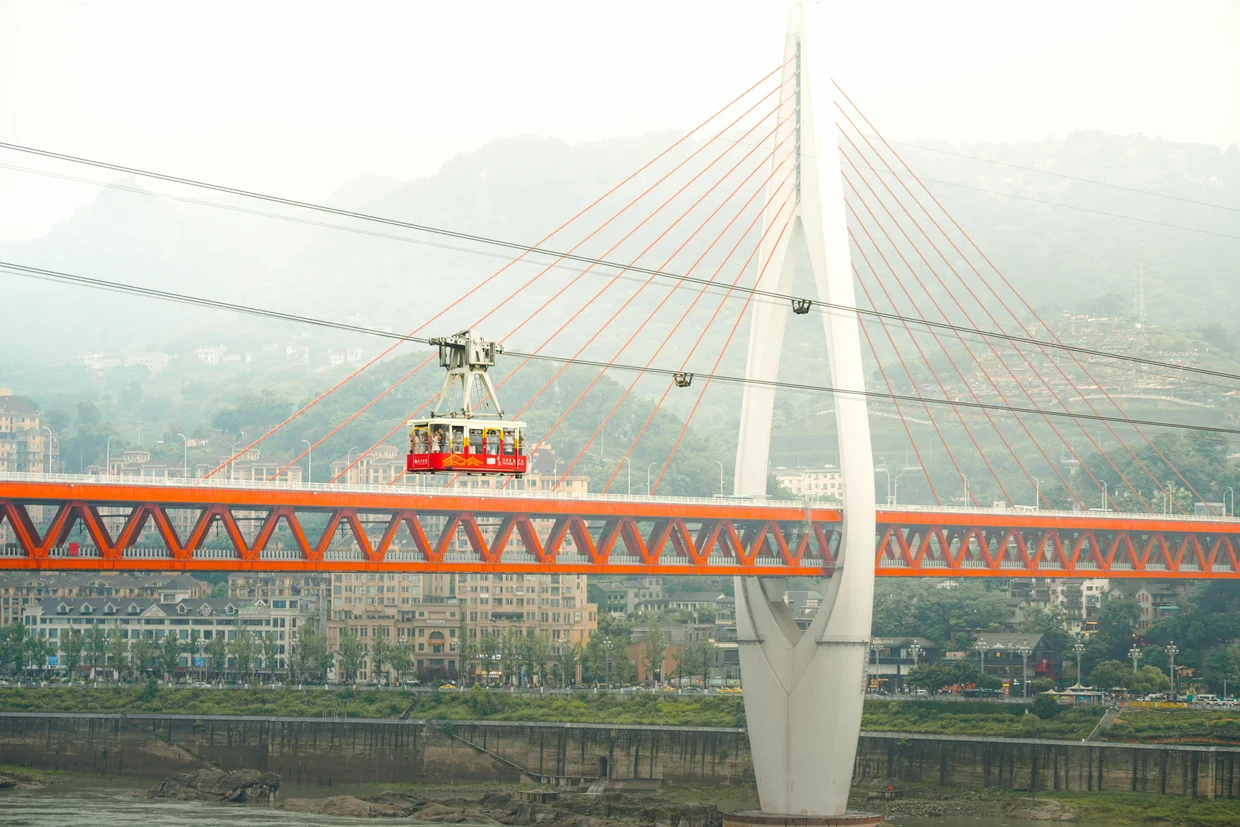
The Yangtze River Cable Car crosses directly over the Yangtze, connecting Yuzhong District on the north bank to Nanshan on the south. The crossing takes only a few minutes but offers an unusual... see more
Liziba Metro Station
Liziba is a metro station on Line 2 where the train passes directly through the middle of a residential skyscraper: floors 6 through 8 of a 19-story apartment building. It became a widely shared... see more
Eling Park
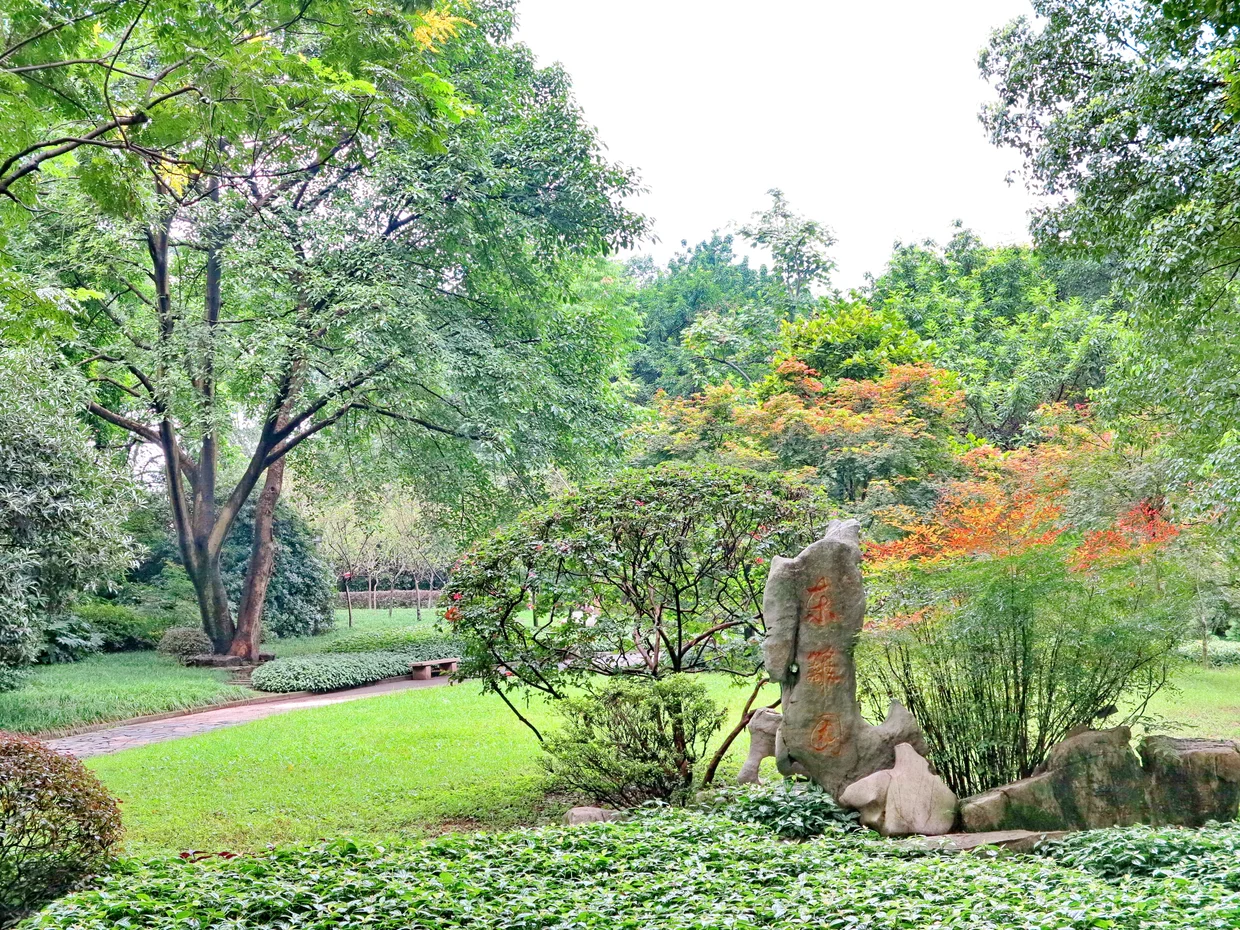
Eling Park sits at the highest point of the Yuzhong Peninsula, offering one of the best panoramic viewpoints in central Chongqing. From the main overlook, you can see the confluence of the Jialing... see more
Chongqing Three Gorges Museum
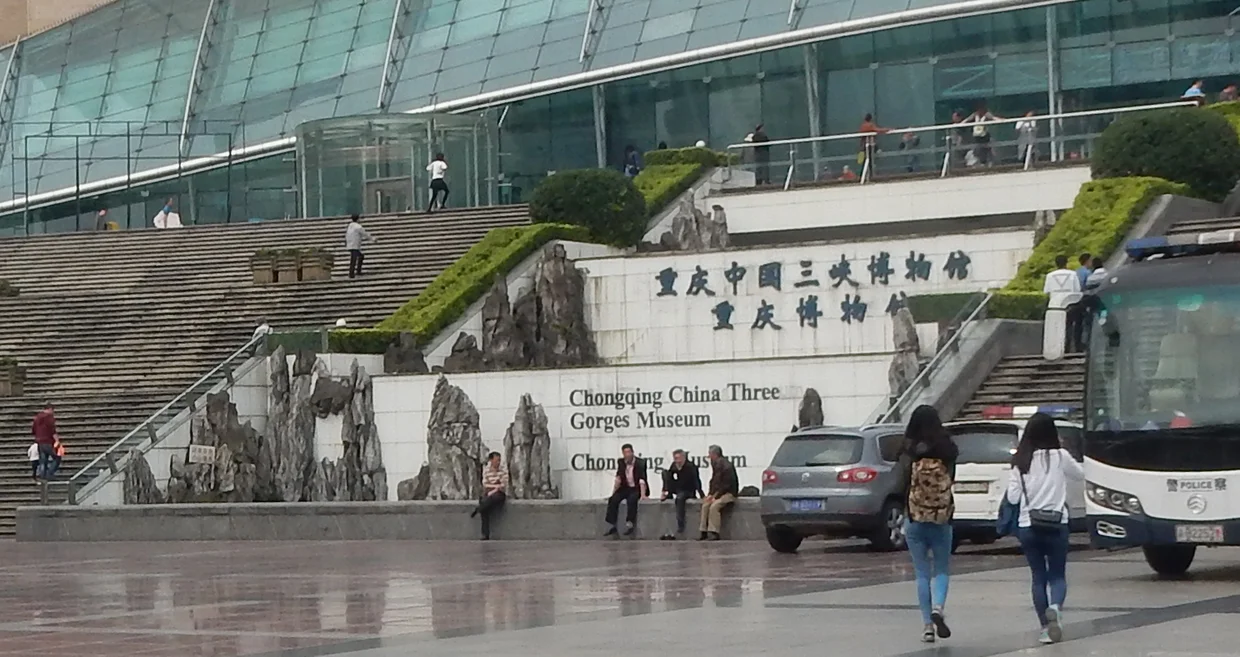
The Three Gorges Museum is one of the most comprehensive museums in southwest China, covering the history, culture, and ecology of the Three Gorges region including the massive Three Gorges Dam... see more
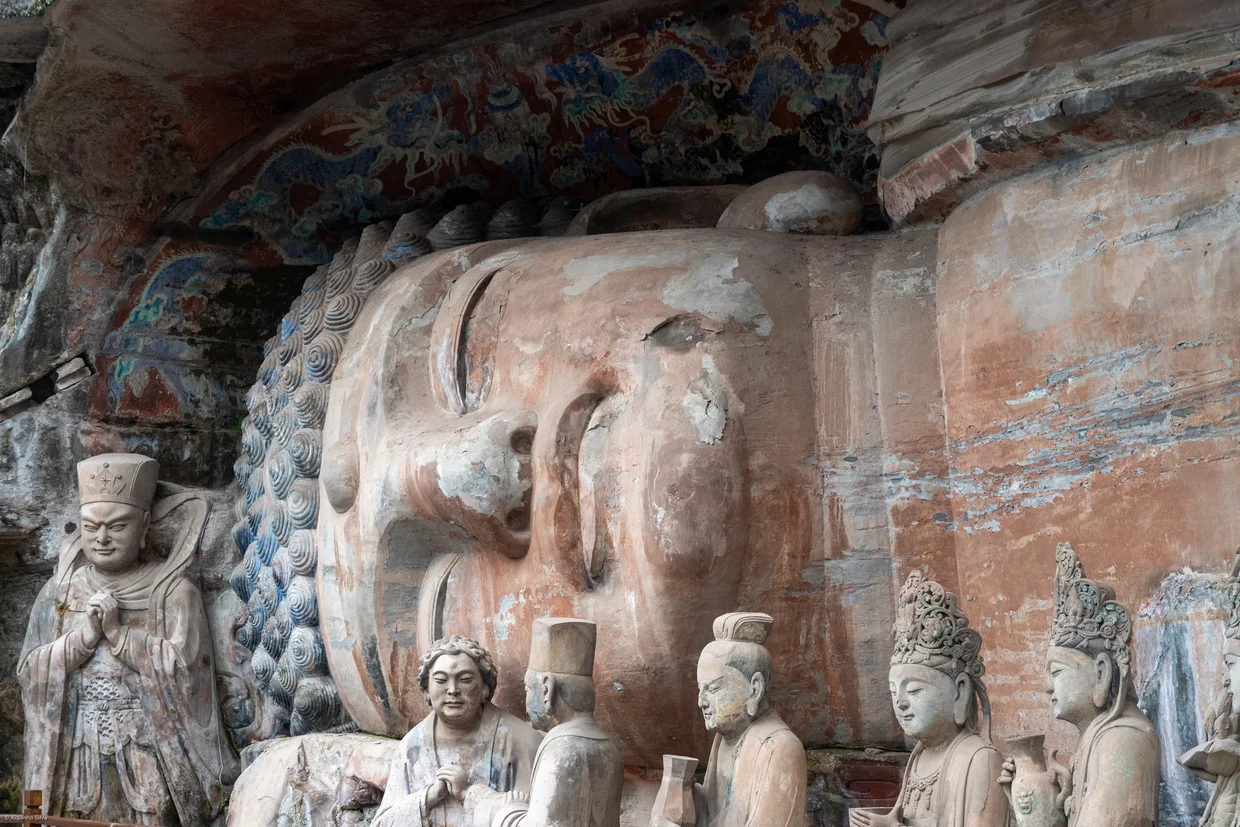
Dazu Rock Carvings
The Dazu Rock Carvings are a UNESCO World Heritage Site about two hours from Chongqing's city center, comprising thousands of Buddhist, Taoist, and Confucian carvings carved into cliffside niches... see more
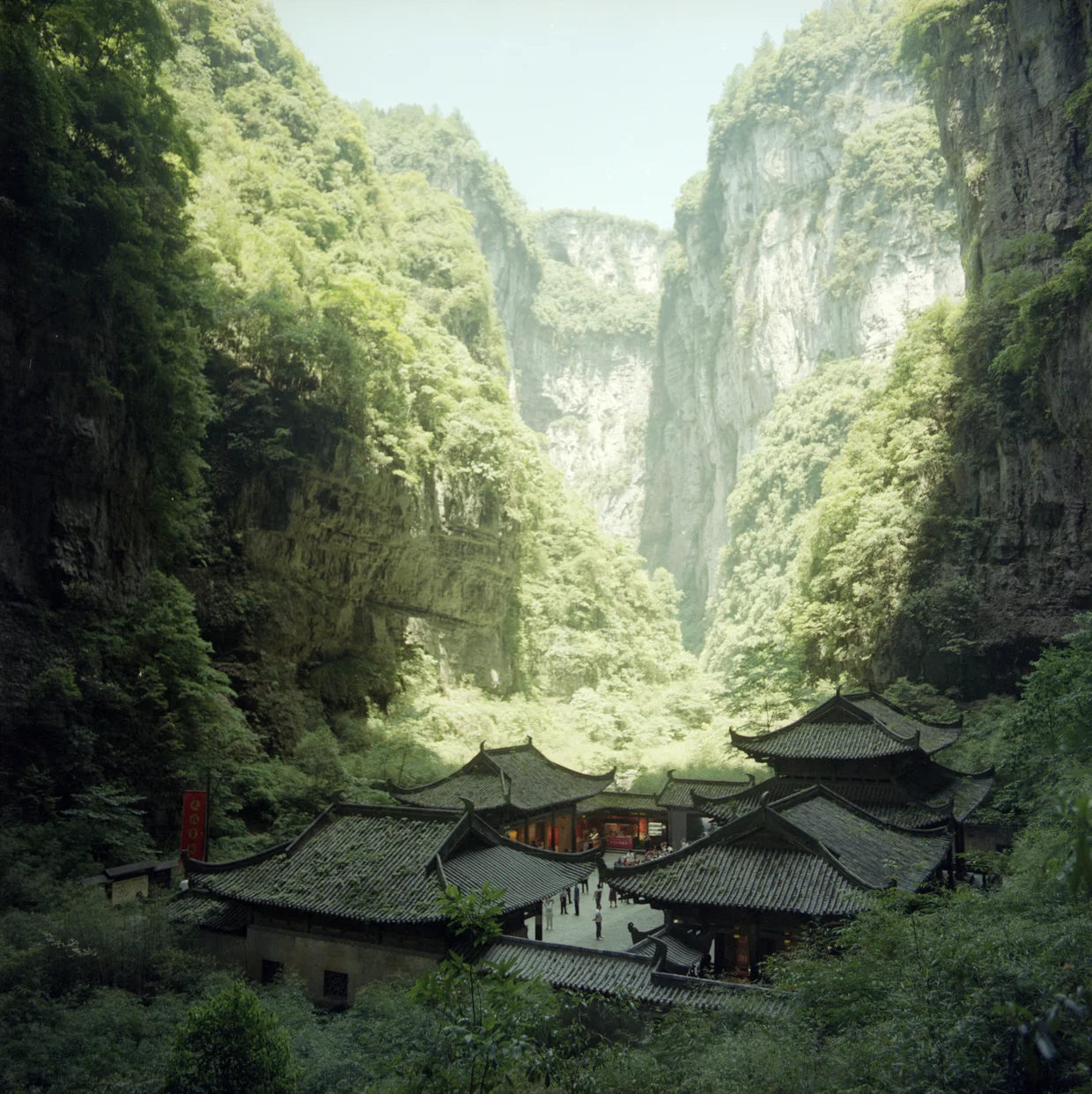
Wulong Karst
Wulong Karst National Park, about three hours from central Chongqing, is the most spectacular natural landscape accessible from the city. The Three Natural Bridges, three massive freestanding... see more
Jiefangbei, the Clock Tower & Central Chaos
As mentioned before, I stayed in Jiefangbei, where the energy shifts again. Here you'll see huge LED screens. Luxury brands next to street snack stalls. Mixed crowds taking photos. Delivery drivers weaving through gaps.
It's busy in a different way than Hongya Cave. Less theatrical, very commercial. Very target group oriented. Thousands of shops, restaurants, hotels, bars and clubs. If you want to feel the city's pulse at full speed, this is where you stand still and let it move around you.
The clock tower is one of the (many) sights in Chongqing. Actually, it's not a clock tower. It's the Liberation Monument to the People's Liberation Army. And its name is Jiefangbei, which literally means "Liberation Monument". But it has a clock on it, so everyone calls it the clock tower. The Jiefangbei CBD is named after the monument.

Here you'll also find a lot of shopping malls fighting for survival. I don't know how commerce works here, but some of the smaller shopping malls were mostly empty. I went through a few of them and saw only some handful of people strolling around, getting something to eat. The shops were mostly empty. How do these shops survive? I don't know.
On the bright side, here you'll find a good mix of different shops, from fashion to local food, from alcoholic specialties to touristy souvenirs. Some are cheaper, some on the pricier side.
Also some nice buildings. But Chongqing is generally interesting from an architectural point of view.
What It Actually Feels Like
Chongqing feels heavy. In a good way. Heavy air. Heavy flavors. Heavy architecture. But also alive. You wake up and the skyline is half hidden in fog. You go to sleep and it's glowing neon. You walk 1 kilometer and feel like you've changed altitude three times.
It is not pretty in a delicate sense. It feels impressive in a relentless one. And the longer you stay, the more the chaos starts making sense.
Where to Stay
Chongqing's geography makes the choice of neighbourhood count more than most cities. You're not just picking a location on a map, you're picking a terrain, an altitude, and a level of chaos. The city is split by two rivers, stacked vertically on steep hills, and connected by a metro that occasionally runs through buildings. Get this right and you're within walking distance of the things you came for. Get it wrong and every outing starts with a 40-minute journey just to reach the starting point.
Jiefangbei (CBD)
Jiefangbei is the beating heart of central Chongqing and the most practical base for a first visit. The neighbourhood sits on the Yuzhong Peninsula, hemmed in by the Yangtze and Jialing rivers, with Hongya Cave a short walk downhill and Liziba...
District map available here.
Activate Full Experience Mode to load the neighborhood map and inspect the best base visually.
How to Get Around
Ride-hailing is the most comfortable way to move around Chongqing. In my experience it is relatively cheap and mostly reliable. I had only one case where a scheduled ride (around 2 a.m. to the airport) did not show up on time, so late at night it still makes sense to have a backup plan.
Chongqing's metro is still excellent: fast, cheap, air conditioned, and usually the most predictable option in a city where road levels and traffic can get confusing quickly.
Walking works for short distances, but never trust "only 500 meters" without checking the elevation and entry point. In Chongqing, the right destination can be one bridge, one escalator, and two levels above where your map marker says you are.
Google Maps does not work very well in China in general, so do not rely on it as your primary navigation app. As of this post's last update, AMap Global was the best option I found for non-Chinese-speaking travelers, as well as the map within Alipay (which you need anyway).
If you want fewer logistics headaches, stay near a metro station in central districts like Jiefangbei or around major line interchanges.
Best Time to Visit
March through May is the window. Chongqing is one of China's "furnace cities" for a reason: summer temperatures regularly push past 33 degrees with suffocating humidity, and the heat lingers well into September. Walking uphill through the city's stacked terrain in July is not tourism, it is endurance training.
Spring brings mild temperatures, occasional rain, and the best balance between comfort and visibility. April is often the sweet spot: warm enough for long walks, cool enough that the city's relentless staircases do not feel punishing. The haze that blankets Chongqing in summer and winter tends to lift more often in spring, which matters if you care about the river views.
Autumn (October and November) is the second-best option. Temperatures drop to comfortable levels and the rain eases, though the famous fog can roll in early. Winter is grey, damp, and cold by subtropical standards. It rarely freezes, but the raw chill and persistent overcast sky make outdoor exploration less pleasant. Chongqing does not do crisp winter days. It does wet, grey ones.
Destination Info
Published September 2025.