Top Things to Do and See in Algarve
The Algarve is best known for its beaches, but the coast delivers plenty beyond just lying on sand. Cliff walks with views that belong on a screensaver, sea caves you paddle into, a Moorish castle surrounded by orange groves, and a fortress at the edge of Europe where the wind tries to push you into the Atlantic. This guide covers the things actually worth your time, from the iconic to the ones most visitors drive right past.
The prices shown here are meant as a rough guide and can vary over time. While I update exchange rates regularly, local prices are typically refreshed only when I revisit the destination.
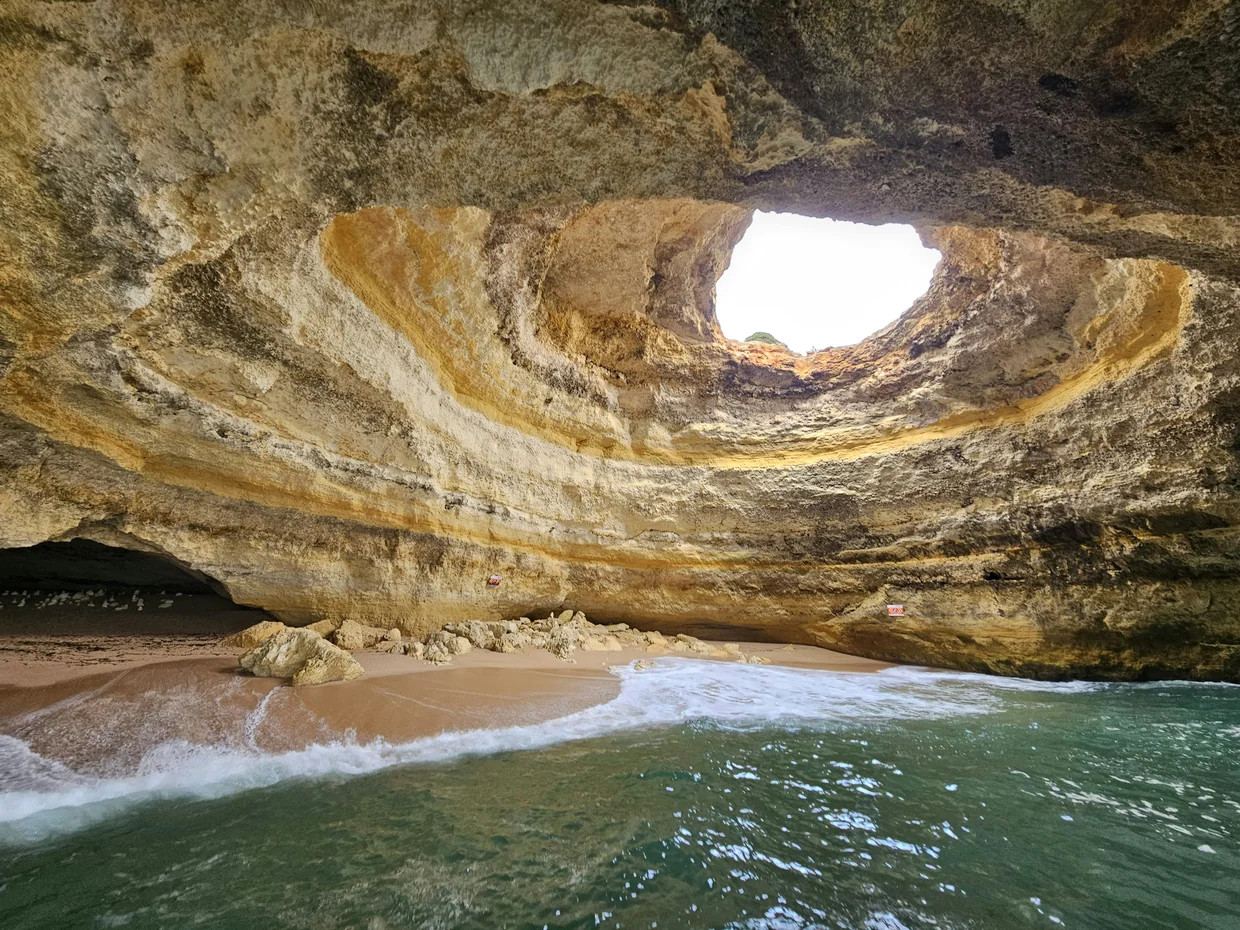
Benagil Cave
The Benagil Cave is a large sea cave with a collapsed ceiling that creates a natural skylight, flooding a tiny interior beach with light. It's become one of Portugal's most photographed spots, which tells you two things: it's genuinely spectacular, and you won't be alone in there. You can only reach the cave by water (there's no land access), so your options are kayak, SUP, or a boat tour. The kayak is the best way to do it because you can enter on your own schedule, stay as long as you want, and actually set foot on the beach inside. Boat tours circle through the cave for about 90 seconds while everyone holds up their phones, which is fine but not exactly contemplative. The paddle from Benagil beach takes about 10 minutes, but the Atlantic swells can make it tricky. If you're not a confident paddler, the guided kayak tours are worth it. Go early in the morning to beat the boat parade.
How to Get There
Benagil is a tiny beach between Carvoeiro and Lagoa. Park above the beach and walk down. Kayak and boat tours depart from Benagil beach, Lagos marina, and Carvoeiro. The beach itself is small and the parking is limited.
Notes
- Kayak gives you the best experience; boats just pass through quickly
- Morning departures have calmer water and fewer boats inside the cave
- The paddle from Benagil beach is short but can be choppy
- You can see the cave from above on the Sete Vales Suspensos trail (cliff top)
- Sea conditions occasionally close access; check with operators on the day
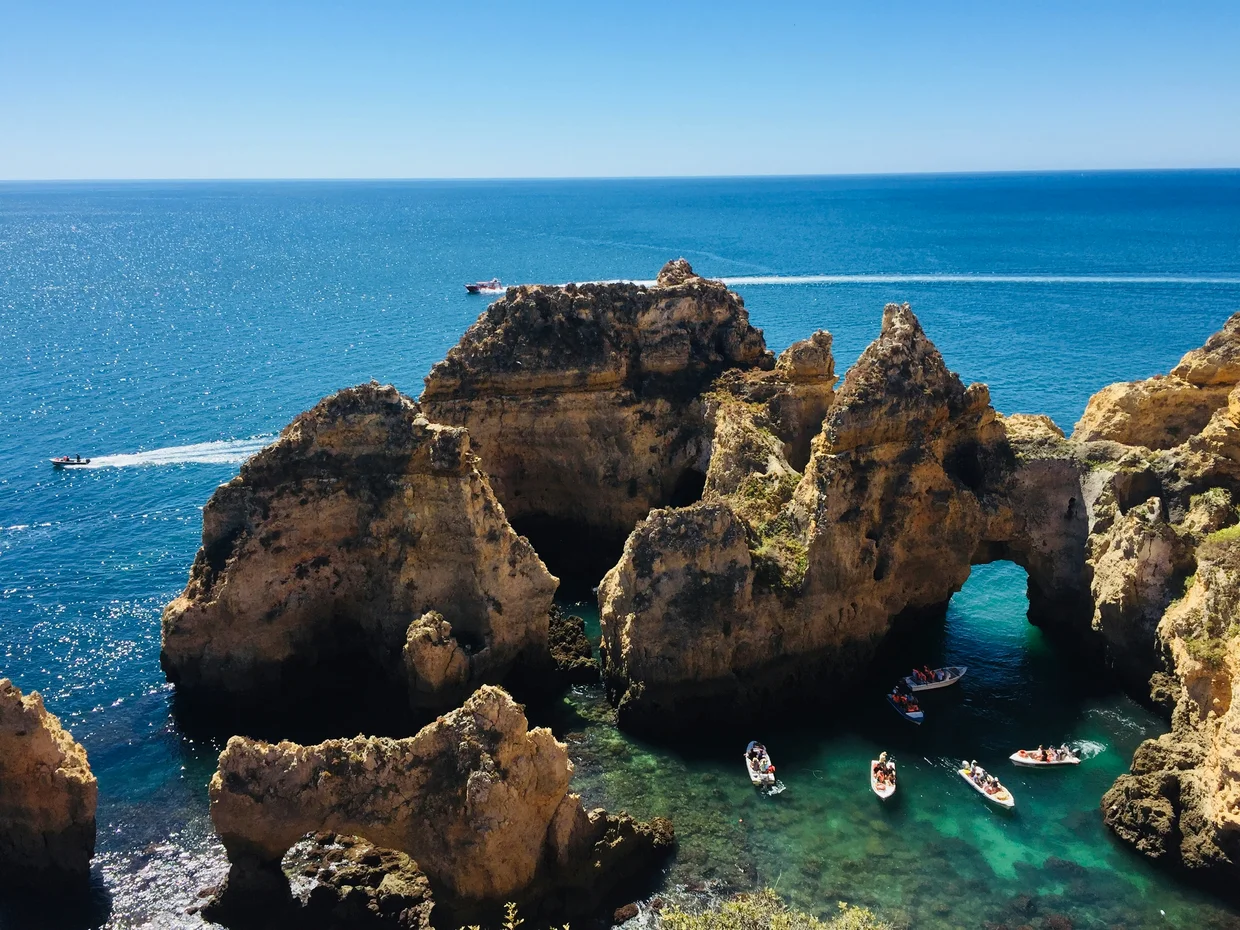
Ponta da Piedade Boat Tour
Ponta da Piedade is the Algarve's most spectacular stretch of coastline, a series of towering golden limestone cliffs, sea stacks, grottos, and arches just south of Lagos. You can walk along the cliff tops for free and the views are already incredible, but seeing it from the water is a completely different experience. Small boats (usually holding 4 to 8 people) depart from the base of the cliffs and spend about an hour weaving through narrow passages, ducking under arches, and poking into caves where the water glows turquoise from the light filtering through. The scale of the rock formations only becomes apparent once you're floating between them. It's one of those "ok I get why everyone talks about this place" moments. The smaller the boat, the better, because the big ones can't fit through the interesting parts.
How to Get There
About 2 km south of Lagos center. Drive or walk to the Ponta da Piedade parking area. Boats depart from the base of the cliffs, reached by a long staircase. You can also book tours from Lagos marina that include the coast approach.
Notes
- Smaller boats get into more caves and grottos than the larger tour boats
- The cliff-top walk is free and spectacular on its own, especially at sunset
- Take the stairs down to the water level for a different perspective
- Morning light is best for the golden color of the cliffs
- Combine with Praia do Camilo and Praia da Dona Ana nearby
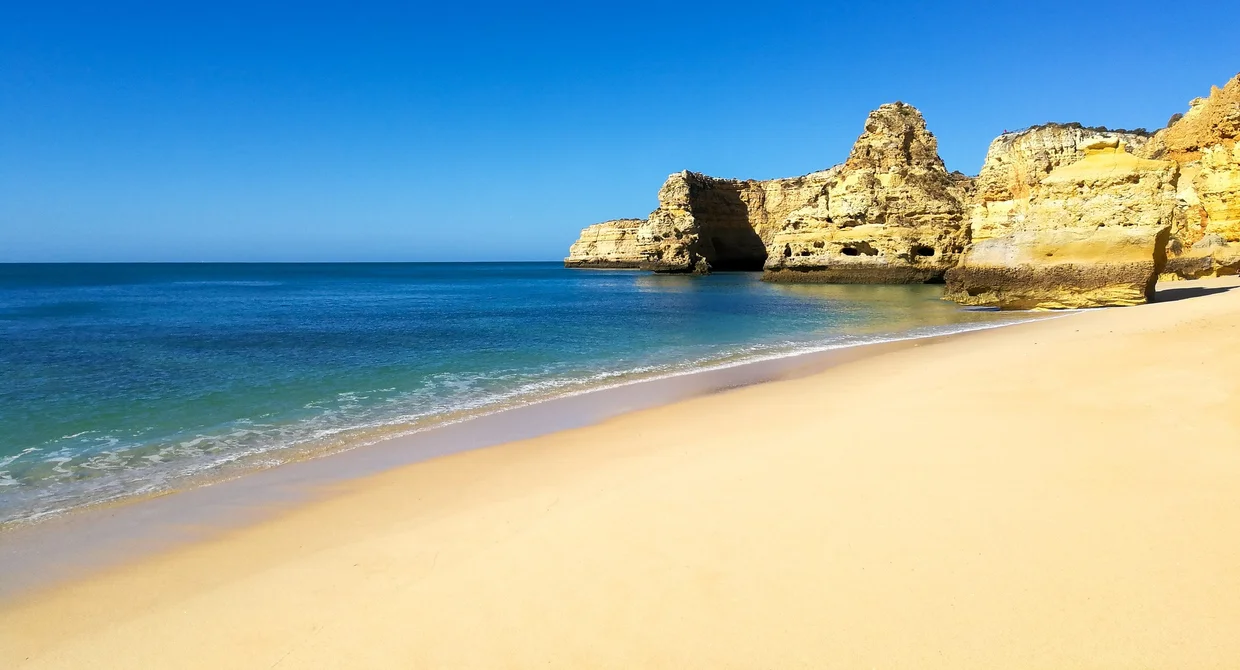
Praia da Marinha
You've seen this beach in every "best beaches in Europe" list, and for once the hype matches reality. Praia da Marinha is a golden cove framed by towering limestone cliffs, with sea stacks, a natural double arch, and water so clear you can see the bottom from the cliff top. The beach itself is reached by a staircase from the parking lot above, and it's smaller than you'd expect given how famous it is. That's part of the charm and part of the problem: in peak summer it fills up fast and the parking lot becomes a competitive sport. Early morning or late afternoon is the move. The real magic here isn't just lying on the beach (though that's great too), it's the cliff scenery surrounding it. Walk east along the cliff top toward Benagil for increasingly dramatic viewpoints. Low tide reveals more sand and some rock pools worth exploring.
How to Get There
Signed from the N125 between Lagoa and Porches. About 25 minutes east of Lagos by car. Parking lot at the top; staircase down to the beach. No public transport.
Notes
- Check the tide before going; low tide means more beach and visible rock pools
- The parking lot fills up by mid-morning in July and August
- The cliff-top viewpoints are just as impressive as the beach itself
- This is the eastern starting point for the Sete Vales Suspensos trail
- Bring your own shade; there's no umbrella rental here
Sete Vales Suspensos Trail
This is the Algarve's best hike and it's not even close. The Sete Vales Suspensos ("Seven Hanging Valleys") trail runs about 5.7 kilometers along the cliff tops between Praia de Vale Centeanes and Praia da Marinha, passing over some of the most absurdly dramatic coastal scenery you'll see anywhere in Europe. Sea arches, golden rock formations, hidden coves way below, the Atlantic crashing into everything. The path is well-marked and mostly flat (it's a cliff walk, not a mountain hike), but some sections get close to the edge and there are no guardrails, so maybe don't do it in flip-flops or after three beers. The whole thing takes about two hours one way, and you can turn around whenever you want if you just wanna do part of it. Go in the morning before the heat kicks in. Late afternoon works too if you want golden light for photos and fewer people.
How to Get There
Drive to either Praia de Vale Centeanes (west end) or Praia da Marinha (east end). Both have parking lots that fill up in summer, so arriving early helps. No public transport to either trailhead. You'll need to walk back the same way or arrange a taxi pickup at the other end.
Notes
- Start from either end; Praia de Vale Centeanes has slightly easier parking
- Bring water and sun protection, there's zero shade on the trail
- Some sections are close to cliff edges with no barriers
- The trail passes above Benagil Cave but you can't access it from the path
- Doable year-round but summer midday heat makes it brutal
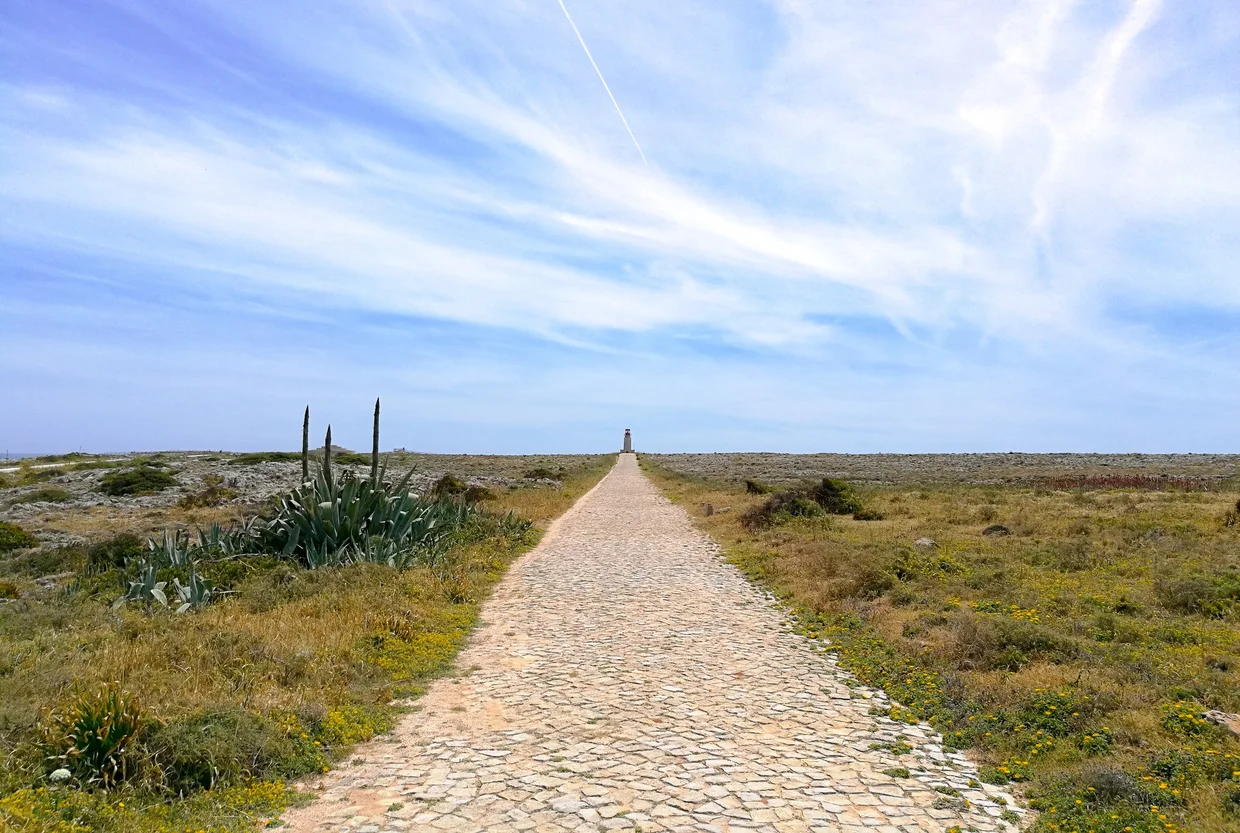
Cape St. Vincent & Sagres
Cape St. Vincent is the southwestern tip of continental Europe, and standing on the cliffs here feels appropriately dramatic. There's a lighthouse, a drop of about 75 meters to the Atlantic below, and on a clear day the horizon stretches into forever. This is where the ancient Romans thought the world ended, and looking at the raw cliff edge with nothing but ocean beyond, you kinda get where they were coming from. The Fortaleza de Sagres is a few kilometers east, a 15th-century fortress perched on a headland above the sea. Prince Henry the Navigator supposedly ran his navigation school from here, which is poetically fitting given the location. The fortress itself is more about the setting than the interior (there's not a whole lot inside), but the wind, the cliffs, and the crashing waves below make it one of the most atmospheric spots in the Algarve. The whole Sagres area feels different from the rest of the coast, wilder and less polished, with a surfer-town vibe and an end-of-the-world energy that the manicured beach resorts further east just don't have.
How to Get There
Sagres is about 30 minutes west of Lagos by car. Cape St. Vincent is another 6 km beyond Sagres. Buses run from Lagos to Sagres but service to the cape itself is limited. A car is strongly recommended.
Notes
- Cape St. Vincent lighthouse area is free; the Sagres fortress charges a small entry fee
- The sunsets from Cape St. Vincent are legendary
- It's always windier here than the rest of the Algarve, bring a layer
- There's a sausage van near the lighthouse that's become weirdly famous
- Combine both in one trip; they're about 6 km apart
Ilha Deserta
Ilha Deserta (literally "Desert Island") is the most southerly point of mainland Portugal, and it lives up to its name. It's a barrier island off the coast of Faro with no roads, no buildings except one restaurant, and a beach that stretches into the distance in both directions. Take the ferry from Faro marina (about 30 minutes), step off, and you're basically on a wild, empty strip of sand backed by dunes. That's it. That's the activity. There's no entertainment complex, no beach bar every 50 meters, no DJ playing house music. Just sand, sea, sky, and the kind of silence you forget exists when you've been doing touristy stuff all week. The one restaurant (Estaminé) serves fresh fish and is actually quite good, but bring your own water, snacks, and sunscreen because once you walk past it, there's nothing. If you want a beach day that feels like the opposite of the crowded central coast, this is it.
How to Get There
Ferries depart from Faro marina (Porta Nova wharf). The crossing takes about 30 to 40 minutes through the Ria Formosa lagoon. Check the return schedule before you go so you don't get stranded on a desert island for real.
Notes
- Ferry runs from Faro marina roughly hourly in summer; reduced in off-season
- Bring everything you need; there's one restaurant and nothing else
- The beach is exposed with no shade; bring a hat and strong sunscreen
- The water on the lagoon side is warmer than the ocean side
- Great for birdwatching (it's part of the Ria Formosa natural park)
Lagos Old Town Walk
Lagos has one of the best-preserved old towns on the Algarve coast, and walking through it is the kind of activity that doesn't feel like an activity until you realize two hours have passed and you've eaten three pastéis de nata. The old town is still partially enclosed by its original walls, and inside it's a maze of narrow cobblestone streets, whitewashed buildings with blue and yellow trim, churches covered in gold leaf, and little squares where people sit drinking cheap espresso like it's a competitive sport. The Igreja de Santo António is worth ducking into for the insanely over-the-top gilded Baroque interior (they apparently ran out of surfaces to cover in gold and had to stop). The Forte da Ponta da Bandeira guards the harbor entrance and gives you nice views back toward town. The marina area is modern but pleasant for an evening stroll, and the restaurant scene in the old town streets is one of the best on the coast, mixing traditional Portuguese with just enough international variety to keep things interesting.
How to Get There
Lagos is the main hub of the western Algarve. The old town is in the center, walkable from anywhere in Lagos. If you're staying elsewhere, park at one of the lots near the marina or the bus station and walk in.
Notes
- The Saturday morning market near the old town walls is worth timing your visit for
- Igreja de Santo António has a small museum attached; entry is a couple of euros
- The old town is walkable and compact; no map needed, just wander
- Evening is the best time for atmosphere as the restaurants and bars come alive
- Combine with a walk south to Ponta da Piedade
Ilha de Tavira
Ilha de Tavira is a barrier island off the eastern Algarve coast, and it's one of the best arguments for leaving the central tourist zone behind. You get there by a short ferry ride from Tavira (or a longer one from the Quatro Águas pier), and what you find is a long, wide, sandy beach that feels like it belongs on a different continent. The western end near the ferry landing has some beach bars, restaurants, and sunbed rentals, so it's not exactly deserted. But walk east for 15 minutes and the crowd thins out dramatically. Keep walking and you'll eventually have the beach pretty much to yourself, just dunes, sand, and the Atlantic. The water on the eastern Algarve is slightly warmer than the western side, which is a nice bonus. Tavira town itself is worth the visit too: a genuinely pretty place with a Roman bridge, whitewashed houses, and a pace that makes the rest of the Algarve feel rushed. Combining the town with a half-day on the island is about as good as it gets for a mellow Algarve day.
How to Get There
Ferries run from Tavira center and from the Quatro Águas pier (about 2 km east of town). In summer, boats run frequently. In off-season, the schedule is reduced. Tavira is about an hour east of Faro by car or train.
Notes
- The ferry from Tavira center (not Quatro Águas) is the most convenient
- Walk east along the beach to escape the crowds near the ferry landing
- There are beach bars and restaurants at the western end if you need food
- The water is slightly warmer than the western Algarve
- Combine with a wander through Tavira old town and lunch at a local spot
Ria Formosa Boat Tour
The Ria Formosa is a massive coastal lagoon system stretching 60 kilometers along the eastern Algarve, protected as a natural park and home to an absurd amount of birdlife. Flamingos, spoonbills, herons, and a bunch of species that birdwatchers get very excited about. Even if you don't know a flamingo from a pelican, the lagoon is gorgeous: shallow turquoise water, salt marshes, sand bars, and barrier islands creating a landscape that feels nothing like the cliff coast further west. Boat tours run from Faro, Olhão, and Tavira, and most last a couple of hours. Some include stops on the barrier islands (Ilha da Culatra, Ilha da Armona) where you can swim on beaches that are significantly less crowded than anything on the central coast. The whole area has a mellow, local feel that the tourist hotspots lack. If you've spent a few days doing the cliff beaches and want something completely different, a morning on the Ria Formosa is a solid change of pace.
How to Get There
Tours depart from Faro marina, Olhão waterfront, and Tavira. All three towns are connected by bus and train. The lagoon is immediately south of these towns so there's no long transfer.
Notes
- Tours from Olhão tend to be more local and less touristy than from Faro
- Flamingos are most common in winter and spring; summer has fewer
- Some tours include stops on Ilha da Culatra or Ilha da Armona for swimming
- The lagoon is very shallow; smaller boats navigate it better
- Combine with a visit to Olhão's fish market for the full eastern Algarve experience
Silves Castle
Silves Castle is a massive red sandstone Moorish fortress sitting on top of a hill, overlooking a valley of orange and lemon groves. For centuries, Silves was the Moorish capital of the Algarve, and the castle is the best-preserved reminder of that era in the region. The walls are intact, you can walk along the ramparts with views over the town and the surrounding countryside, and there's a small archaeological museum inside that covers the Islamic and pre-Islamic history of the area. It's not gonna blow you away with interactive exhibits or dramatic recreations, but the setting does the heavy lifting. Silves itself is a quiet, pretty town that most beach-focused visitors skip entirely, which means you get an actual Portuguese small-town experience without the tourist crowds. Grab a fresh-squeezed orange juice from a local cafe (the oranges here are famous and they cost basically nothing), wander the narrow streets, and appreciate that the Algarve existed long before beach tourism.
How to Get There
Silves is about 20 minutes inland from the coast, reachable from Portimão, Lagos, or Albufeira. Follow signs to the castle once in town. Parking available near the castle walls. Buses run from Portimão and Albufeira but the schedules are limited.
Notes
- Combine with a walk through Silves old town and a stop at the cathedral
- The annual Medieval Festival in August transforms the whole town
- The surrounding countryside is beautiful for a scenic drive
- Fresh orange juice in town is practically free and excellent
- A good rainy-day or midday alternative when the beach is too hot or crowded
Published April 2026.