Where Africa Meets Everything Else
South Africa is a country that contains multitudes. Cape Town's coastline, Johannesburg's urban energy, Kruger's wildlife, the Drakensberg's peaks, wine valleys, townships, and a history that's impossible to ignore. It's beautiful, complicated, and endlessly fascinating.
It's also enormous. Driving from Cape Town to Kruger National Park takes about 16 hours. The country spans deserts, mountains, subtropical coastlines, rolling savanna, and dense forest. The climate changes, the vegetation changes, the languages change, the food changes. It's not one place. It's many places that happen to share a flag.
Most visitors come for three things: Cape Town, a safari, and the coast. That's a good start. But South Africa rewards people who go further, who drive the roads that don't appear in the top-ten lists, who stop at the small towns, who talk to the people. The country has more depth than any two-week trip can cover. You leave knowing you'll come back. And you do.

Why South Africa
The variety is unmatched. In a single trip you can summit a mountain, surf an ocean, drive through wine country, see the Big Five, hike a canyon, visit a township, eat world-class food, and stand where Nelson Mandela walked free. No other country in Africa, and very few in the world, pack this much into one destination.
The wildlife is world-class. Kruger National Park alone covers an area roughly the size of Israel. It has the Big Five, hundreds of bird species, and an infrastructure that lets you self-drive through the bush at your own pace. Private reserves on Kruger's borders offer luxury safari experiences that rival anything in East Africa at a fraction of the cost. But Kruger is just the beginning. Addo Elephant Park, Hluhluwe-iMfolozi, iSimangaliso, the Kgalagadi Transfrontier Park in the Northern Cape. South Africa has more safari options than most people realize.
Cape Town is one of the most beautiful cities on earth. That's not hyperbole. Table Mountain, the Atlantic seaboard, the V&A Waterfront, the Winelands within an hour's drive, the Cape Peninsula stretching south toward the Cape of Good Hope. The setting alone is extraordinary. The food scene, the art, the energy of Long Street, the quiet of Kirstenbosch Gardens. Cape Town earns its reputation.
It's affordable. The rand is weak against most major currencies. A good dinner costs what a pub meal costs in London. A night in a safari lodge costs what a mid-range hotel costs in Paris. Wine that would sell for 30 euros in Europe costs 5 in Stellenbosch. For travelers from Europe or North America, South Africa delivers exceptional value.
The infrastructure works. Roads are good, often excellent. Domestic flights connect major cities. Car rental is straightforward. Accommodation ranges from backpacker hostels to some of the finest luxury lodges in the world. By African standards, and by many global standards, South Africa is easy to travel in.
The Complexity
South Africa's beauty comes with weight. The country's history, from colonialism through apartheid to the democratic transition of 1994, is written into every landscape, every city, every interaction. You can't visit without encountering it, and you shouldn't try to avoid it.
Apartheid ended in 1994, but its legacy is visible everywhere. The spatial planning of cities, where townships sit on the periphery while suburbs sprawl behind walls, reflects decades of forced separation. The income inequality is among the highest in the world. The contrast between a wine estate in Stellenbosch and a settlement in Khayelitsha, separated by 30 kilometers, is jarring and important.
This is not a reason to stay away. It's a reason to pay attention. South Africa doesn't hide from its history. The Apartheid Museum in Johannesburg, Robben Island in Cape Town, the District Six Museum, Constitution Hill. These places exist because the country chose remembrance over erasure. Visit them. They're some of the most powerful museum experiences anywhere.
The crime situation is real. South Africa has high rates of violent crime, particularly in certain urban areas. As a tourist, you are unlikely to encounter violence if you take basic precautions, but "basic precautions" here means more than in most countries. Don't walk alone at night in cities. Don't display expensive equipment. Lock your car. Use common sense, and ask locals or your accommodation for specific advice about the area you're in. The vast majority of visitors have trouble-free trips. But awareness matters.
Load shedding, the scheduled power outages that South Africa has experienced in recent years, can affect your trip. Hotels and lodges generally have generators. Traffic lights go dark. It's an inconvenience rather than a danger, but it's part of the reality of visiting the country.
None of this should deter you. South Africa is a country that's working through its challenges with a resilience and openness that's admirable. The people are warm, the landscapes are breathtaking, and the experience is richer because it includes the full picture.
Cape Town & the Peninsula
Cape Town alone justifies the flight. The city sits in a natural amphitheater between Table Mountain and the Atlantic, and no amount of photographs prepares you for seeing it in person.

Table Mountain dominates everything. You can take the cable car up or hike one of several routes (Platteklip Gorge is the most direct, Skeleton Gorge the most scenic). From the top, the city unfolds below you, the Atlantic stretches to the horizon, and on a clear day you can see the curve of the coast all the way to Cape Point.

The V&A Waterfront is the commercial heart of the tourist experience, and it's better than that sounds. Restaurants, markets, the Zeitz MOCAA contemporary art museum, boat tours to Robben Island. It feels polished without being soulless. Signal Hill and Table Mountain provide a constant backdrop that makes even a parking lot look cinematic.


Kirstenbosch is one of the great botanical gardens of the world. The setting, at the eastern foot of Table Mountain, is as good as the collection. The Tree Canopy Walkway gives you a bird's-eye view of the treetops and the mountain above. Simon's Town, further south along the False Bay coast, is a charming naval village with Victorian architecture and a main street that feels like it belongs in a different century.
The Cape Peninsula stretches south from the city toward the Cape of Good Hope. The drive is spectacular: Chapman's Peak, the beaches of Noordhoek, the lighthouse at Cape Point. And then there are the penguins.


Boulders Beach near Simon's Town is home to a colony of African penguins. You walk along boardwalks above them, and they waddle around on the sand below, completely unbothered by the attention. It's one of those wildlife encounters that feels improbable: penguins in Africa, on a beach, next to a suburb.

South of the peninsula, Cape Agulhas marks the actual southernmost point of Africa, where the Indian Ocean and the Atlantic officially meet. It's quieter than Cape Point and more significant geographically.

The Panorama Route
The Panorama Route in Mpumalanga province is one of the great scenic drives in the world, and most people combine it with a visit to Kruger. The road winds along the edge of the Drakensberg Escarpment, dropping from the highveld plateau into the subtropical lowveld below, passing waterfalls, canyons, and viewpoints that justify every stop.

The Blyde River Canyon is the centerpiece. It's the third-largest canyon in the world by some measures, but unlike the Grand Canyon or Fish River Canyon, it's green. Dense subtropical vegetation covers the walls, and the Blyde Dam fills the canyon floor with turquoise water. The Three Rondavels viewpoint, where three enormous rock pillars resemble traditional round huts, is the most photographed spot on the route.


The waterfalls along the route are worth every detour. The region around Sabie and Graskop has the highest concentration of waterfalls in Southern Africa. Some are easily visible from the road, others require short walks through indigenous forest.

The Pinnacle is a freestanding quartzite column that rises from the dense forest floor, standing alone like something from a fantasy novel. The viewpoint is right off the road and gives you a panoramic sweep of the escarpment dropping away to the lowveld.


The Graskop Gorge Lift is a more recent addition: a glass elevator that descends 51 meters into the gorge, where a network of boardwalks winds through the forest canopy. It's touristy, but the gorge itself is worth it.

For something more adventurous, the area offers a Big Swing over the gorge and ziplines across the canyons. The free fall is exhilarating but over in seconds. The real workout comes after: climbing back up to the car on what feels like an endless wooden staircase carved into the gorge wall. You'll pass other jumpers on the way, all of them drenched in sweat and questioning their life choices. It's part of the experience.
Kruger & the Bush
Kruger National Park is South Africa's flagship wildlife destination, and it delivers. Nearly two million hectares of bushveld, home to the Big Five and hundreds of other species, with a road network that lets you self-drive through the park at your own pace. No guides required, no open-top jeeps unless you want them. Just you, your car, and whatever decides to cross the road.

Elephants are the most common of the Big Five sightings, and they're the most memorable. A herd crossing the road in front of your car, calves tucked between adults, trunks swinging, ears flapping. You turn off the engine, sit still, and wait. There's no rush. They take their time.


The Big Five get the headlines, but the smaller encounters are just as good. Buffalo staring you down from ten meters away. Wildebeest lying in whatever shade they can find during the midday heat. The bush is never empty, even when it looks like it is.


The birdlife in Kruger is extraordinary. Over 500 species have been recorded. Long-tailed widowbirds with their absurd tail feathers, yellow-billed storks hunting in shallow pools, hornbills, eagles, rollers, bee-eaters. If you have even a passing interest in birds, bring binoculars.

Kruger's drama plays out at the waterholes. An impala approaches the water's edge to drink, and just behind it, a crocodile's ridged back breaks the surface. These moments happen constantly. The bush is a place where life and death are separated by seconds and meters. For the record: The crocodile did strike but the impala was quicker. This time.


The rest camps inside Kruger have their own character. Thatched rondavels, braai areas, small shops, and wildlife that doesn't care about fences. Vervet monkeys patrol the camps looking for unattended food. Baobab trees, some of them thousands of years old, mark the northern reaches of the park like ancient sentinels.


Vervet monkeys are everywhere, and their social dynamics are endlessly watchable. Warthogs trot through the bush with their tails held straight up like antennae, looking ridiculous and unbothered by it.
iSimangaliso & the Wild Coast
iSimangaliso Wetland Park, on the KwaZulu-Natal coast, is a UNESCO World Heritage Site that most international visitors skip in favor of Kruger. That's their loss. The park stretches 220 kilometers along the coast, from the Mozambique border south to Mapelane, and it contains a bewildering variety of ecosystems: coral reefs, sandy beaches, coastal forest, papyrus wetlands, savanna, and Lake St Lucia, the largest estuarine system in Africa.

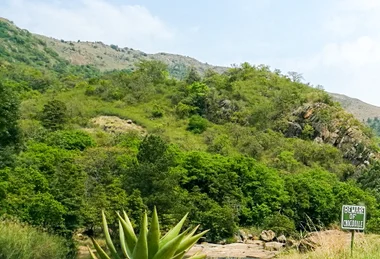
The warning signs at the beaches tell you everything about this place. Sharks, crocodiles, hippos, strong currents. No lifeguards. Swimming at your own risk. This is not a resort coast. It's wild in the truest sense.

The beaches themselves are vast and empty. Kilometers of sand with no one on them. The Indian Ocean rolls in with force, and the sky above seems bigger here than anywhere else. On overcast days, the light is moody and cinematic.


The coastline alternates between long sandy stretches and rocky shelves exposed at low tide. Inland, the wetlands open up into shallow lakes fringed by grass and backed by forested hills.


The vegetation changes as you move through the park. Dense subtropical forest on the coastal dunes gives way to open grassland and wetland further inland. The hills in the background catch the mist and cloud, giving the landscape a moody, layered quality that changes by the hour.


The roads through iSimangaliso are dirt, often red clay, and they wind through landscapes that feel genuinely remote. After rain, they can get challenging. The reward is having the park to yourself, with no other vehicles in sight.

Some sections require a proper 4x4, especially in the wet season. The tracks climb through dense coastal forest, cross streams, and emerge onto hilltops with views that make the rattling and mud worth it.


The wildlife here is different from Kruger. Buffalo herds graze on the open grassland. Banded mongooses travel in tight packs along the roadsides, all of them looking in the same direction at once.


Vervet monkeys are as present here as in Kruger, and the youngsters are particularly photogenic. Weaver ants build their elaborate nests on thorny acacia branches, the thorns providing protection from predators.


The warning signs in iSimangaliso deserve a gallery of their own. "Beware of hippos at night." "At own risk: unfenced." Pictograms showing hippos, crocodiles, buffalo, and sharks, all within the same park. This is a place where the wildlife has not been contained for your convenience.
The Drakensberg
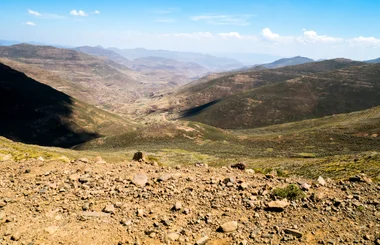
The Drakensberg mountains form a 200-kilometer escarpment along the western border of KwaZulu-Natal, rising to over 3,000 meters. The Zulu name, uKhahlamba, means "barrier of spears." It looks exactly like that. Jagged basalt peaks and sandstone cliffs forming a wall against the sky.

The scale is hard to convey in photographs. The valleys are wide, the peaks are high, and the grassland between them rolls in waves of green and gold depending on the season. The Drakensberg is a landscape that makes you feel small in the best possible way.

The foothills are inhabited, with homesteads and small settlements scattered across the slopes. Rivers wind through the valleys below, the water clear and cold from the mountains above.


The rock formations are extraordinary. Sandstone towers and buttresses eroded into shapes that look deliberate, as if someone carved them. The basalt cap on top is darker and harder, creating a two-tone effect against the sky.

The Sani Pass is the most famous road in the Drakensberg, climbing from KwaZulu-Natal up to the border with Lesotho at nearly 2,900 meters. It's a proper 4x4 track: loose rocks, steep switchbacks, no barriers, and views that get more dramatic with every turn. At the top sits the highest pub in Africa.

The hiking in the Drakensberg is some of the best in South Africa. Day hikes to waterfalls, overnight trails through the mountains, and the Grand Traverse for the truly committed. The paths wind through grassland, along rivers, and up to passes where the views extend for what feels like forever.
The Garden Route
The Garden Route runs along the southern coast from Mossel Bay to Storms River, roughly 300 kilometers of coastline where mountains meet the sea, indigenous forest covers the hillsides, and lagoons and estuaries dot the shoreline. It's South Africa's most popular road trip, and it earns that status.

Knysna is the heart of the Garden Route. The town sits on the edge of a large lagoon that opens to the sea through the Knysna Heads, two massive sandstone cliffs that frame the entrance. The view from the eastern head, looking back across the lagoon toward the Outeniqua Mountains, is one of the defining images of the region.

At low tide, the lagoon reveals its mudflats, and the landscape takes on a different character. Quieter, more contemplative. The mist sits on the surrounding hills in the early morning, and the stillness is complete.

Wilderness, just east of George, is where the Touw River meets the sea through a series of lagoons. The view from the hills above shows all of it at once: forest, lagoon, beach, ocean. It's a landscape that looks designed rather than natural.


The mountain passes along the Garden Route are part of the experience. The road climbs through indigenous forest where clouds roll over the treetops, then opens up to reveal panoramic views of the mountain ranges stretching into the distance. The Outeniqua Pass between George and Oudtshoorn is one of the most scenic.

The signage along the route is a constant reminder that South Africa is a multilingual country. River names in Afrikaans, town names in English, and place names that predate both.

Chacma baboons are the unofficial mascots of the Garden Route and the Cape Peninsula. They sit on the road, on your car if you let them, and on anything else they feel like sitting on. They're bold, intelligent, and not intimidated by humans. Keep your car windows up and your food locked away.

Just over the Outeniqua Pass, Oudtshoorn is the ostrich capital of the world. The birds are farmed here, and you can visit the farms to get uncomfortably close to animals that are taller than you and look at you with an expression that suggests they know something you don't.

West of the Garden Route, the mountains give way to the wine valleys around Franschhoek and Stellenbosch. The landscape shifts from coastal forest to something more Mediterranean: vineyards on slopes, oak-lined avenues, and mountain peaks that catch the afternoon light.

Between the coast and the interior lies the Karoo, South Africa's vast semi-desert heartland. The landscape is spare: flat plains of scrub stretching to mountain ranges that shimmer in the heat. It's the antithesis of the lush Garden Route, and it's beautiful for entirely different reasons. The silence here is total. The night skies are among the darkest in the world.
When to Go
South Africa spans multiple climate zones, so "best time" depends on what you're doing.
For safaris (Kruger and surrounds): The dry winter months, May to September, are best. Animals gather at water sources, the bush is thinner, and sightings are easier. Mornings and evenings are cold (bring layers), but days are pleasant. Summer (November to March) brings rain, lush vegetation, and baby animals, but the thick bush makes spotting harder.
For Cape Town and the Western Cape: Summer, November to March. Cape Town's Mediterranean climate means warm, dry summers and cool, wet winters. December to February is peak season, with long days, beach weather, and crowds. The shoulder months of October and March are quieter and still pleasant. Winter (June to August) brings rain and wind, but also whale watching along the coast and dramatic skies.
For the Garden Route: Year-round, though spring (September to November) and autumn (March to May) offer the best balance of weather and fewer crowds.
For the Drakensberg: Summer (October to March) for hiking, when trails are accessible and waterfalls are full. Winter brings snow to the peaks and crisp, clear days at lower altitudes.
For the whole country: September to November (spring) or March to May (autumn) give you the best of both worlds without the extremes of peak summer heat or winter cold.
Food
South African food is a collision of cultures, and it works.
Braai is not just a barbecue. It's a social institution, a national pastime, and arguably the closest thing South Africa has to a unifying cultural practice. Everyone braais, all groups, all income levels, all weekends. Boerewors (a coiled spiced sausage), lamb chops, sosaties (skewered meat), steak, chicken. The meat is good. The fire is the point. If you're invited to a braai, say yes.
Biltong is dried, cured meat, usually beef or game. It's everywhere, from petrol stations to craft markets to dedicated biltong shops. It's nothing like jerky. The texture is different, the flavor is deeper, and once you've had good biltong, jerky feels like a lesser product. Droewors (dried sausage) is equally addictive.
Bunny chow from Durban is a hollowed-out loaf of white bread filled with curry. It sounds odd. It's extraordinary. The Indian community in KwaZulu-Natal created something that's now a national dish. Get it in Durban where it originated, from a place that's been making it for decades.
Bobotie is a Cape Malay dish: spiced minced meat topped with an egg custard, baked, served with yellow rice and chutney. It's comfort food at its most generous.
Cape Malay cooking in general deserves attention. The Bo-Kaap neighborhood in Cape Town is the center. Curries, samoosas, koeksisters (twisted doughnuts dipped in syrup), and flavors that trace back centuries to Southeast Asian spice routes.
The wine. Stellenbosch, Franschhoek, and Paarl produce wines that compete globally. Pinotage is the signature grape, a South African original. The wine regions are among the most beautiful agricultural landscapes in the world, and a tasting here costs a fraction of what it would in Napa or Bordeaux.
Safety
South Africa has a serious crime problem. This is not a cliche. The statistics are real, and the country consistently ranks among the highest in the world for violent crime. Most of this is concentrated in specific areas and circumstances, and tourists are rarely targets of violent crime if they exercise caution. But the caution needs to be active, not passive.
In cities: Don't walk alone at night. Don't walk in quiet or poorly lit areas even during the day. Keep your phone and camera out of sight when not in use. Don't leave anything visible in your car. Carjacking occurs, predominantly in Johannesburg, often at traffic lights or in driveways. Lock doors, keep windows up in unfamiliar areas, and be aware of your surroundings.
On the road: South Africa's roads are good, but driving culture can be aggressive. Keep to the speed limits. Don't stop for people flagging you down on remote roads after dark. If your car breaks down, call for help rather than walking.
In tourist areas: Cape Town's Waterfront, the Winelands, the Garden Route, and safari lodges are generally very safe. The tourist infrastructure is well established and security is taken seriously.
The reality check: Millions of tourists visit South Africa every year without incident. The crime is real, the precautions matter, but the country is not a war zone. It's a place where awareness and common sense go a long way. Ask your hotel or hosts for specific advice. They know their area. Listen to them.
Getting Around
Rent a car. This is the answer for most of South Africa. The road network is excellent, distances are vast, and public transport outside cities is limited. Driving is on the left. Roads are well signed. Petrol stations are staffed (an attendant fills your car, checks your oil, washes your windscreen, and you tip them a few rand). The N1, N2, and N3 highways connect the major cities and are generally good quality.
Domestic flights connect Cape Town, Johannesburg, Durban, Port Elizabeth, George, and other cities. They're reasonably priced if booked in advance and save enormous amounts of driving time. Johannesburg to Cape Town is a 2-hour flight or a 14-hour drive.
In Cape Town: Uber works well and is cheap. The MyCiTi bus system covers some routes. Walking is fine in the city center and Waterfront area during the day.
In Johannesburg: Uber is the default. Do not walk around Johannesburg's CBD unless you know exactly where you're going and have local guidance. The Gautrain connects the airport to Sandton and Pretoria and is clean, safe, and efficient.
Public transport between cities is limited. Intercape, Greyhound (when operating), and Translux run bus services between major cities. The Baz Bus caters to backpackers on the Cape Town to Durban route. Trains exist but are slow and have reliability issues. The exception is the Blue Train and Rovos Rail for luxury rail experiences.
Destination Info
Published March 2026.