The City That Never Logs Off
Seoul is a city that somehow runs at full speed and full volume, all day, every day, and still finds time to be beautiful about it. Ten million people crammed into a valley between granite mountains, living in a place where a 600-year-old gate sits directly across the street from a glass tower with a Starbucks on the 47th floor. That's not a metaphor. That's literally the view from most major intersections.

I came to Seoul expecting K-pop aesthetics, good food, and a fast metro. I got all of that. I also got a city so layered and so ridiculously efficient that it made every other capital I've visited feel like it's still buffering. Seoul doesn't just work. It works like someone optimized it overnight, tested it, shipped it, and is already working on version 2.0.
The food is absurd (in the best way). The convenience stores are better than most restaurants in other countries. The nightlife goes until the sun comes up and then some. The palaces are gorgeous. The mountains are right there, like actually right there, you can see granite peaks from the subway exit. And the metro is a thing of beauty that I will talk about in its own section because it deserves it.

If you're someone who thinks Asia means Bangkok or Tokyo and you haven't considered Seoul yet, you're sleeping on it. This city hits different. Not quieter, not louder, just different. It has its own frequency, and once you tune into it, you're gonna have a hard time wanting to leave.
The Palaces
Seoul has five major palaces from the Joseon Dynasty, which ruled Korea for about 500 years, and they're scattered across the city center like someone was really committed to making sure no neighborhood was more than a 15-minute walk from royalty. You don't need to visit all five. But you gotta do at least one properly, and that one should be Gyeongbokgung.


Gyeongbokgung is the biggest and the most famous. It sits at the northern end of a straight axis that runs from Gwanghwamun Square, which means the approach alone is dramatic. You walk through the gate and suddenly the noise drops, the skyscrapers disappear behind old walls, and you're standing in a vast courtyard surrounded by wooden buildings with curved tile roofs that look like they're trying to touch the sky.
The changing of the guard ceremony happens twice a day and it's free. Guys in full Joseon-era military gear, drums, flags, the whole show. It's choreographed and rehearsed, yeah, but it's also oddly impressive. There's a weight to it that catches you off guard.

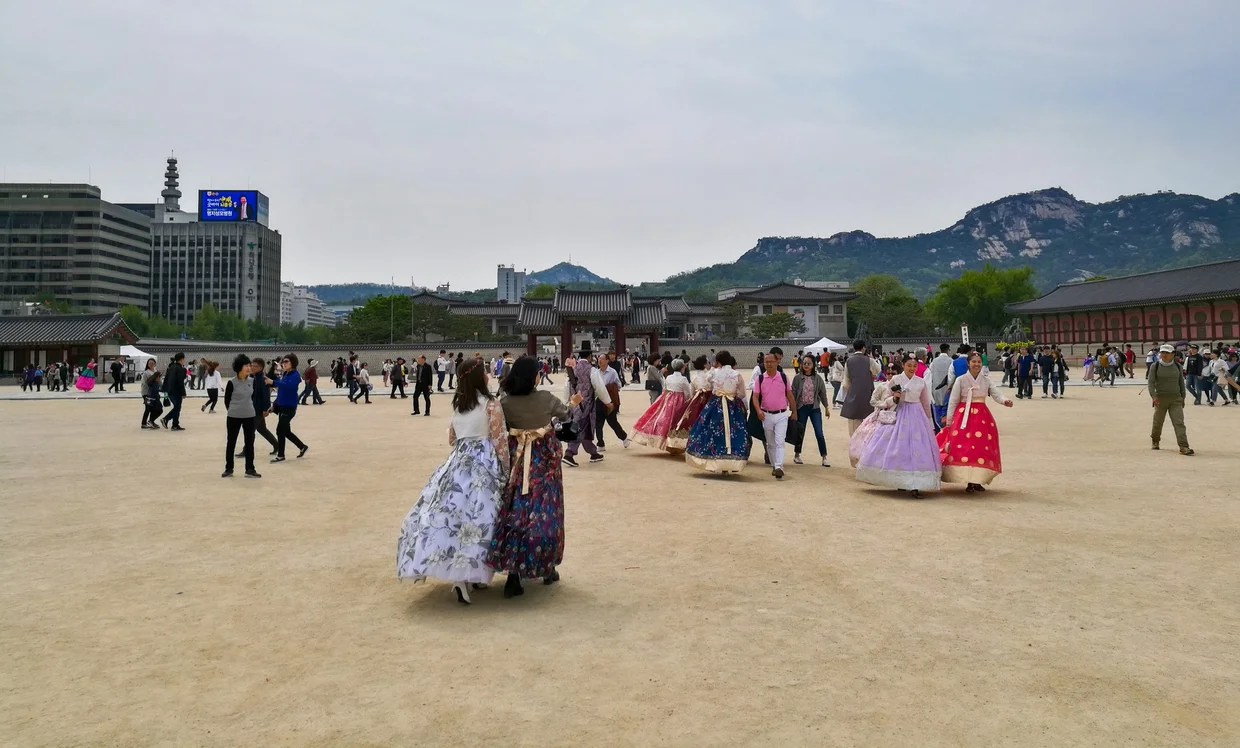
Now here's the thing about the palaces that nobody warns you about: hanbok. Everywhere. Renting a traditional Korean outfit is a massive tourist activity in Seoul, and if you wear one, you get free entry to all the palaces. Which means the palace grounds are absolutely packed with people in brightly colored silk robes, posing for photos, adjusting headpieces, trying to walk in uncomfortable shoes on gravel paths. It looks like a period drama set exploded. It's chaotic and kinda beautiful at the same time.

Between Gyeongbokgung and Changdeokgung Palace, you'll find Bukchon Hanok Village, a neighborhood of traditional Korean wooden houses on narrow hilly streets. It's gorgeous, it's photogenic, and it's a real residential area where people actually live. There are signs everywhere asking tourists to keep quiet because, well, some people are just trying to have breakfast while 200 visitors pose outside the kitchen window. Respect the signs. Please.


The Neighborhoods
Seoul is enormous. You could spend a week here and only scratch the surface of what each district offers. But here are the ones that matter most for a first visit, and they all feel like completely different cities. The metro connects everything, so hopping between neighborhoods is fast and cheap. Each one has its own personality, its own food scene, and its own pace.
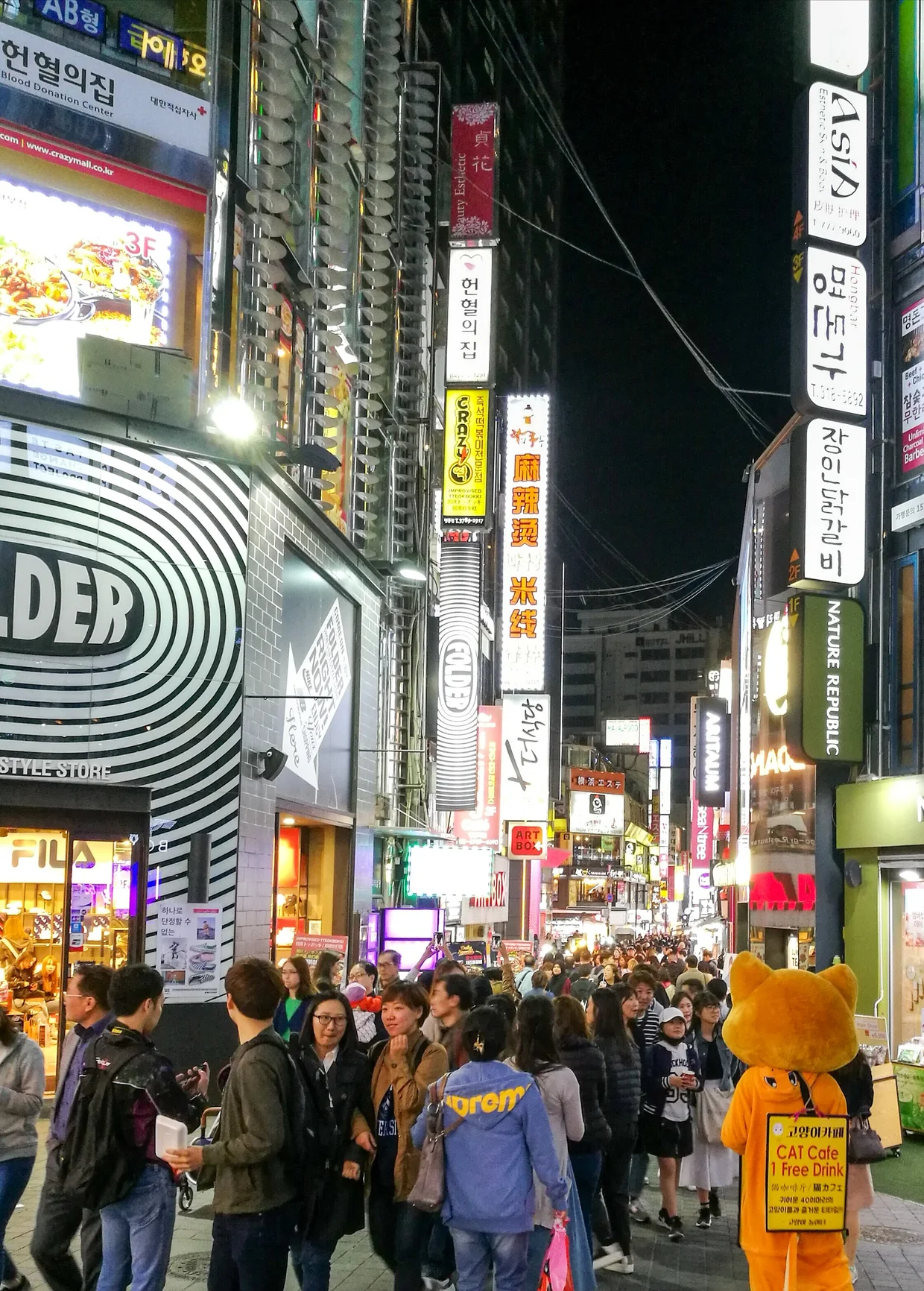
Myeongdong is the shopping district, and when I say shopping, I mean K-beauty shopping turned up to eleven. Every other storefront is a skincare brand. The sales staff stand outside with free samples and won't take no for an answer in the friendliest possible way. If you care about skincare, this is your temple. If you don't, it's still interesting for about 30 minutes before sensory overload kicks in. The street food here is top tier though. Egg bread, tornado potatoes, hotteok. Come hungry.


Hongdae is where the energy lives. Named after nearby Hongik University, this area is the beating heart of Seoul's youth culture. Street performers every evening, live music bars, indie shops, vintage stores, and a nightlife scene that starts at 10 PM and doesn't even think about stopping until 5 AM. If you're in your 20s or 30s, you're gonna end up here whether you planned to or not. The side streets are the best part. Skip the main drag and wander.
Gangnam. Yeah, that Gangnam. Oppa style. The famous district south of the Han River is sleek, wealthy, and full of plastic surgery clinics, luxury brands, and some of the best restaurants in the city. It feels more corporate than fun, but the underground shopping arcades beneath the metro stations are surprisingly good for affordable finds. COEX Mall is here too, with the famous Starfield Library (an open library inside a shopping mall, which is the most Seoul thing you can imagine).


Insadong is the cultural one. Tea houses, traditional craft shops, art galleries, calligraphy stores. It's touristy but in a tasteful way. The narrow side alleys are where it gets interesting, with small galleries and cafés hidden behind sliding doors. If you wanna buy traditional Korean gifts or just sit in a quiet tea house while the rest of Seoul buzzes outside, this is your spot.
Neon, Noise & No Sleep
Seoul at night is a different city. Not a worse one. Not a louder one. Just... more. The neon doesn't just light up the streets, it replaces the sun. Every sign, every storefront, every restaurant entrance is glowing in a way that feels like someone decided that darkness is simply not acceptable.
Walk through Jongno 3-ga after dark and you'll find a neighborhood of tiny alleys packed with grilled meat joints, soju tents, and groups of friends and coworkers eating, drinking, and being very loud about it. This is the real Seoul drinking culture. Not the Instagram rooftop bars (those exist too, and they're fine), but the plastic-chair-and-folding-table places where the food comes on a portable gas burner and the soju flows like it's the municipal water supply.
The concept of "rounds" in Korea is a thing. You don't just go to one place. First round: meat and soju. Second round: a different bar, maybe chicken and beer. Third round: noraebang, which is karaoke in a private room with your friends. By round three, nobody cares about singing ability anymore. That's the entire point.

Noraebang deserves a special mention. It's not karaoke in the Western sense where you embarrass yourself in front of strangers. It's a private room, just you and your group, with a screen, two microphones, tambourines, disco lights, and a songbook that includes everything from K-pop to Queen to songs you didn't know existed. You pay by the hour. You will stay longer than you planned. And whatever happened in the noraebang stays in the noraebang. That's the unwritten rule.
Food That Does Not Mess Around
Here's what you need to know about food in Seoul: there's no such thing as a bad meal. I'm not being dramatic. The floor for food quality in this city is higher than the ceiling in most places I've been. Even a random hole-in-the-wall picked by pointing at a sign you can't read will probably serve you something that makes you question every meal you've had before.
Korean BBQ is the star attraction, and if you've only had it outside of Korea, you haven't had it. You sit at a table with a built-in grill, order way too much meat (you will), and cook it yourself. Pork belly (samgyeopsal), marinated beef (bulgogi), short ribs (galbi). Wrap it in lettuce with garlic, chili paste, and a slice of grilled garlic. Repeat until you physically cannot move. The banchan (side dishes) that arrive before the meat are free and refillable. Yes, free. Yes, refillable. I still think about this.
Korean fried chicken deserves its own paragraph because it's that good. Crispy, double-fried, and sauced (yangnyeom) or plain (huraideu). Pair it with beer. This combination (called chimaek, a mashup of chicken and maekju/beer) is practically a national pastime. There are entire chains dedicated to it. The fried chicken in Seoul is, without exaggeration, the best I've ever had anywhere. Fight me on this.
Tteokbokki (spicy rice cakes) is the street food king. Chewy rice cakes in a thick, sweet-spicy red sauce. You can get it from street vendors, from dedicated tteokbokki restaurants, and from convenience stores. It's cheap, it's filling, and it's addictive in a way that should probably be studied by scientists.
The convenience stores. I'm gonna say something that sounds like I've lost my mind, but hear me out. Korean convenience stores (GS25, CU, 7-Eleven) are a genuine food destination. Not a "well, it's 2 AM and nothing else is open" backup plan. An actual, intentional, I'm-choosing-this food destination. They have triangle kimbap (seaweed rice wraps), ready-made ramyeon stations where you cook instant noodles on the spot with hot water, sandwiches, onigiri, and a rotating selection of snacks that would put most European delis to shame. Some have small seating areas. I ate at least one convenience store meal every single day and I regret absolutely nothing.
And then there's soju. Korea's national drink. A clear liquor, usually around 16 to 20% alcohol, that comes in small green bottles and costs less than a bottle of water. It goes with everything. Koreans drink more soju per capita than any other spirit in the world, and after one evening in a Korean BBQ restaurant, you'll understand why. It's smooth, it's cheap, and it makes everything funnier. Just don't underestimate it. The hangover has teeth.
What to Do
There are many things to experience, to see and to do in Seoul. This here is just my personal highlight. For a more comprehensive and detailed overview, visit my dedicated what to do in Seoul page.
Gyeongbokgung Palace
The big one. The main palace. The reason half the people on the Seoul metro are wearing hanbok. Gyeongbokgung was built in 1395 as the main royal palace of the Joseon Dynasty, destroyed by the... see more
Changdeokgung Palace & Secret Garden
If Gyeongbokgung is the showpiece, Changdeokgung is the one with soul. Built in 1405 as a secondary palace, it eventually became the primary royal residence because the kings just liked it better... see more
Bukchon Hanok Village
A hillside neighborhood of traditional Korean wooden houses (hanok) wedged between two palaces, with narrow alleys, stone walls, and rooftop views of both the old and new Seoul. It's gorgeous and... see more
Gwangjang Market
If Seoul has a food heart, this is it. Gwangjang Market opened in 1905, making it one of the oldest and largest traditional markets in Korea, and the food hall section is the reason you came. Rows... see more
Myeongdong Street Food
Myeongdong is primarily a shopping district (K-beauty central, if that's your thing), but the street food scene that sets up every evening is worth the visit even if you have zero interest in... see more
Hongdae Night Scene
Hongdae (short for Hongik University area) is Seoul's youth culture epicenter, and it comes alive after dark in a way that makes you forget what sleep is. The main streets and side alleys are packed... see more
Korean BBQ Experience
Eating Korean BBQ in Korea is not just a meal; it's a full contact sport disguised as dinner. You sit at a table with a built-in grill (charcoal if you're lucky, gas if you're everywhere else), order... see more
Bukhansan National Park
A national park inside a city of ten million people. Bukhansan sits on Seoul's northern edge, and you can reach the trailheads by metro, which still blows my mind. The park has granite peaks, ancient... see more
Namsan Tower (N Seoul Tower)
Namsan Tower sits on top of Namsan Mountain right in the center of Seoul, and it's the kind of landmark that's visible from basically everywhere. The tower itself is a communications tower turned... see more
DMZ Day Trip
The Demilitarized Zone between North and South Korea is the most heavily fortified border on earth, and it's about 50 kilometers north of Seoul. Which is wild when you think about it: one of the... see more
Jogyesa Temple
The head temple of Korean Buddhism, sitting right in the middle of Seoul's busy Jongno district, surrounded by office buildings and traffic. You walk through the gate and the city just... stops. Not... see more
Noraebang (Karaoke)
Noraebang means "singing room," and it's not karaoke the way you know it. Forget the bar with a stage and an audience of judgmental strangers. In Korea, noraebang is a private room with your group,... see more
War Memorial of Korea
This museum is massive, free, and genuinely one of the best military history museums I've visited anywhere. It covers Korea's entire military history from ancient battles to the Korean War and the... see more
COEX Mall & Starfield Library
COEX is one of the largest underground shopping malls in the world, and its centerpiece is the Starfield Library, a massive open library in the middle of the mall atrium with floor-to-ceiling... see more
The Quiet Part
For all its neon chaos, Seoul also has genuinely peaceful corners. And I don't mean "peaceful by Seoul standards." I mean actually, properly quiet. The kind of quiet that makes you forget you're in a city of ten million.

Jogyesa Temple is the head temple of Korean Buddhism, and it's right in the middle of the city, surrounded by office buildings and traffic. You walk through the gate and the noise vanishes. Lanterns hang in rows, monks walk past in grey robes, and there's an ancient white pine tree in the courtyard that's been standing there for about 500 years. During the Buddha's Birthday celebration (usually around May), the entire temple and surrounding streets are draped in thousands of colorful paper lanterns, and it's one of the most visually stunning things you'll see in Seoul.


Bongeunsa Temple is another good one, right across from the COEX Mall in Gangnam. Buddhist meditation garden on one side, luxury shopping complex on the other. Seoul in a nutshell.
If you want something bigger, Bukhansan National Park is right on the northern edge of the city. Proper granite peaks, proper hiking trails, proper views. You can take the metro to the trailhead. Not many capitals on this planet let you do that. The hike up to Baegundae Peak (836 meters) is challenging but doable in half a day, and the view of Seoul sprawling below you in every direction is something else entirely. Koreans are serious about hiking. Don't be surprised when 70-year-olds in full gear overtake you on a steep section. It will happen. Accept it gracefully.
Where to Stay
Where you stay in Seoul matters less than in most cities, because the metro is so good that you can reach any neighborhood from any other neighborhood in 30 minutes or less. What matters more than the neighborhood itself is staying close to a metro station. Seoul's stations are sometimes further apart than in other major cities, so a hotel that's a 15-minute walk from the nearest station will feel significantly less convenient than one that's a 3-minute walk away. That said, each district has its own personality, and picking the right base shapes what your mornings, evenings, and late nights feel like. The north side of the Han River (Jongno, Myeongdong, Hongdae) is where most first-time visitors stay because that's where the palaces, markets, and main tourist areas are. The south side (Gangnam, Itaewon) is more modern and more local. There's no wrong answer, but there are better fits depending on what you're after.
Hongdae / Mapo
The best all-round base for most travelers, especially if you care about nightlife, food, and a lively atmosphere. Hongdae is Seoul's youth and arts district, packed with bars, live music venues, cafés, vintage shops, and street food. The area around...
District map available here.
Activate Full Experience Mode to load the neighborhood map and inspect the best base visually.
Best Time to Visit
Seoul has four distinct seasons, and two of them are great, one is fine, and one is a test of character.
Spring (April to May) is the winner. Cherry blossom season hits in early to mid April, and for about two weeks the city turns pink. Yeouido along the Han River is the famous spot, but you'll see blossoms on pretty much every block. Temperatures are comfortable (15 to 23 degrees), the skies are clear, and the city is at its most photogenic. May is warmer, parks turning lush green, and the vibe shifts from "everything is blooming" to "everything is alive." This is the sweet spot.
Autumn (September to November) is almost as good. The heat drops, the humidity goes away, and the foliage starts turning. October is gorgeous. The palace grounds surrounded by red and gold maples are the kind of thing that makes you take 400 photos and think every single one could be a postcard. Bukhansan in fall colors is spectacular.
Summer (June to August) is monsoon season. Hot, humid, rainy. July is the worst. Temperatures pushing 30+ degrees and humidity that makes you feel like you're breathing through a wet towel. The rain comes in intense bursts. If you're visiting in summer, bring an umbrella and accept that you're gonna sweat through every shirt you packed.
Winter (December to February) is cold. Like, properly cold. Minus 10 is not unusual in January. The air is dry, the sky is often grey, and the wind cuts through everything. But Seoul handles winter well. The ondol (floor heating) system in Korean buildings is amazing, and there's something atmospheric about a snowy palace courtyard. If you can deal with cold, winter Seoul has a quiet beauty and much fewer tourists.
How Long to Stay
Four to five days. That's the minimum for the highlights without turning your trip into a speed run.
Day one for palaces, Bukchon, and Insadong. Day two for Hongdae, Myeongdong, and street food. Day three for the quieter stuff: temples, Namsan Tower, a long lunch that accidentally becomes dinner. Day four for whatever pulled you in hardest. Day five for the things you missed and one last Korean BBQ because you can't leave without one more.
A week lets you breathe. You can add a DMZ day trip, explore Gangnam properly, do a cooking class, hike Bukhansan, or just spend an entire afternoon eating your way through a street food market without looking at the time.
Seoul rewards lingering. The best stuff happens when you stop rushing, sit down at a random pojangmacha (street tent bar), order something you can't read on the menu, and just let the city happen around you.
Getting Around
The Seoul Metro is, and I'm saying this with full conviction, the best public transport system I've ever used. It's clean. It's on time. It goes everywhere. The stations have heated seats in winter. The announcements are in Korean, English, Chinese, and Japanese. Every station has numbered exits with detailed maps showing exactly what's near each one. The trains run from about 5:30 AM to midnight. And a single ride costs around 1,250 KRW, which is roughly one euro. One euro. For a system this good.
Get a T-money card. You can buy one at any convenience store for about 2,500 KRW, charge it up, and use it on metro, buses, and even taxis. It just works. No apps to download, no QR codes to scan, no drama. Tap in, tap out, done.

Buses cover what the metro doesn't, and they're equally efficient. The numbering system is a bit confusing at first (blue for trunk routes, green for branch routes, red for express, yellow for circular), but Naver Map or KakaoMap will sort that out for you in seconds.
Taxis are cheap by Western standards. The base fare is around 4,800 KRW (about 3 euros). The only catch: not every driver speaks English. Have your destination written in Korean or just show it on your map app. Late at night, fares increase slightly, but it's still very reasonable.
One important note: Google Maps doesn't work properly in South Korea. Not broken, but limited. Korean law restricts map data exports, so Google can't offer proper directions. Use Naver Map or KakaoMap instead. Both have English interfaces and are significantly more accurate for navigation in Seoul. This is not a suggestion. It's survival advice.
Costs
Seoul is surprisingly affordable for a world-class capital. Cheaper than Tokyo, way cheaper than Singapore, and the quality you get for what you pay is consistently impressive. The combination of excellent street food, a cheap metro, and no tipping culture means your money goes further here than in almost any other major Asian city.
The prices shown here are meant as a rough guide and can vary over time. While I update exchange rates regularly, local prices are typically refreshed only when I revisit the destination.
The biggest savings come from food and transport, which are both ridiculously well-priced. The biggest spend will be your hotel, especially if you're staying in Myeongdong or Hongdae. Move one or two metro stops away from the tourist centers and rates drop significantly.
No tipping. Anywhere. Ever. This alone saves you a mental load you didn't realize you were carrying until it's gone.
Common Mistakes
Only staying in Myeongdong. It's convenient, it's central, and it's also the most touristy, most overpriced area in Seoul. Stay in Hongdae, Mapo, or even around Seoul Station for better value and a more authentic feel. You can reach Myeongdong in minutes from anywhere on the metro.
Using Google Maps. It won't route you properly. Download Naver Map or KakaoMap before you arrive. I cannot stress this enough. You'll be standing on a street corner spinning in circles while Google confidently points you into a wall. Don't be that person.

Skipping the convenience stores. If you eat every meal at a sit-down restaurant, you're doing Seoul wrong. GS25 and CU are not just for emergency snacks. They're a food group. Triangle kimbap at 2 AM after noraebang is a core Seoul experience.
Not learning basic Hangul. You don't need to be fluent, but knowing how to read Korea's alphabet will change your experience. It was literally designed to be easy to learn (King Sejong invented it in the 1440s because he thought Chinese characters were too hard for commoners, what a legend). You can pick up the basics in a couple of hours with a free app. Suddenly all those "cryptic" signs start making sense, and even if you can't understand the words, sounding them out helps more than you'd think.
Trying to see everything. Seoul is too big for three days. Pick neighborhoods, not attractions. You'll have a much better time spending an afternoon exploring Hongdae at your own pace than sprinting between ten "must-see" sights on a checklist. Slow down. Seoul rewards that.
Underestimating the walking. Seoul is hilly. Very hilly. The palace grounds are vast. The neighborhoods sprawl. You're gonna walk 20,000+ steps a day without trying. Wear good shoes. This is not a sandals city (unless you're Korean, they somehow make it work, I don't know how).
Going to Korean BBQ alone. Most BBQ restaurants require a minimum of two people because the portions are designed for sharing. Solo travelers: the solution is fried chicken spots, bibimbap joints, kimbap restaurants, or the beautiful, beautiful convenience stores. Nobody is judging you. Especially not at 1 AM over a bowl of instant ramyeon.
Ignoring the café scene. Seoul has more cafés per capita than almost any city on earth, and they're not just coffee shops. They're elaborate, themed, multi-story experiences. Some are designed by famous architects, some have plant walls three stories tall, some occupy converted warehouses. Pick a few, sit down, order something pretty, and just take it in. Rushing past Seoul's cafés is like rushing past art in a gallery. You're technically allowed to do it, but why would you?
Destination Info
Published March 2026.