Top Things to Do and See in Seoul
Seoul doesn't really do "tourist attractions" the way most capitals do. There's no single monument you line up for, snap a photo, and leave. Instead, the city is a collection of experiences that blend into each other: a palace visit turns into a hanbok photoshoot, a market walk turns into the best meal of your life, a temple visit turns into a hike up a granite peak with a view of ten million people below. The trick is to not over-plan. Pick a few things per day, leave gaps, and let Seoul fill them for you. It will.
The prices shown here are meant as a rough guide and can vary over time. While I update exchange rates regularly, local prices are typically refreshed only when I revisit the destination.
Gyeongbokgung Palace
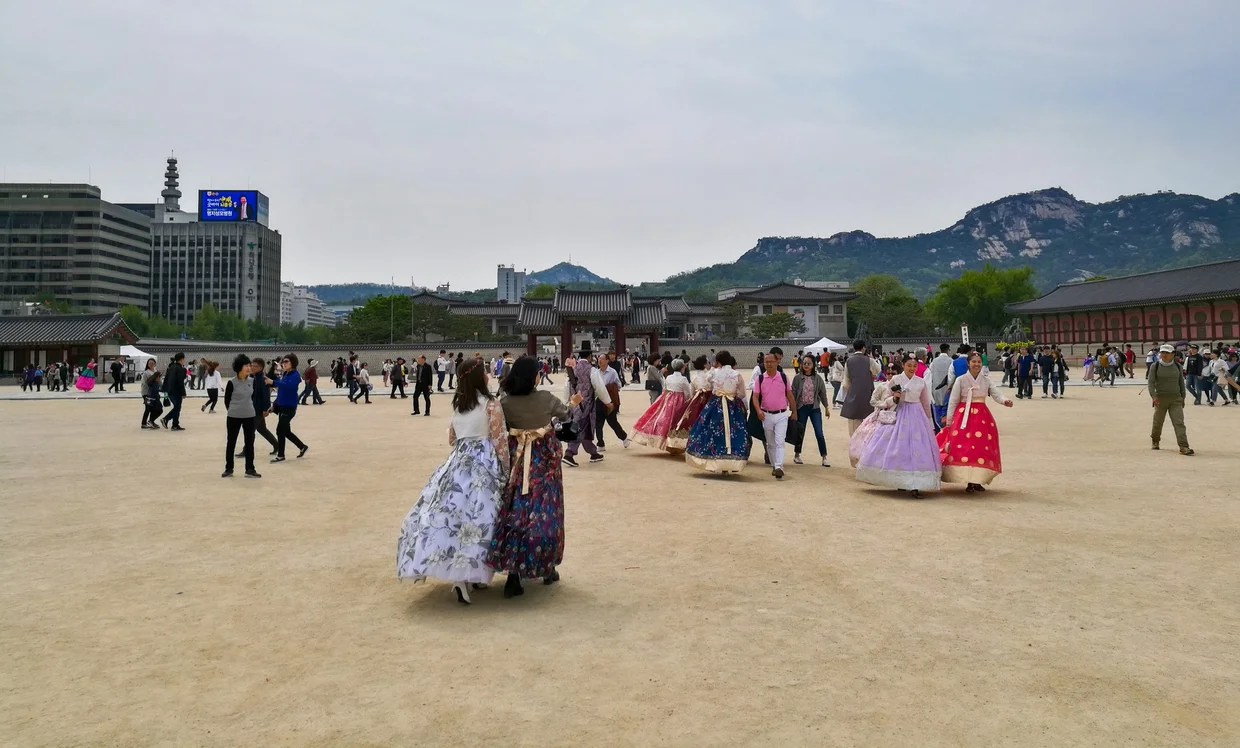
The big one. The main palace. The reason half the people on the Seoul metro are wearing hanbok. Gyeongbokgung was built in 1395 as the main royal palace of the Joseon Dynasty, destroyed by the Japanese (twice), and painstakingly restored. The complex is enormous: courtyards, throne halls, gardens, pavilions, and the National Folk Museum, all set against the backdrop of Bugaksan mountain. The changing of the guard ceremony at the main gate happens twice daily and is surprisingly impressive for something you'd expect to be a cheesy tourist thing. Rent a hanbok from one of the dozens of shops nearby and you get in free. Yes, free. The palace grounds are massive enough that even on busy days you can find quiet corners. Go early morning for the best light and fewer crowds. The Gyeonghoeru Pavilion, a two-story structure sitting on 48 stone pillars over a lotus pond, is one of the most photographed spots in all of Korea for a reason.
How to Get There
Gyeongbokgung Station (Line 3, Exit 5) drops you right at the main gate. You can also walk from Anguk Station (Line 3) if you're coming from Insadong or Bukchon.
Notes
- Free entry if you wear a hanbok (rental shops start at around 15,000 KRW for 2 hours)
- Changing of the guard ceremony at 10:00 and 14:00 (not on Tuesdays)
- Closed on Tuesdays
- The National Folk Museum inside the grounds is included in the ticket
- Combine with Bukchon Hanok Village, which is a 10-minute walk east
Changdeokgung Palace & Secret Garden
If Gyeongbokgung is the showpiece, Changdeokgung is the one with soul. Built in 1405 as a secondary palace, it eventually became the primary royal residence because the kings just liked it better (fair enough). The architecture follows the natural contours of the landscape instead of imposing a rigid grid, which gives it a more organic, relaxed feel than Gyeongbokgung. But the real draw is the Huwon, the "Secret Garden" at the back. It's a 78-acre woodland with pavilions, ponds, and centuries-old trees that was reserved for the royal family. Access is by guided tour only (offered in English), and the group size is limited, which means you actually get to enjoy it without fighting through crowds. The garden changes dramatically with the seasons: cherry blossoms in spring, deep green in summer, fiery colors in autumn, snow-dusted branches in winter. This is a UNESCO World Heritage Site, and it earns that status more than most places I've seen with that label.
How to Get There
Anguk Station (Line 3, Exit 3), then a 5-minute walk. It's between Bukchon Hanok Village and Insadong, making it easy to combine with both.
Notes
- Secret Garden tour is an additional 5,000 KRW on top of palace entry
- English garden tours run at set times (check schedule, usually 10:30 and 14:30)
- Limited to 50 people per tour; book online or arrive early
- Closed on Mondays
- Free with hanbok, like all major palaces
- Autumn (October to November) is the best time for the garden
Bukchon Hanok Village
A hillside neighborhood of traditional Korean wooden houses (hanok) wedged between two palaces, with narrow alleys, stone walls, and rooftop views of both the old and new Seoul. It's gorgeous and photogenic in a way that makes you take the same photo from slightly different angles about 40 times. The houses date from the Joseon Dynasty era, and many have been converted into tea houses, small museums, craft workshops, and cultural centers. But here's the thing you need to know: people actually live here. Real residents, real homes, real mornings. There are signs everywhere asking visitors to keep quiet, stay out of private alleys, and not block doorways for photos. Respect them. The residents have been dealing with tourism pressure for years and their patience is wearing thin. Come early in the morning when the light is best and the crowds are thinnest. The viewpoint at Bukchon 8-gil (sometimes called "Instagram Alley") gives you the classic shot of traditional rooftops with modern towers behind, but it's a narrow residential street, not a viewing platform. Be quick, be quiet, move on.
How to Get There
Anguk Station (Line 3, Exit 2 or 3). The village is on the hills between Gyeongbokgung and Changdeokgung. It's uphill, wear comfortable shoes.
Notes
- This is a residential area, not a museum; keep noise down and respect privacy
- Visit early morning (before 9 AM) for the best photos and fewest people
- Some hanok stay open as guesthouses if you want to sleep in a traditional house
- Bukchon 8-gil is the famous photo spot but gets very crowded after 10 AM
- Easily combined with Gyeongbokgung (west) and Changdeokgung (east)
- The Bukchon Traditional Culture Center offers free exhibitions and hanok interior tours
Gwangjang Market
If Seoul has a food heart, this is it. Gwangjang Market opened in 1905, making it one of the oldest and largest traditional markets in Korea, and the food hall section is the reason you came. Rows upon rows of stalls, each one specializing in something specific, with ajummas (Korean aunties) running the show with military precision. Bindaetteok (mung bean pancakes), fried crispy and golden, are the market's signature dish. Mayak gimbap (tiny, addictive seaweed rice rolls with a mustard dipping sauce) will ruin all other gimbap for you forever. Tteokbokki, sundae (Korean blood sausage, not a dessert), knife-cut noodles, and raw beef bibimbap are all here. You sit on plastic stools at crowded counters, point at what looks good, eat something incredible, pay almost nothing, and repeat until your body physically refuses to cooperate. The market also has a huge textile and vintage clothing section upstairs, which is interesting if you can still move after the food section. Come hungry. Leave happy. The Netflix "Street Food" series featured this place and the crowds have grown since, but it's still worth every elbow.
How to Get There
Jongno 5-ga Station (Line 1, Exit 8) or Euljiro 4-ga Station (Line 2/5, Exit 4). The market is impossible to miss once you're in the area.
Notes
- The food hall is in the center of the market; follow the crowds (and the smell)
- Bindaetteok and mayak gimbap stalls have the longest queues for a reason
- Cash is preferred at many stalls, though card acceptance is growing
- Best visited for lunch or as an early dinner; some stalls close by evening
- The vintage clothing section on the upper floors is surprisingly good
- Mondays are quieter; weekends are packed
Myeongdong Street Food
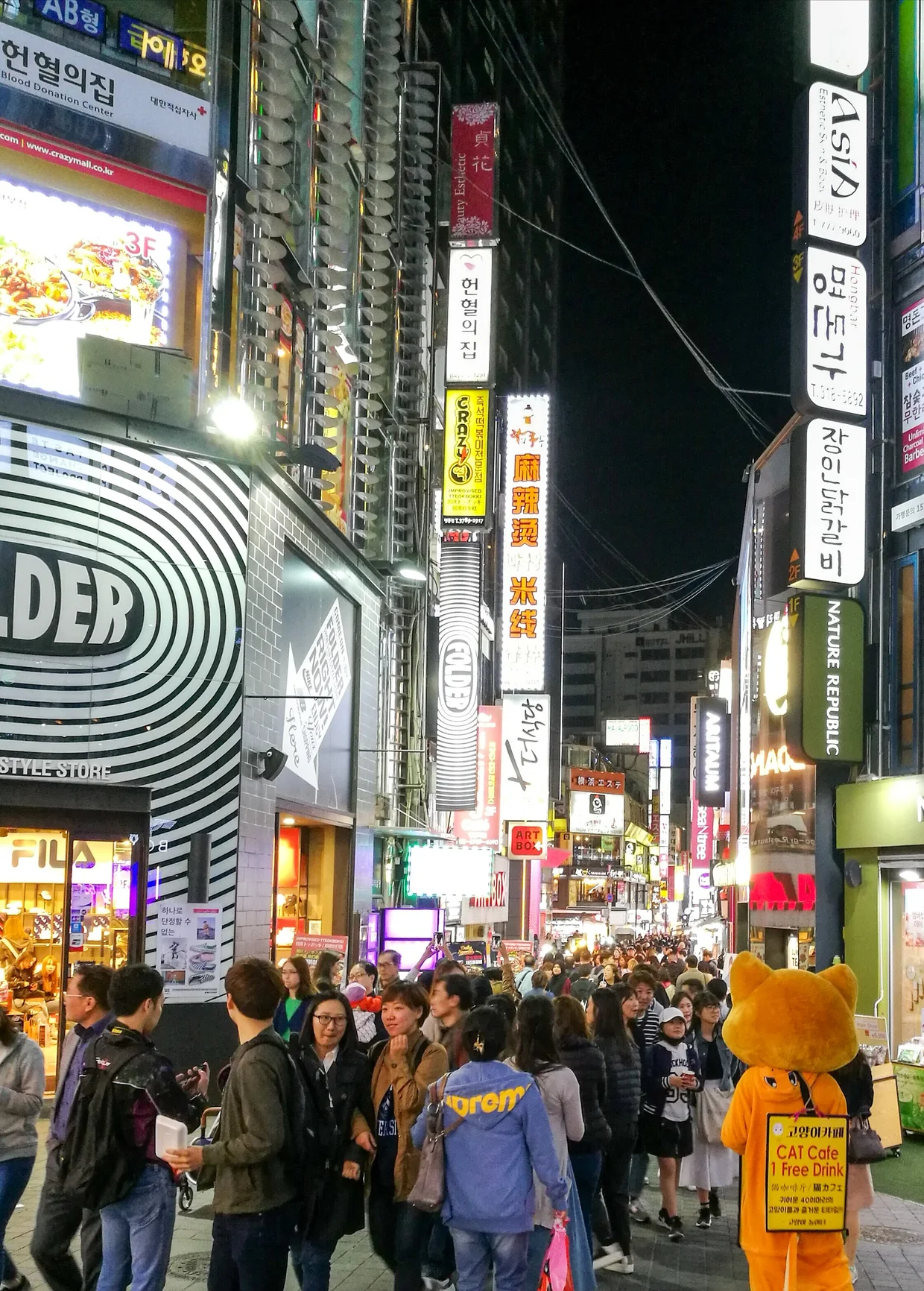
Myeongdong is primarily a shopping district (K-beauty central, if that's your thing), but the street food scene that sets up every evening is worth the visit even if you have zero interest in skincare. Vendors line the main streets and side alleys selling tornado potatoes (a whole spiral-cut potato on a stick, deep-fried), egg bread (gyeran-ppang, a fluffy bread pocket with a whole egg baked inside), hotteok (sweet pancakes filled with cinnamon, sugar, and nuts), giant corn dogs coated in french fries or ramen noodles, and every flavor of tteokbokki you can imagine. It's loud, it's crowded, it's sensory overload in the best possible way. The food quality is solid for street food prices, and the variety means you can graze your way through an entire dinner without sitting down once. The K-beauty shopping is genuinely good if that's your thing: Innisfree, Etude, Olive Young, The Face Shop, all competing for attention with free samples and deals that actually are deals. Just don't come here expecting a quiet evening stroll. Myeongdong at 7 PM is controlled chaos with a cat café mascot.
How to Get There
Myeongdong Station (Line 4, Exit 6 or 7) drops you right into the main shopping street. Euljiro 1-ga (Line 2) is also close.
Notes
- Street food vendors set up in the late afternoon and run until around 10 PM
- The main street and side alleys off it have the highest vendor density
- Olive Young is the best all-round K-beauty store for variety and English labeling
- Lotte Department Store (main branch) is on the edge of Myeongdong if you want something more upscale
- Namdaemun Market is a 10-minute walk south and worth combining
Hongdae Night Scene
Hongdae (short for Hongik University area) is Seoul's youth culture epicenter, and it comes alive after dark in a way that makes you forget what sleep is. The main streets and side alleys are packed with live music venues, indie bars, vintage shops, cafés with ridiculous themes (raccoon café, VR café, anger room café where you smash things), and street performers who range from genuinely talented buskers to full K-pop dance crews doing choreographed routines for growing crowds. The nightlife here skews younger and more casual than Gangnam or Itaewon, which is part of the charm. Nobody is trying to impress anyone. People are just out having fun. The clubs in Hongdae run until dawn, with most places picking up around midnight. The area around "Parking Street" and "Club Street" is the densest concentration of bars and clubs. But the real magic is in the smaller side streets where you stumble into a tiny bar with eight seats, a bartender who speaks no English, and somehow the best night of your trip. The convenience stores here double as late-night hangout spots: grab soju and snacks, sit on the plastic chairs outside, and watch the street show. That's peak Hongdae.
How to Get There
Hongik University Station (Line 2 / Airport Railroad, Exit 9) is the main entry point. Sangsu Station (Line 6) gives you access to the slightly calmer southern part of the district.
Notes
- Most bars and clubs don't charge cover; you pay for drinks
- Street performers are most active on Friday and Saturday evenings (around 7 to 10 PM)
- The area between Hongik University Station and Sangsu Station has the highest density
- Thursday nights are popular because many Koreans go out before the weekend
- If you're over 30, you'll still have a great time, you just won't be the majority
- Many places don't get going until midnight; adjust your dinner schedule accordingly
Korean BBQ Experience
Eating Korean BBQ in Korea is not just a meal; it's a full contact sport disguised as dinner. You sit at a table with a built-in grill (charcoal if you're lucky, gas if you're everywhere else), order more meat than any reasonable human should consume, and cook it yourself while an army of banchan (side dishes) surrounds your grill like a delicious siege. Samgyeopsal (thick-cut pork belly) is the classic: fatty, caramelized, wrapped in lettuce with garlic, ssamjang (spicy bean paste), and a slice of raw garlic. Galbi (marinated short ribs) is sweeter and more tender. Bulgogi (thin-sliced marinated beef) is the crowd-pleaser. The banchan are free, unlimited, and refillable, and this fact alone will ruin every other dining culture for you. Kimchi, pickled radish, bean sprouts, japchae, egg roll, and whatever else the kitchen decides you need today. The soju comes in green bottles and pairs with everything. Korean BBQ restaurants are everywhere in Seoul, from cheap local spots to upscale Hanwoo beef joints. The cheap ones are usually just as good. Bring a friend: most BBQ places have a two-person minimum order because the portions are designed for sharing.
How to Get There
Everywhere. Korean BBQ restaurants are in every neighborhood. Popular clusters include Mapo-gu (near Hongdae), Jongno 3-ga (the back alleys), and the streets around Seoul Station.
Notes
- Most BBQ restaurants require a minimum of two people per order
- [object Object]
- Your clothes will smell like grilled meat afterward; plan accordingly
- Banchan (side dishes) are free and refillable; just ask
- Cheaper places near universities (Hongdae, Sinchon) offer great quality at lower prices
- Late-night BBQ (after 10 PM) is a very normal Seoul activity
Bukhansan National Park
A national park inside a city of ten million people. Bukhansan sits on Seoul's northern edge, and you can reach the trailheads by metro, which still blows my mind. The park has granite peaks, ancient fortress walls, Buddhist temples, and hiking trails that range from "pleasant morning walk" to "why did I think this was a good idea." The main summit, Baegundae Peak at 836 meters, is the most popular and the most rewarding. The final approach involves some scrambling over rocks with metal handrails, and the view from the top is Seoul stretching endlessly in every direction, rivers and towers and mountains layered behind mountains. Koreans are obsessed with hiking (it's basically the national hobby), and the trails on weekends are packed with ajummas and ajussis in full professional hiking gear who will cheerfully overtake you on a steep section while you're gasping for air. They'll also offer you snacks and soju at the summit, because that's what you do on Korean mountains. The Bukhansanseong fortress trail is an easier alternative with great wall-walking sections and views without the summit scramble.
How to Get There
Gupabal Station (Line 3, Exit 1) then bus 704 to Bukhansan entrance, or walk 20 minutes. Alternatively, Bukhansan Ui Station (Ui-Sinseol Line) for the eastern approach.
Notes
- Baegundae Peak trail is about 3.5 hours round trip; start early
- Weekends are very crowded on popular trails; weekdays are significantly better
- Bring water and snacks, though there are some small vendors near trailheads
- The final summit push has metal railings and some rock scrambling; not for vertigo sufferers
- Hiking poles are available for rent at some park entrances
- [object Object]
Namsan Tower (N Seoul Tower)
Namsan Tower sits on top of Namsan Mountain right in the center of Seoul, and it's the kind of landmark that's visible from basically everywhere. The tower itself is a communications tower turned observation deck, and the 360-degree views from the top are genuinely impressive, especially at sunset when the city transitions from daytime concrete to nighttime neon. Getting up there is half the fun: you can take the Namsan Cable Car (scenic, a bit touristy), ride the shuttle bus, or hike up through the forested paths on Namsan Mountain, which takes about 30 to 40 minutes and is a popular evening activity for locals. The observation deck costs money, but walking around the base area is free and the views are almost as good. The area around the tower is famous for its "love locks," thousands of padlocks left by couples on the fence railings. It's romantic, it's cheesy, it's very Seoul. There are some restaurants and cafés at the top if you wanna make an evening of it. The whole experience is pleasant rather than spectacular, more of a "yeah, that's a nice view" than a jaw-drop moment. Worth doing once, especially at dusk.
How to Get There
Multiple options: Namsan Cable Car from the lower station near Myeongdong, shuttle bus from various points, or hiking trails from Myeongdong or Itaewon side. The cable car station is walkable from Myeongdong Station (Line 4) or Chungmuro Station (Line 3/4).
Notes
- Sunset timing is the best for the observation deck; arrive 30 to 45 minutes before
- The cable car has long queues on weekends; hiking up avoids this entirely
- The base area and outdoor terrace are free; only the indoor observation deck is paid
- Night views are better than daytime views
- Bring a lock if the love lock thing appeals to you; vendors nearby sell them too
DMZ Day Trip
The Demilitarized Zone between North and South Korea is the most heavily fortified border on earth, and it's about 50 kilometers north of Seoul. Which is wild when you think about it: one of the world's most dynamic, free, neon-lit cities is less than an hour from one of the most tense military standoffs in modern history. A DMZ tour takes you to the Joint Security Area (JSA) at Panmunjeom, where you can technically step into North Korean territory inside the blue UN conference buildings. You stand in a room, a soldier points at the line on the floor, and says "that side is North Korea." It's surreal. The Dora Observatory gives you binocular views into North Korea (you can see Kaesong and the propaganda village of Kijong-dong). The Third Tunnel of Aggression is an infiltration tunnel dug by North Korea that was discovered in 1978, and you can walk down into it. The whole experience is heavy, educational, and strange. It's not fun exactly, but it's important, and it gives you context for understanding Korea that no amount of reading can replace. Tours must be booked in advance through authorized operators, and you need your passport. Dress code is enforced (no flip-flops, no tank tops). Photography restrictions apply in certain areas.
How to Get There
All tours depart from central Seoul (most pick up near City Hall or major hotels). Independent visits are not possible; you must go with an authorized tour group.
Notes
- JSA/Panmunjeom tours require advance booking, sometimes weeks ahead
- Passport is mandatory; no exceptions
- Dress code is strictly enforced; no sleeveless shirts, shorts above the knee, or sandals
- Photography is restricted in certain areas; your guide will tell you when and where
- USO tours include JSA access; many cheaper tours only visit the observatory and tunnel
- The tour is a full day including transport from Seoul
- Not recommended for young children (both logistically and thematically)
Jogyesa Temple
The head temple of Korean Buddhism, sitting right in the middle of Seoul's busy Jongno district, surrounded by office buildings and traffic. You walk through the gate and the city just... stops. Not literally, you can still hear it, but the shift in energy is real. Lanterns hang in colored rows across the courtyard, the main hall is ornate and peaceful, and there's an ancient white pine tree that's been growing here for about 500 years, looking unbothered by the skyscrapers that grew up around it. Jogyesa is a working temple, not a museum. Monks go about their routines, visitors come to pray, and the atmosphere is genuinely calm in a way that feels earned rather than staged. If you're in Seoul around the Buddha's Birthday (usually late April or early May), the temple and the entire surrounding neighborhood are draped in thousands of paper lotus lanterns, and there's a massive lantern parade through the streets of Jongno. It's one of the most visually spectacular festivals in Korea and it's completely free to watch. Even outside festival season, the temple is a welcome pause button in a city that doesn't have many of those.
How to Get There
Anguk Station (Line 3, Exit 6) or Jonggak Station (Line 1, Exit 2), then a 5-minute walk. Right in the heart of the Jongno cultural area.
Notes
- The Lotus Lantern Festival (around Buddha's Birthday in May) is spectacular; check dates
- Temple stay programs are available if you want a deeper experience (1 to 2 nights)
- Photography is allowed but be respectful of worshippers
- The temple shop sells nice traditional crafts and Buddhist items
- Easy to combine with Insadong (5-minute walk) and Bukchon
Noraebang (Karaoke)
Noraebang means "singing room," and it's not karaoke the way you know it. Forget the bar with a stage and an audience of judgmental strangers. In Korea, noraebang is a private room with your group, two microphones, a massive screen, a tambourine, a disco ball, and a songbook thicker than a phone book. You rent by the hour, pick your songs (K-pop, classic rock, Disney, whatever), and sing your lungs out with zero consequences. The song selection is enormous and includes English, Japanese, Chinese, and Korean tracks. The rooms range from tiny (fits 4 people) to massive (fits 20). Some upscale noraebangs have professional-grade sound systems and lighting. Some budget ones have sticky floors and broken tambourines. Both are equally fun. This is what Koreans do after dinner and drinks. It's the classic "third round" of a night out. You'll walk in thinking "this is kinda silly" and walk out two hours later with a sore throat and the best memories of your trip. Every neighborhood has multiple noraebangs. They're open late (many until 4 or 5 AM), and they're cheap. This is a non-negotiable Seoul experience. I don't care if you "don't sing." You'll sing.
How to Get There
Everywhere. Literally every entertainment district has multiple noraebangs. Look for the Korean characters 노래방 on neon signs. You'll find them on upper floors of commercial buildings.
Notes
- Prices are per room per hour, not per person; bigger groups = better value
- Most noraebangs charge 5,000 to 20,000 KRW per hour depending on area and quality
- Coin noraebang (coin-operated, one or two songs at a time) are great for solo travelers or quick sessions
- Drinks and snacks are usually available inside (vending machines or small menus)
- Hongdae, Gangnam, and Sinchon have the highest density of noraebangs
- Late night (after midnight) is when the atmosphere is best
War Memorial of Korea
This museum is massive, free, and genuinely one of the best military history museums I've visited anywhere. It covers Korea's entire military history from ancient battles to the Korean War and the ongoing division of the peninsula. The Korean War section is the core, and it's done well: personal stories, artifacts, reconstructed battle scenes, and enough context to understand why Korea is still technically at war. The outdoor exhibition has tanks, planes, missiles, and naval vessels you can walk around. The indoor galleries are extensive and well-designed with English explanations throughout. What makes this place worth the visit (beyond the obvious historical importance) is the emotional weight. Korea's modern history is intense, and this museum doesn't shy away from it. The Hall of Honor, with names of fallen soldiers covering entire walls, is sobering. Plan at least two hours. If you're doing the DMZ trip, visiting this museum before or after gives the border experience significantly more meaning. It's also right next to the Itaewon and Yongsan area, so it's easy to combine with a neighborhood walk.
How to Get There
Samgakji Station (Line 4/6, Exit 12), then a 5-minute walk. The museum is between Itaewon and Yongsan Station.
Notes
- Free entry; one of the best free museums in Asia
- Closed on Mondays
- The outdoor exhibition area is good for kids (and adults who like military hardware)
- English audio guides are available
- Combines well with the nearby National Museum of Korea (also free, also excellent)
- Allow at least 2 hours; the collection is enormous
COEX Mall & Starfield Library
COEX is one of the largest underground shopping malls in the world, and its centerpiece is the Starfield Library, a massive open library in the middle of the mall atrium with floor-to-ceiling bookshelves, thousands of books, comfortable seating, and the kind of architectural ambition that makes you think "only Korea would put a public library inside a shopping mall and make it the main attraction." It's beautiful, it's free, and it makes for great photos. The bookshelves are about 13 meters tall and contain around 50,000 books and magazines, many of which you can actually sit down and read. The mall around it is enormous and has everything: restaurants, cafés, a cinema, an aquarium (COEX Aquarium, decent for families), and shops. Is any of this essential? Not really. But the library is one of those uniquely Seoul experiences where capitalism meets culture in a way that somehow works. Bongeunsa Temple is right across the street, which creates a funny contrast: ancient Buddhist temple on one side, mega-mall with a public library on the other. If you're in Gangnam already, it's worth a stop. If you're coming from north of the river specifically for this, maybe combine it with something else to justify the trip.
How to Get There
Samseong Station (Line 2, Exit 5 or 6) connects directly to the mall underground. Bongeunsa Station (Line 9) is also close.
Notes
- The Starfield Library is free and open during mall hours (usually 10 AM to 10 PM)
- COEX Aquarium costs around 28,000 KRW for adults
- The underground shopping area is vast; it's easy to get lost
- Bongeunsa Temple across the street is a good contrast and is free
- Several good restaurants are in the mall's food court and surrounding floors
Published March 2026.