What to See & Insider Tips
Once upon a time (actually, a very long time ago, in the 9th century) there stood a humble little fortress. Nothing fancy, just a place to keep out invaders and maybe the odd pigeon. But as the centuries rolled by, every ruler who moved in decided, quite decisively, that "humble" simply wouldn't do. More carvings! More tiles! More fountains! More geometry! More everything! And so, brick by brick, tile by tile, the fortress blossomed into a palace so elaborately decorated that your brain politely puffs. And then you turn the corner and, lo and behold ... This is the story on how to do it right.

Sight Essentials
Quick Facts
Essentials
- Open year-round, 8:30 AM to 6 PM (winter) or 8 PM (summer)
- General Visit ticket around 19 EUR, covers everything
- Pre-booking required, often weeks in advance in peak season
- Allow 3 to 6 hours for the full complex
Getting There
- Bus C30/C32 from Plaza Isabel la Catolica
- 20-minute walk uphill from Plaza Nueva
- Paid parking lot near the main entrance
Good to Know
- Partially wheelchair accessible, expect uneven stone surfaces
- Night visits available on select evenings (Fri/Sat)
- Nasrid Palaces time slot is strict, no late entry
The Alhambra is one of those places that actually lives up to the hype. I know, that's a dangerous sentence. Every travel blog on the internet calls everything "breathtaking" and "a must-see" and most of the time you show up and think "yeah, it's a building." The Alhambra is not that. The Alhambra is the real deal.

I walked in expecting "a nice old palace" and walked out genuinely impressed. Not in the "that was nice" way, but in the "wow, people made this by hand" way. The Nasrid Palaces in particular are something else. The way light moves through the carved screens, the way water reflects the architecture, the way every single surface has been thought about and designed down to the millimeter. I've seen a lot of old buildings in a lot of countries, and the Alhambra is comfortably in the top tier.


But here's the catch: the Alhambra is also one of the most visited monuments in Spain, and if you don't plan ahead, your visit can go from amazing to frustrating and sweaty real quick. Tickets sell out weeks in advance. The Nasrid Palaces have strict timed entry. Summer heat is brutal. And the place is massive, so without a plan you'll either miss the best parts or burn out before you reach them.
This page is everything I wish someone had told me before I went.
Planning Your Visit
Tickets. This is the most important section on this page. Yeah, the most important part happens before you even go. Or you might not go at all. Read it twice if you have to. The Alhambra has a daily visitor cap and the Nasrid Palaces (the best part) have timed entry slots that sell out fast.
In peak season, tickets can be gone four to six weeks before your visit date. If you show up at the gate hoping to buy one on the day, you're almost certainly going home disappointed.
Book online at the official Alhambra ticket site the moment you know your dates. The "General Visit" ticket (around 19 EUR) covers everything: the Nasrid Palaces, the Generalife gardens, and the Alcazaba. This is the one you want. There are also partial tickets for just the gardens or just the Alcazaba, but you didn't come all the way to Granada to skip the main event.
Your Nasrid Palaces time slot is printed on the ticket. If you're late, you don't get in. Not "you'll have to wait," not "they'll make an exception." You don't get in. Plan your day around that time slot, not the other way around.
If tickets are sold out: I speak from experience here. I showed up at the Alhambra without tickets. Nothing available. Sat back in the car, checked the official site for the next day. Nothing. Checked GetYourGuide, Klook. And there it was: a guided tour starting 20 minutes later. I had more luck than brain on that one.
That tour turned out to be the highlight of my entire Andalusia trip. Five hours with a guide who explained the symbolism behind the carvings, the engineering of the water systems, the stories behind individual rooms. Things I would have walked right past without a second thought. So the "sold out" disaster became the best thing that happened.
The Alhambra also releases a small batch of tickets for same-day sale at the ticket office early in the morning, but the line forms before dawn and your odds in peak season are slim. Maybe one day they'll partner with Apple so people can camp out for Alhambra tickets and the new iPhone in one go. Guided tours through platforms like GetYourGuide or Klook are the more reliable backup, and as it turns out, the better experience anyway.

When to go. Early morning is king. The first entry slot (usually 8:30 AM) has the fewest people, the softest light, and the coolest temperatures. By midday the complex fills up, the sun gets aggressive, and you'll be sharing every photo with 40 other people's selfie sticks.
Late afternoon is the second-best option, especially in summer when the heat finally starts to drop. The Alhambra also offers night visits on certain evenings (usually Friday and Saturday), which let you see the Nasrid Palaces illuminated. It's a completely different experience, moody and atmospheric, and the visitor numbers are much smaller.
Weekdays beat weekends. Always. If you can visit on a Tuesday or Wednesday, do it.
Getting there. The Alhambra sits on a hill (the Sabika) above Granada's old town. You have three options:
Walk up from Plaza Nueva. It takes about 20 minutes uphill through the Cuesta de Gomerez, a shaded path through woods that's actually quite pleasant. It's steep, though, and in summer you'll arrive sweaty. Think of it as earning the view with some cardio.
Take the bus. Lines C30 and C32 run from Plaza Isabel la Catolica up to the Alhambra entrance. Cheap, easy, air-conditioned. The smart move in hot weather.
Drive. There's a paid parking lot near the main entrance. It fills up fast in peak season, so arrive early if you're driving.
Opening hours vary by season. Generally the Alhambra opens at 8:30 AM and closes at 6 PM in winter (October to March) or 8 PM in summer (April to September). Night visits, when available, typically run from 10 PM to 11:30 PM. Always double-check on the official site before your visit, because hours can shift and the last thing you want is to show up to a closed gate with a valid ticket.
How long to spend. Give yourself at least three hours. Four to five is better. The complex is enormous: the Alcazaba, the Nasrid Palaces, the Palace of Charles V, and the Generalife gardens together cover a lot of ground, and rushing through defeats the entire purpose. This is not a "see it in 45 minutes" kind of place.
Inside the Alhambra
The Alhambra complex is split into four main areas, and each one has a different character. Here's what you're walking into.
The Nasrid Palaces are the main event. This is what people mean when they talk about the Alhambra. Three connected palaces built in the 13th and 14th centuries by the Nasrid dynasty, the last Muslim rulers of the Iberian Peninsula. Every room is more elaborate than the last, and just when you think "OK, this must be peak ornamentation," you turn a corner and your jaw drops again.
The Mexuar is the first palace you enter, originally a council chamber and the most modified over the centuries. It's beautiful but relatively restrained compared to what's coming, which is like saying the opening act was "only" amazing.
The Comares Palace is where things escalate. The Court of the Myrtles is the first big "whoa" moment: a long rectangular pool flanked by myrtle hedges, reflecting the Torre de Comares at the far end. On a still morning, the reflection is so perfect it looks fake. Inside the tower, the Hall of the Ambassadors has the largest room in the Alhambra with a massive cedar ceiling representing the seven heavens in Islamic cosmology. The walls are covered floor-to-ceiling in carved stucco and tilework. It's overwhelming in the best way.


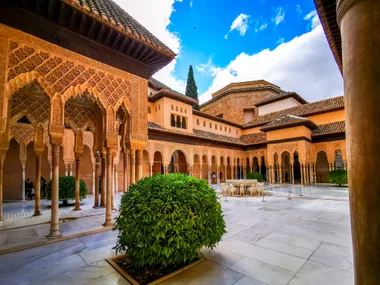
Then comes the Palace of the Lions, which is the peak of the whole experience. The Court of the Lions is the one you've seen in every photo: twelve marble lions holding up a fountain basin in the center of a courtyard surrounded by impossibly slender columns. The proportions are perfect. The carving is delicate to the point of looking fragile.

And about those lions: if you look at them and think "those don't really look like lions," you're not wrong. The craftsmen who carved them had most likely never seen an actual lion. They worked from descriptions and stories, sculpting an animal they knew only by reputation. (No selfies with lions back then.) The result is twelve creatures that are somewhere between a lion, a large dog, and a very confident cat. It's oddly endearing. They've been holding up that fountain for over 600 years, and they still look mildly confused about the whole arrangement.


Off this courtyard, the Hall of the Two Sisters has a muqarnas dome (a honeycomb-like ceiling made of over 5,000 individual carved cells) that is genuinely one of the most stunning things human hands have ever made. Stand in the center of the room and look up. Just look up.


The Generalife is the summer palace and gardens, located on the hillside above the main Alhambra complex. After the intensity of the Nasrid Palaces, it feels like coming up for air. Long water channels lined with fountains, flower beds, cypress alleys, hedge tunnels, and terraced gardens with views over Granada and the mountains beyond. The Patio de la Acequia (Court of the Water Channel) is the centerpiece: a narrow pool with arching water jets lining both sides, surrounded by flowers and archways. It's calm, green, and fragrant in a way that makes you want to sit down and not move for an hour.


The upper gardens are less visited and worth the extra walk. The views from up there, looking back at the Alhambra complex and out across the Darro valley toward the Albaicin, are some of the best you'll get.


The Alcazaba is the oldest part of the complex, a military fortress dating back to the 9th century. It's all stone walls, watchtowers, and defensive architecture. There's less decorative beauty here, but the Torre de la Vela (the watchtower) gives you a 360-degree panorama of Granada, the Sierra Nevada mountains, and the surrounding countryside. On a clear day you can see all the way to the Mediterranean coast. It's also the least crowded part of the complex, which is a bonus.


The Palace of Charles V is the odd one out. Built in the 16th century after the Christian conquest, it's a Renaissance building plopped right in the middle of the Islamic complex. A circular courtyard inside a square exterior. It's architecturally interesting and historically jarring, like someone put Candy Shop on the soundtrack of Gladiator. Inside, it houses the Alhambra Museum and the Fine Arts Museum of Granada, both free with your ticket. The Alhambra Museum in particular is worth a stop: it has original artifacts, carvings, and tiles from the palace that give you context for everything you just saw.

The corners most people walk past. The Partal area, east of the Nasrid Palaces, has the Torre de las Damas reflected in a small pool, with gardens sloping down toward the city. It's one of the most photogenic spots in the entire complex and somehow never crowded. The Bath of the Comares (Bano de Comares), beneath the Comares Palace, is a beautifully preserved Arab bathhouse with star-shaped skylights in the ceiling. It's easy to miss because it's below the main floor, but peek down and you'll see one of the most atmospheric rooms in the Alhambra.


Insider Tips
Get a guide. I normally don't recommend guided tours. I prefer wandering at my own pace, reading up on things myself, doing my own thing. But the Alhambra is one of those places where a good guide transforms the visit from "wow, pretty" to "I actually understand what I'm looking at." The symbolism in the carvings, the history of individual rooms, why certain courtyards face the direction they do: none of that is obvious from the plaques on the wall. As I mentioned above, my guided tour happened by accident and it was the best thing that could have happened. I came out understanding the Alhambra in a way I never would have from just reading signs. If a small-group tour is available when you book, take it.
Photography. The Nasrid Palaces are an absolute playground for photography, but the light changes everything. Early morning gives you soft, warm tones and empty rooms. Midday light is harsh and flat. Late afternoon brings golden warmth through the western windows. The Court of the Myrtles reflection works best in calm conditions with angled light. The Court of the Lions photographs beautifully at almost any time. And the muqarnas dome in the Hall of the Two Sisters? Point your camera straight up from the center of the room. You'll know the shot when you see it.
Tripods are generally not allowed inside the Nasrid Palaces, so steady hands or image stabilization is your friend. The gardens are more relaxed about gear.
Pace yourself. Slow down in the palaces. Sit on a bench. Look at the details. The carvings that look identical from five meters away are actually all different when you get close. Every archway frames a specific view that was designed centuries ago. You're not just looking at decoration, you're standing inside a building that was meant to be a physical representation of paradise. Give it the time it deserves. If you book a guided tour, check the duration. A 2-hour tour is meh at best.
Shoes matter. You'll walk a lot, on stone, gravel, and garden paths. Wear comfortable walking shoes. Heels and flip-flops are a recipe for suffering.
Bring water and sun protection. Especially in summer. Large parts of the complex (the Alcazaba in particular) are fully exposed to the sun, and shade is limited. The gardens have more cover, but the walk between areas can be hot.
Suggested order (if your Nasrid Palaces time slot allows): Start with the Alcazaba early, when it's cool and quiet. Climb the Torre de la Vela for the panoramic views. Then hit the Nasrid Palaces at your assigned time. This is the emotional peak, so you want fresh eyes and full energy. After the palaces, walk through the Partal area and then head to the Generalife gardens for a calm wind-down. Finish with the Palace of Charles V and its museums if you still have steam.
The free stuff. The Alhambra Museum and the Fine Arts Museum inside the Palace of Charles V are both free, even without an Alhambra ticket. If tickets to the Nasrid Palaces are sold out, you can still visit the gardens, the Alcazaba, and these museums on a reduced ticket. It's not the full experience, but it's not nothing either.
Beyond the Walls
The Alhambra doesn't exist in a vacuum. Granada itself is a fantastic city, and some of the best Alhambra-adjacent experiences happen outside the complex.
Mirador de San Nicolas. This is the viewpoint. The one from every postcard, every travel show, every "Granada sunset" Instagram post. The Alhambra complex in the foreground, the Sierra Nevada mountains behind, and the sky doing whatever dramatic thing it feels like that evening. Go at sunset. Get there 30 to 45 minutes early because everyone else has the same idea, and the good spots fill up fast. Buskers play some stuff I don't like. People sit on the wall with their feet dangling. The light turns the Alhambra golden and then pink and then deep orange.
The Albaicin. The old Moorish quarter, a UNESCO World Heritage Site on the hill facing the Alhambra. It's a labyrinth of narrow, winding streets, white walls, hidden courtyards, and tiny squares with fountains. The best way to experience it is to get lost, and I mean that literally. Put the phone away and just walk. You'll stumble into corners that feel like they haven't changed in 500 years. The Albaicin is also full of carmenes (traditional houses with enclosed gardens) and small plazas where locals hang out in the evening. The walk from the Albaicin down to the Darro river along the Paseo de los Tristes, with the Alhambra looming above, is one of the most beautiful urban walks in Spain.


Sacromonte. The neighborhood above the Albaicin, built into caves carved from the hillside. This is the traditional home of Granada's Roma community and the birthplace of Granada-style flamenco. The cave flamenco shows (zambras) here are raw, intimate, and intense. Much smaller and more authentic than the big tourist tablaos in the city center. If you're going to see flamenco anywhere in Spain, a cave in Sacromonte is a pretty good place to do it.
Tapas. Granada is one of the last cities in Spain where you still get a free tapa with every drink. Not a sad little bowl of olives, either. Actual food: a plate of croquetas, a slice of tortilla, a mini portion of whatever the kitchen just made. Start around Calle Navas or Plaza Nueva and just bar-hop. Three or four drinks and their tapas is dinner.

The tea houses on Calle Calderia Nueva. This narrow street in the Albaicin is lined with Moroccan-style teterias (tea houses) serving mint tea, pastries, and hookah in cushioned, lantern-lit rooms. It's a reminder that North Africa is closer to Granada than Madrid is, both geographically and culturally.
Published April 2026.