This page is a seed in the digital garden. It will very likely be finished within the next two weeks. Until then, content may change, sections may be incomplete, and some details might still be missing.
Top Things to Do and See in Georgia
Georgia is a country where the best things tend to involve either very old rocks or very good wine. Cave cities carved 3,000 years ago are a day trip from the capital. A monastery complex in a semi-desert cliff has been continuously inhabited for 1,500 years. A turquoise river canyon in the west looks like it belongs in a different climate entirely. Most of these are free or close to it, and several can be combined. This is what is genuinely worth your time.
The prices shown here are meant as a rough guide and can vary over time. While I update exchange rates regularly, local prices are typically refreshed only when I revisit the destination.
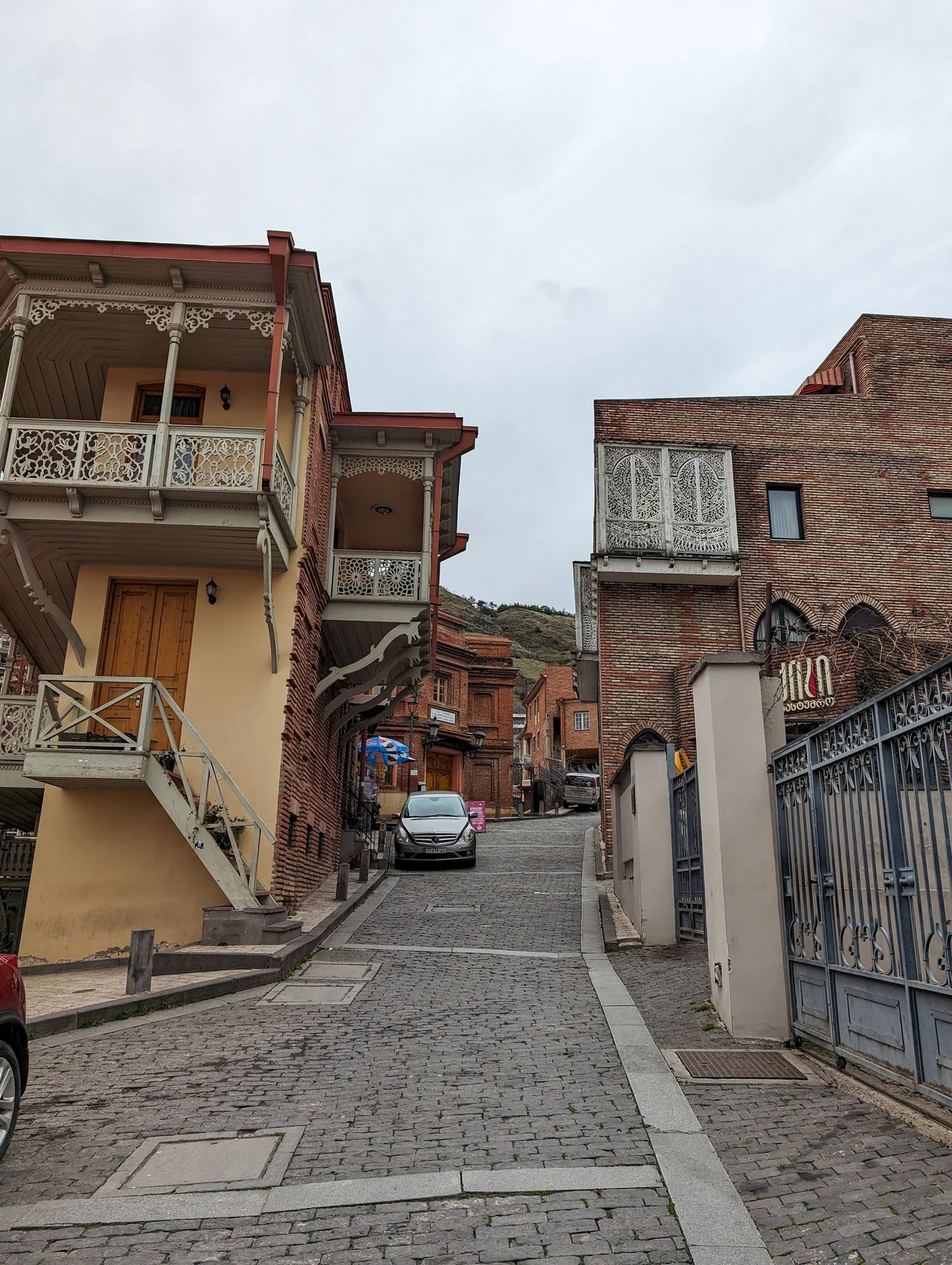
Tbilisi Old Town & Sulfur Baths
The Old Town (Kala district) is where Tbilisi does its best work. Cobblestone streets climb the hills in no particular order, wooden balconies with ornate carved lattice hang out over the lanes, and medieval churches sit on cliffsides that make you wonder how they got them there. The Abanotubani sulfur bath district sits at the base of the cliffs, its brick domes venting steam over the neighborhood. Book a private room at one of the bathhouses and spend an hour in naturally heated, sulfuric spring water in a tiled stone room. It smells exactly like sulfur. Do it anyway. The crooked clock tower of the Rezo Gabriadze Puppet Theater is in this neighborhood too: a deliberately tilted brick tower with a golden angel that appears on the hour and strikes a bell. The Dry Bridge flea market on weekends sells Soviet memorabilia, old cameras, and handmade work. The whole area rewards wandering without a plan. Get lost in it for at least half a day.
How to Get There
The Old Town is walkable from the city center. Take the metro to Avlabari station and walk down toward the river, or start from Freedom Square and walk south. The sulfur baths are a 10-minute walk from Freedom Square.
Notes
- Wear comfortable shoes with grip; the cobblestones are uneven and the hills are steep
- The sulfur baths are in the Abanotubani district, below the Old Town cliffs
- The clock tower angel appears on the hour; arrive a few minutes early and look up
- The Dry Bridge flea market runs Saturday and Sunday mornings
- Evening is when the neighborhood is most atmospheric; the lit cobblestones and wooden facades are worth coming back for
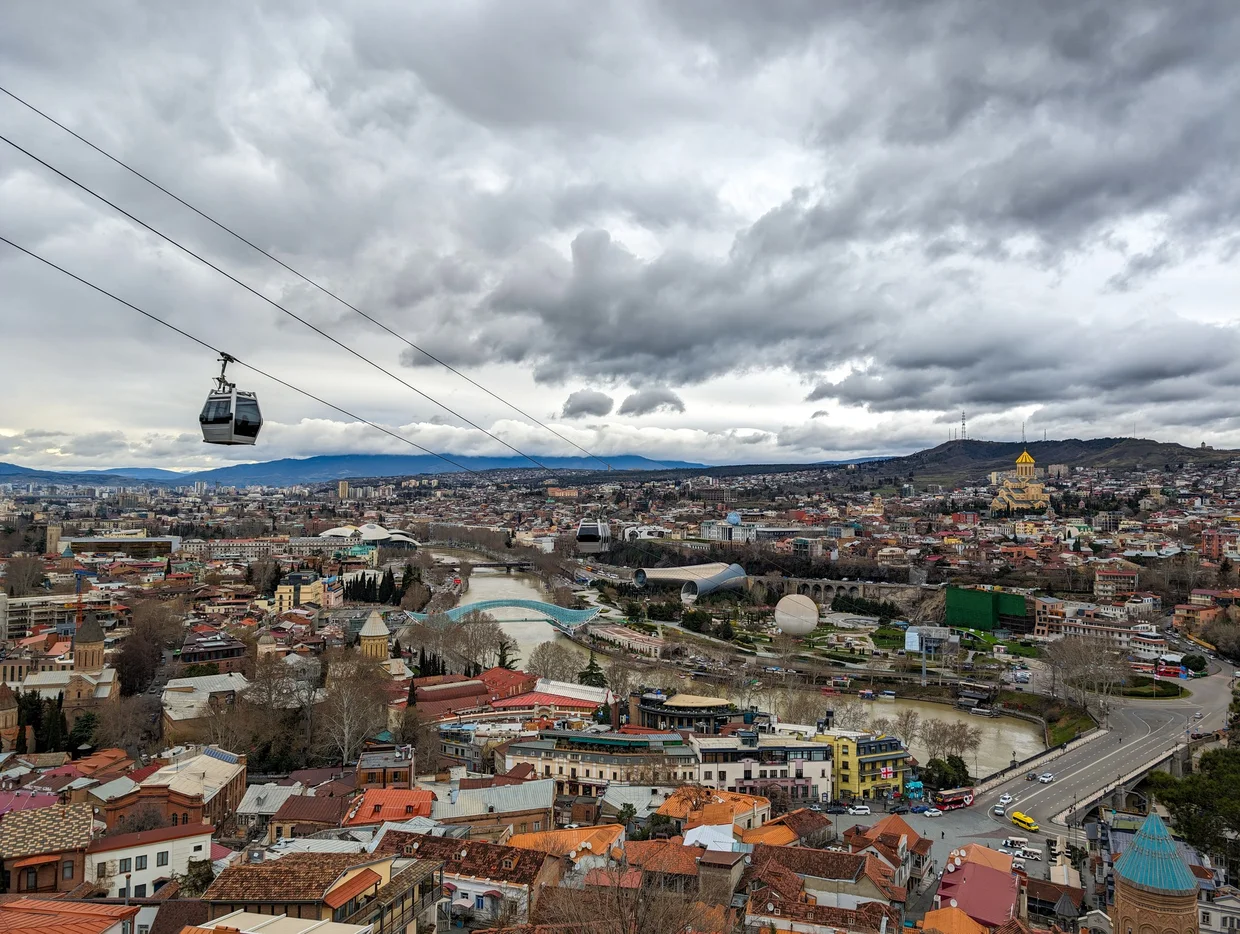
Narikala Fortress & Cable Car
Narikala is the medieval fortress above Tbilisi's Old Town, dating back to the 4th century, with walls that are still standing in large sections along the ridge. The fortress itself is a ruin, which is fine, because what you actually come for is the view. The cable car from Rike Park (the park at the base of the cliff, near the Bridge of Peace) takes you up to the fortress level in a few minutes. From there the whole city spreads below: the Mtkvari river curving through the valley, the glass arc of the Bridge of Peace, the Old Town rooftops, Mtatsminda mountain to the west with its Soviet TV tower, and on clear days the snow-capped Caucasus in the distance. Come at sunset. The city turns gold and then orange and then the lights start coming on across the valley. It is one of the better views in the Caucasus, and the cable car makes it almost too easy.
How to Get There
The cable car departs from Rike Park, a short walk from the Bridge of Peace in central Tbilisi. The park is easily walkable from the Old Town or from Freedom Square.
Notes
- The cable car runs from Rike Park near the Bridge of Peace
- You can also walk up from the Old Town via steep paths if you prefer
- The Mother of Georgia statue (Kartlis Deda) is near the fortress and visible from a distance
- Sunset is the best time; arrive 30-45 minutes before for good light
- The walk along the fortress walls offers multiple viewpoints
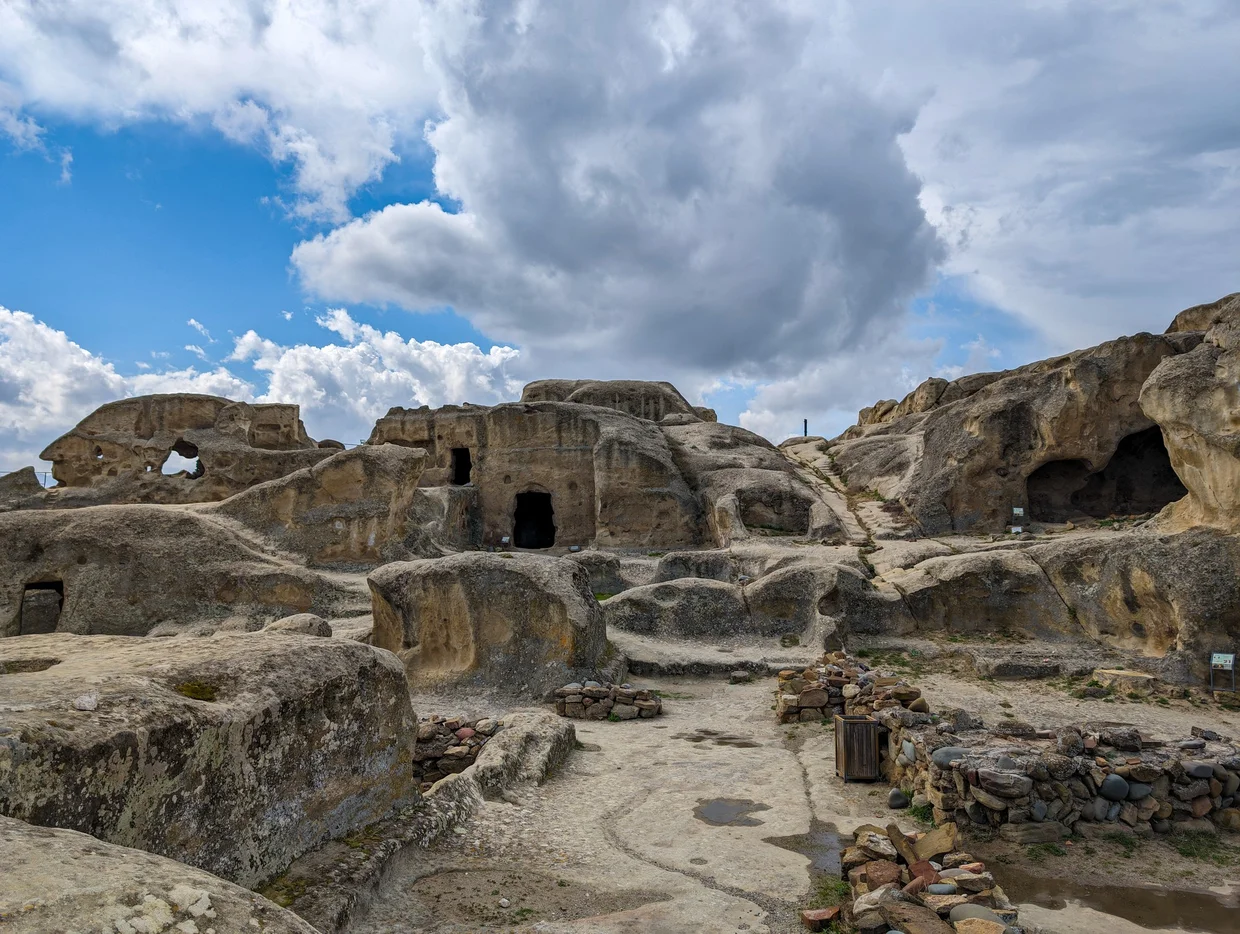
Uplistsikhe Cave City
Uplistsikhe is a rock-hewn city carved directly into a sandstone cliff above the Mtkvari river, about 80 kilometers west of Tbilisi. The place dates back to the early Iron Age, around 1000 BC, and was a major urban center as late as the 13th century. That means an entire city in the rock: streets, multi-room dwellings, a colonnaded hall used as a theater, granaries with carved ceilings, storage rooms, and a church built on top when Christianity arrived. You walk through it on paths cut into the sandstone, ducking into rooms that have been empty for 700 years, looking out through carved windows at the wide river valley below. The underground stairway carved through the interior of the cliff is the detail that gets most people: a passage from one level of the city to another, lit now with warm light, the walls smooth from millennia of use. You emerge on the upper level near the church. In spring, almond trees on the hillside below bloom white against the cliff. The whole scene at that time of year is almost unfairly beautiful.
How to Get There
From Tbilisi, take the marshrutka or train toward Gori (about 1 hour). From Gori, take a taxi or local marshrutka the 15 km to Uplistsikhe. Alternatively, rent a car from Tbilisi and drive directly; the site is about 90 minutes by car, well-signposted.
Notes
- About 15 km east of Gori; easy to combine with the Stalin Museum in Gori (though that is a separate trip)
- The underground stairway and carved tunnel sections require ducking; not suitable for anyone with severe claustrophobia
- Spring (late March to May) is the best time; the almond and cherry blossoms add to an already impressive scene
- Wear shoes with grip; the carved stone paths can be slippery
- Allow 2 hours minimum to see it properly; 3 if you want to take it slow
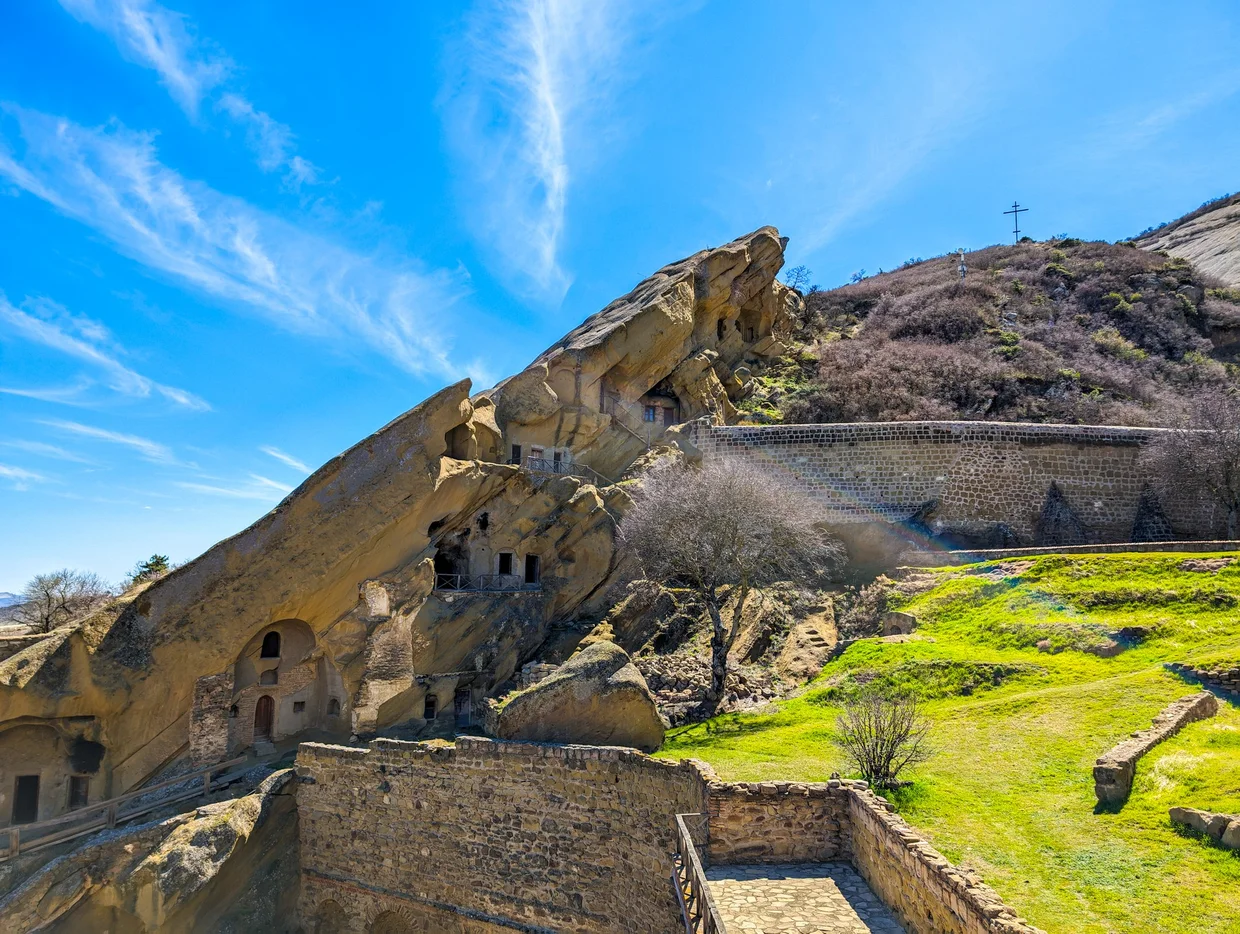
David Gareja Monastery
David Gareja is a monastery complex carved into a semi-desert cliff in southeastern Georgia, near the Azerbaijan border. Monks have been there since the 6th century. The cave cells run up the cliff face in rows like a vertical village, and inside some of them you can still see 9th and 10th century frescoes on the walls. The landscape around the complex is a color palette you would not believe without seeing it: burnt orange and ochre hills, a vast arid plateau stretching out below, and a sky that looks too saturated to be real. The contrast between this landscape and the green mountains of western Georgia is one of the more striking things about the country. Getting there takes effort. It is about two and a half hours from Tbilisi by car, and the last stretch of road is rough. The site sits near the Azerbaijan border, so you stay on the Georgian side of the ridge, but the views from the top down into the Gareja semi-desert are a bonus. Go in the morning before the heat builds. Combine it with a stop at the painted hills viewpoint on the way.
How to Get There
About 70 km southeast of Tbilisi. Rent a car and follow the road toward Sagarejo, then south toward David Gareja. The drive is approximately 2 to 2.5 hours. Organized day tours from Tbilisi also cover this route if you prefer not to drive.
Notes
- Requires a car; public transport options are very limited
- The last stretch of road is unpaved and rough in places; a standard car can manage but go slowly
- Arrive early; the monastery gets hot by midday and the light is better in the morning
- The painted hills viewpoint is about 10 km before the monastery; worth stopping for
- Check current border situation before going; the area near the Azerbaijan border occasionally has restrictions
- Bring water; there is nothing to buy at the site
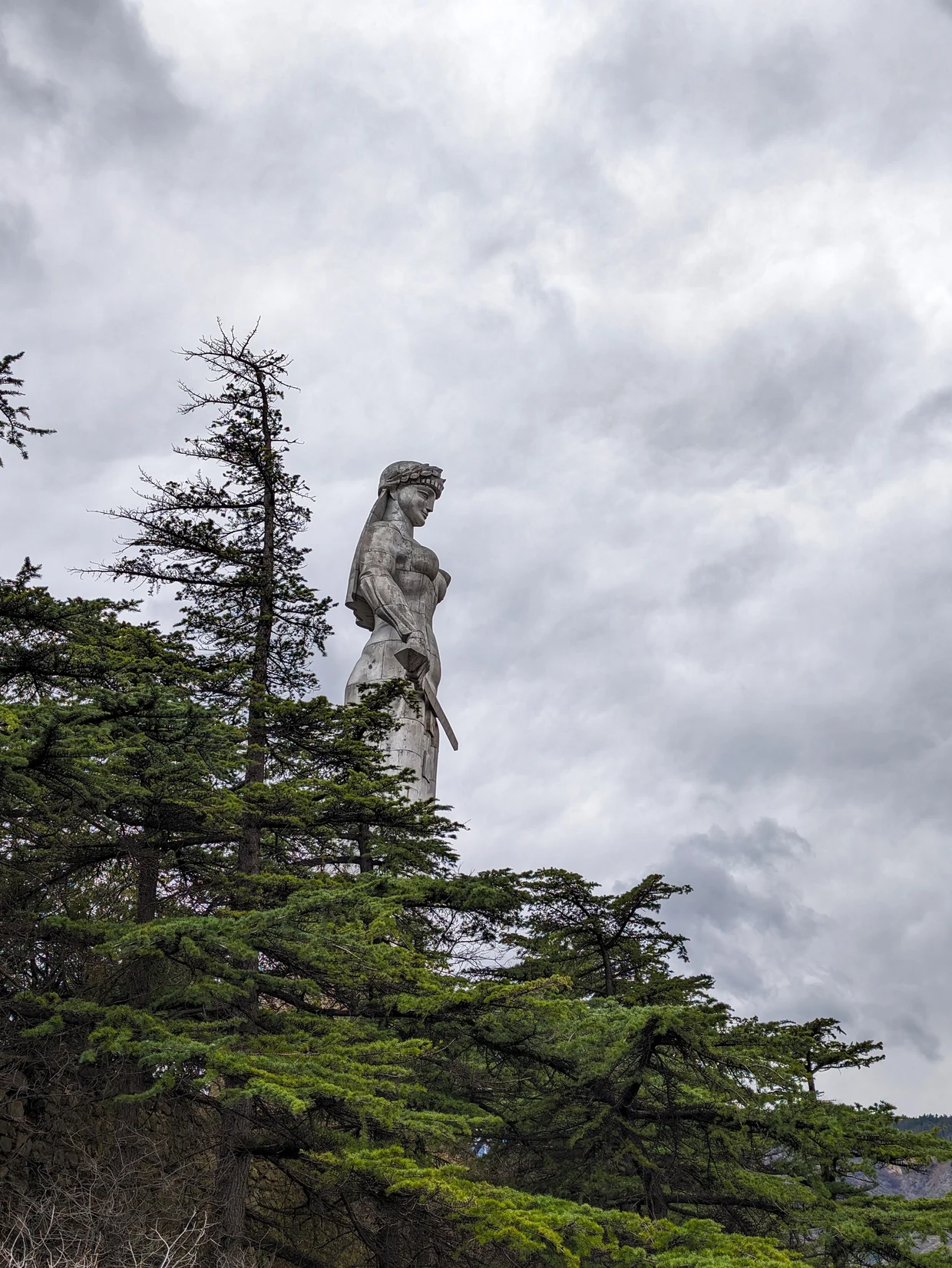
Kartlis Deda (Mother of Georgia)
Kartlis Deda, the Mother of Georgia, is a 20-meter aluminum statue of a woman in traditional Georgian dress standing on the edge of Sololaki hill above the Old Town. She was put up in 1958 for Tbilisi's 1,500th birthday and has watched the city from the same spot ever since. In one hand she holds a bowl of wine, in the other a sword. The symbolism is simple and very Georgian: wine for those who come as friends, a sword for those who come as enemies. Pragmatic, welcoming, and slightly threatening all at once, which turns out to be a reasonable summary of the national character after a few days in the country. The statue sits on the same ridge as Narikala Fortress, a short walk along the path between the two, with the whole of Tbilisi rolling out below. Come up here with the fortress and the cable car as part of a single loop and you cover most of the Old Town's best elevated viewpoints in one go.
How to Get There
Take the cable car from Rike Park up to Narikala Fortress, then follow the ridge path west for a few minutes. The statue is visible from most of Tbilisi's Old Town, so it is hard to miss once you are on the hill.
Notes
- Free and accessible at any time, day or night
- Best combined with Narikala Fortress and the cable car from Rike Park as a single walking loop
- The ridge walk between the fortress and the statue is the scenic part; the statue itself is a 5-minute stop
- Sunset is the best time for light on the city below
- You can also reach it on foot from the Old Town via steep lanes, but the cable car is much easier
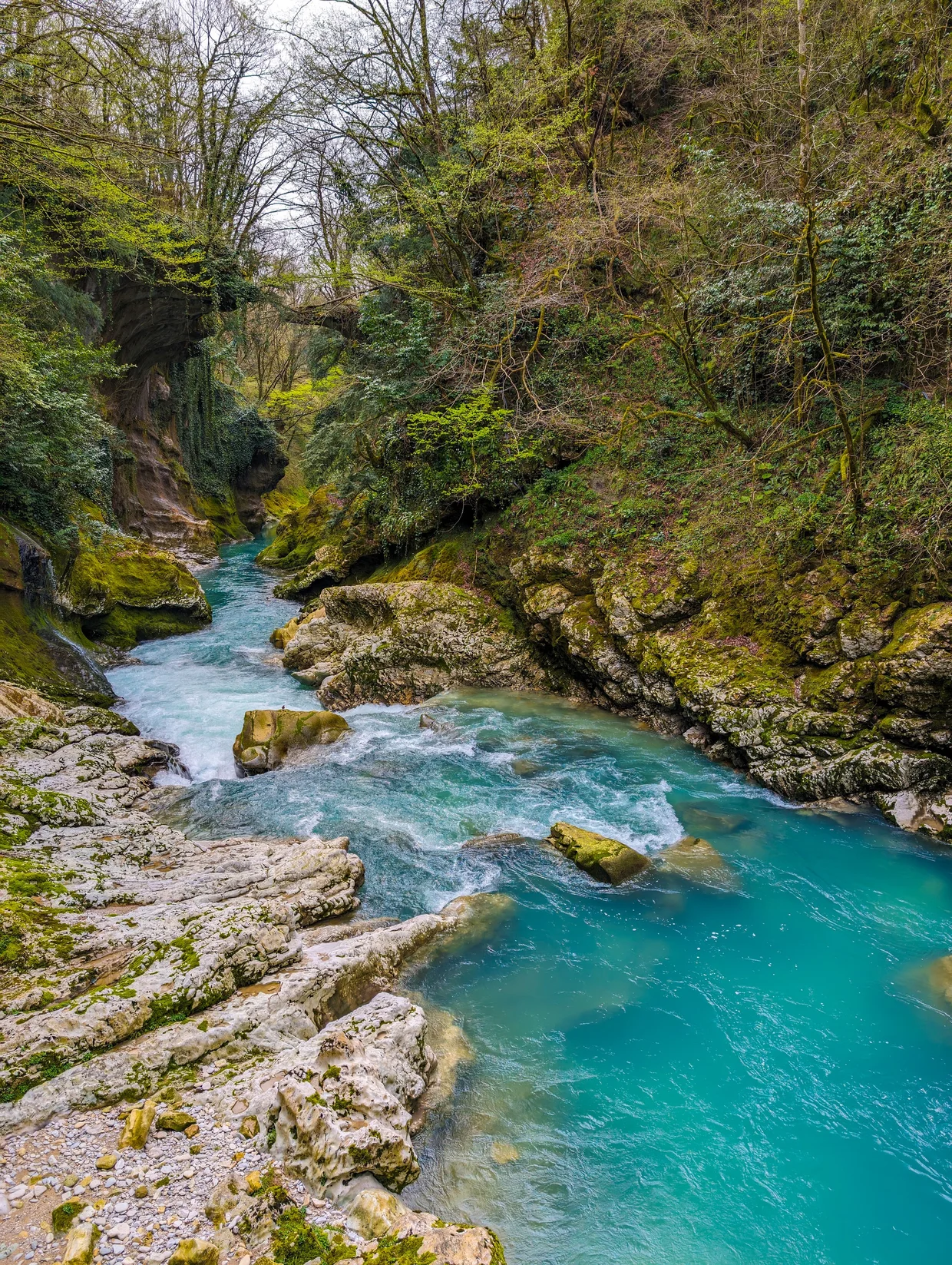
Martvili Canyon
Martvili Canyon is about 40 minutes from Kutaisi and the single best natural attraction in western Georgia. The Abasha river has carved a gorge through the limestone, and the water is a turquoise that looks edited in photos and is even more vivid in person. A trail runs along the top of the canyon with wooden bridges across the gorge, viewpoints over the water, and waterfalls coming in from the sides. You can also take a short motorized boat ride through the narrowest section of the gorge, between tall mossy walls with the water close below. It takes about 15 minutes and is one of those things that sounds touristy and turns out to be genuinely good. The canyon takes two to three hours at a relaxed pace including the boat section. The waterfalls at the entry point are worth stopping for even before you enter the gorge proper.
How to Get There
About 55 km northwest of Kutaisi. Drive or take a taxi from Kutaisi toward Martvili town, then follow signs to the canyon. From Tbilisi, the drive is about 3.5 to 4 hours; best done as part of a multi-day western Georgia trip based in Kutaisi.
Notes
- Boat rides run when enough visitors are present; busy in summer, slower in shoulder season
- The trail can be slippery after rain; waterproof shoes are useful in wet weather
- Combine with Prometheus Cave (about 45 minutes away) for a full day from Kutaisi
- Go in the morning for better light and smaller crowds
- The waterfalls at the entrance are free to view even without entering the canyon
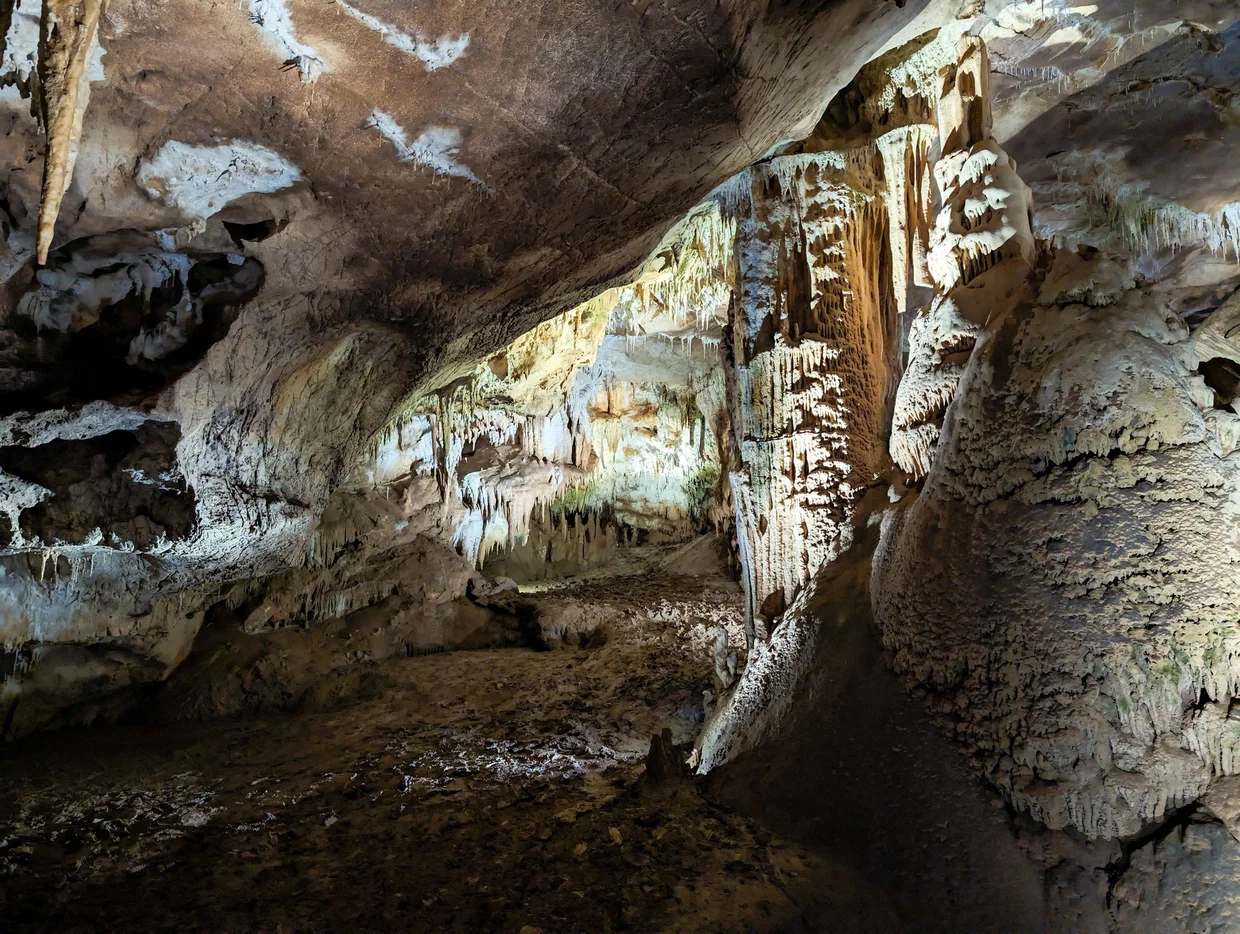
Prometheus Cave
Prometheus Cave is 15 kilometers from Kutaisi and one of the larger show caves in the Caucasus. A guided tour takes you through a series of chambers with stalactites, stalagmites, underground rivers, and crystalline formations that have been building up for hundreds of thousands of years. The tour ends with a boat ride through a flooded cavern, lit with colored lights reflecting off the water above and below. If you are generally skeptical about tourist caves, this one is worth setting that aside for. The scale is real, the formations are genuinely dense, and the boat section is the kind of thing you describe badly to people afterward because words do not quite capture the combination of silence, water, and light. The whole tour takes about an hour.
How to Get There
15 km east of Kutaisi near the village of Kumistavi. Drive or take a taxi from Kutaisi; the journey takes about 20 minutes. Signposted from the main road.
Notes
- The cave temperature is constant at around 14°C year-round; bring a light layer even in summer
- Tours depart every 20-30 minutes with a guide; you cannot enter independently
- Combine with Martvili Canyon for a full day from Kutaisi
- Photography is allowed inside; tripods are not practical on the tour path
- The boat ride is at the end of the circuit; everyone on the tour does it
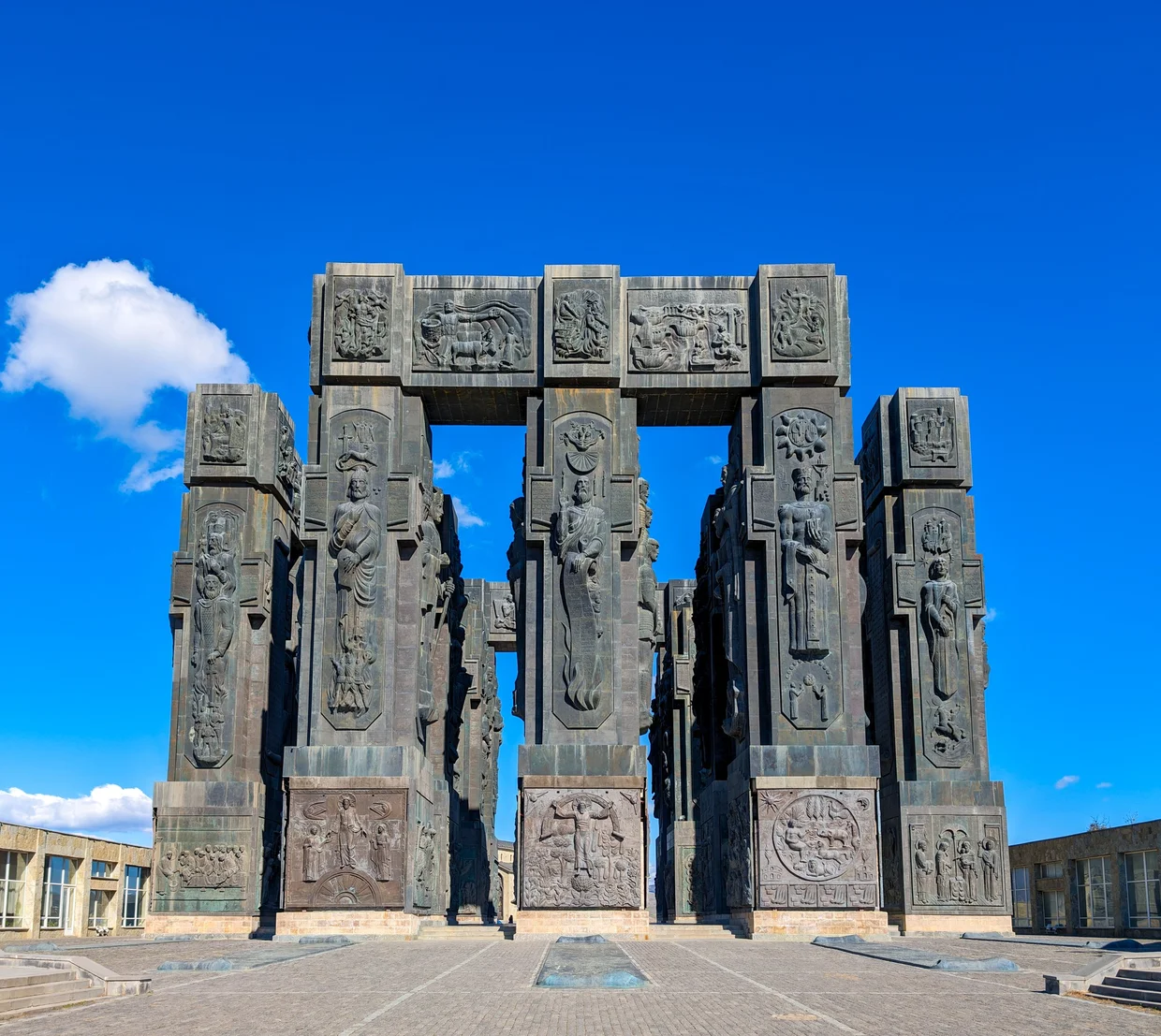
Chronicle of Georgia Monument
The Chronicle of Georgia is a monumental sculpture complex on the shore of the Tbilisi Sea reservoir, about 15 kilometers from the city center. Sixteen massive stone pillars, each around 35 meters tall, carved with reliefs depicting Georgian kings, saints, and historical events, arranged in two rows facing each other. The project was started in 1985 by Georgian sculptor Zurab Tsereteli and was never fully completed, which somehow adds to its character. It is enormous, slightly eccentric, and completely unlike anything else you will encounter on the trip. Standing between the pillars and looking up, you get a proper sense of the scale. From a distance, the complex looks like a stone Stonehenge built by someone who had never seen Stonehenge and had significantly more budget. It pairs well with a drive around the reservoir or a stop at the nearby beach in summer.
How to Get There
About 15 km north of central Tbilisi, near the Tbilisi Sea reservoir. Drive or take a taxi; public transport is limited. The monument is visible from the road and easy to find.
Notes
- Free and always accessible; no entry fee, no gates
- Best visited as a stop on the way to or from somewhere else, rather than the sole reason for a journey
- The drive around Tbilisi Sea is a nice 30-minute loop that can include the monument
- Light is best in the morning or late afternoon; midday sun flattens the carved reliefs
- The site is not well maintained; the surroundings are rough but the monument itself is intact
Published September 2025.