Small Country, A Lot of Green
Slovenia is small. Two million people, a land area you can cross in three or four hours of driving, and a shape on the map that looks like a chicken facing west, depending on how long you stare at it. What the size doesn't tell you is how much the country manages to fit into it. Alps in the north, a short stretch of Adriatic coast in the south-west, karst caves in the middle, vineyards in the east, forest basically everywhere in between. Over half the country's covered in trees, and you feel that the moment you leave any town.
The first thing that hits you is how clean everything is. Streets, rivers, even public bathrooms. Not clean in a sterile, over-polished way, but clean in a way that suggests nobody here is fighting against it. The tap water's good enough to drink even in the remote valleys. The air in Ljubljana smells like a forest because a forest is fifteen minutes away in any direction. You notice it before you even notice the landscape.
The second thing is that it feels safe. Slovenia consistently ranks among the safest countries in the world for solo travellers, and once you're on the ground it's easy to see why. You can walk around Ljubljana at night without thinking about which streets to avoid, because there isn't really a list. Mountain villages leave front doors unlocked in the middle of the day. The usual city-centre pickpocket rules still apply around the train station and in busy tourist spots, but that's about it. For a country sitting at the crossroads of Italy, Austria, Hungary, and Croatia, it's surprisingly relaxed.

What Slovenia is really about, for me, is the nature. The Julian Alps on one side, the Soča River cutting through its own valley, karst caves and gorges in the middle, pine forests that go on for longer than you expect them to. The scale isn't Alpine-huge in the way Switzerland is, but the density is unusual. You drive an hour in any direction and the scenery's completely changed.


The country is also easy. Roads are in good shape, signage is clear, English is widely spoken by anyone under forty, the currency is the euro, and the trains and buses actually run. If you've spent any time in the rest of the Balkans, the contrast is obvious. Slovenia feels like an Alpine country on the admin side and a Balkan country on the price side, which is a good combo to end up with.
Ljubljana: A Capital That Feels Like a Town
Ljubljana is the smallest EU capital that feels like a proper capital. Around 290,000 people, a compact old centre, a castle on a hill, a river running through the middle lined with cafés and willow trees. The whole thing can be walked in a morning, which is part of the charm and part of the point.

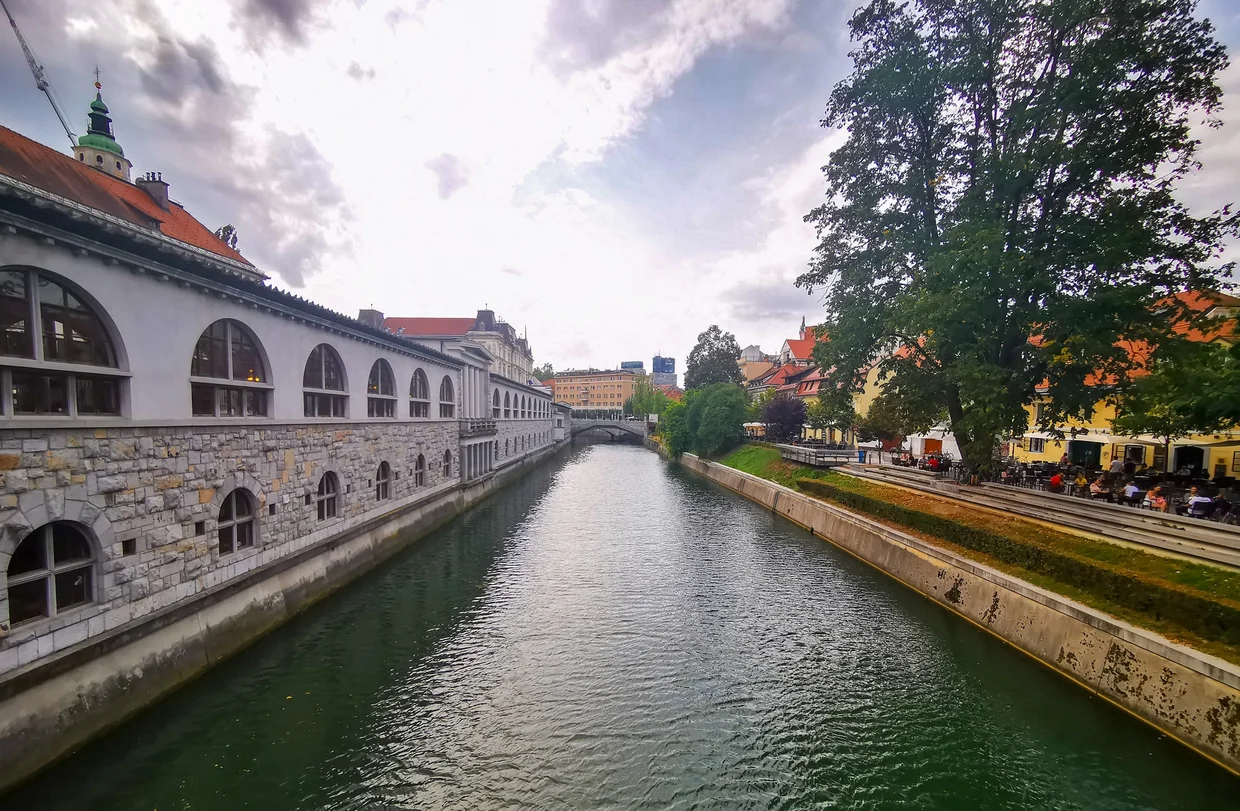
The old town sits on one bank of the Ljubljanica river, the castle hill behind it, the newer parts of the city on the other side. The two are connected by a set of bridges, including the Triple Bridge and the Dragon Bridge, both designed by or around the work of Jože Plečnik, the architect who spent most of the 20th century shaping the city with a series of quiet touches: arcades, river embankments, a library, a covered market. His work isn't loud, but once you notice it you start spotting it everywhere.


Ljubljana Castle sits on a low hill right above the old town. You can walk up (twenty minutes through a shaded path) or take the funicular from the base. The grounds are free, the tower and museum sections are ticketed, and the view from the ramparts gives you most of the city in one frame with the Kamnik Alps in the distance on a clear day.


Down by the river, the Plečnik market arcades run along the embankment next to the open-air stalls. Saturday is the big day, when the farmers come in from the countryside and the whole stretch turns into a slow-moving food market. Cheese, honey, fruit, bread, wine, dried sausage. You can put together a picnic here for very little and eat it on the embankment twenty metres away.

Metelkova is the other side of the city's personality. A former Yugoslav army barracks that got squatted in the early 90s and turned into an alternative cultural centre, it's now a small block of buildings covered floor to roof in graffiti, sculptures welded out of scrap metal, and painted murals. During the day it's quiet and a little strange. At night it turns into one of the main alternative nightlife spots in the city. If you want something further from the postcard-pretty old town, this is the easiest place to find it.
Ljubljana works best as a slow city. A morning walk along the river, a long coffee on Prešeren Square, a stroll up to the castle, a wander through the market, dinner at one of the restaurants along the embankment. You don't need more than a day and a half to see the highlights, but the city rewards you for staying longer and going slower.

Destination Info
Quick Facts
Overview
- Best 7 to 10 days in May till September.
- At 295m in Central Europe, time zone UTC+1 (UTC+2 DST).
- The population of 2.1M people speaks Slovene, writes in Latin script.
- Euro (EUR) is the official currency, and tipping is 10% optional.
Local Flavor
- Get a Teran wine and Štruklji.
- The main festival here is Ljubljana Festival (summer), and popular sports include Skiing, football, basketball.
Practicalities
- You can use Buses, trains for public transportation, while driving on the right.
- You can get here mostly via Ljubljana Jože Pučnik (LJU).
- The best area to stay is Ljubljana.
The Julian Alps
The northwest of the country is dominated by the Julian Alps, a limestone range that crosses into Italy on one side and holds Triglav National Park, Slovenia's only national park, on the other. Triglav is the name of the highest peak in the range (2,864 metres) and it shows up on the Slovenian flag. You don't have to climb it to get a feel for the range. Most of the best scenery is accessible from the valleys and the roads that run through them.


The Vršič Pass is the iconic drive. Fifty hairpin bends zig-zagging up and over the range, connecting the Upper Sava valley near Kranjska Gora on the north side to the Soča valley at Trenta on the south side. The pass itself tops out just over 1,600 metres. In summer the road is open to cars, motorbikes, and a steady stream of cyclists who are clearly fitter than the rest of us. Each hairpin is numbered, there are small pull-offs for photos, and the views on both sides are as good as anything the Alps have to offer at this altitude. The pass is closed in winter because of snow.
One small warning: the pass gets slow, but not for the reason you'd expect. It's not that the road is busy. It's that a surprising number of drivers in front of you have clearly never taken a hairpin in their lives. They brake in the middle of the turn, hesitate on the straight, brake again, and the queue behind them grows. You can end up being overtaken by snails. If you like driving mountain roads, pick a weekday morning and hope the car in front of you knows what a second gear is for.


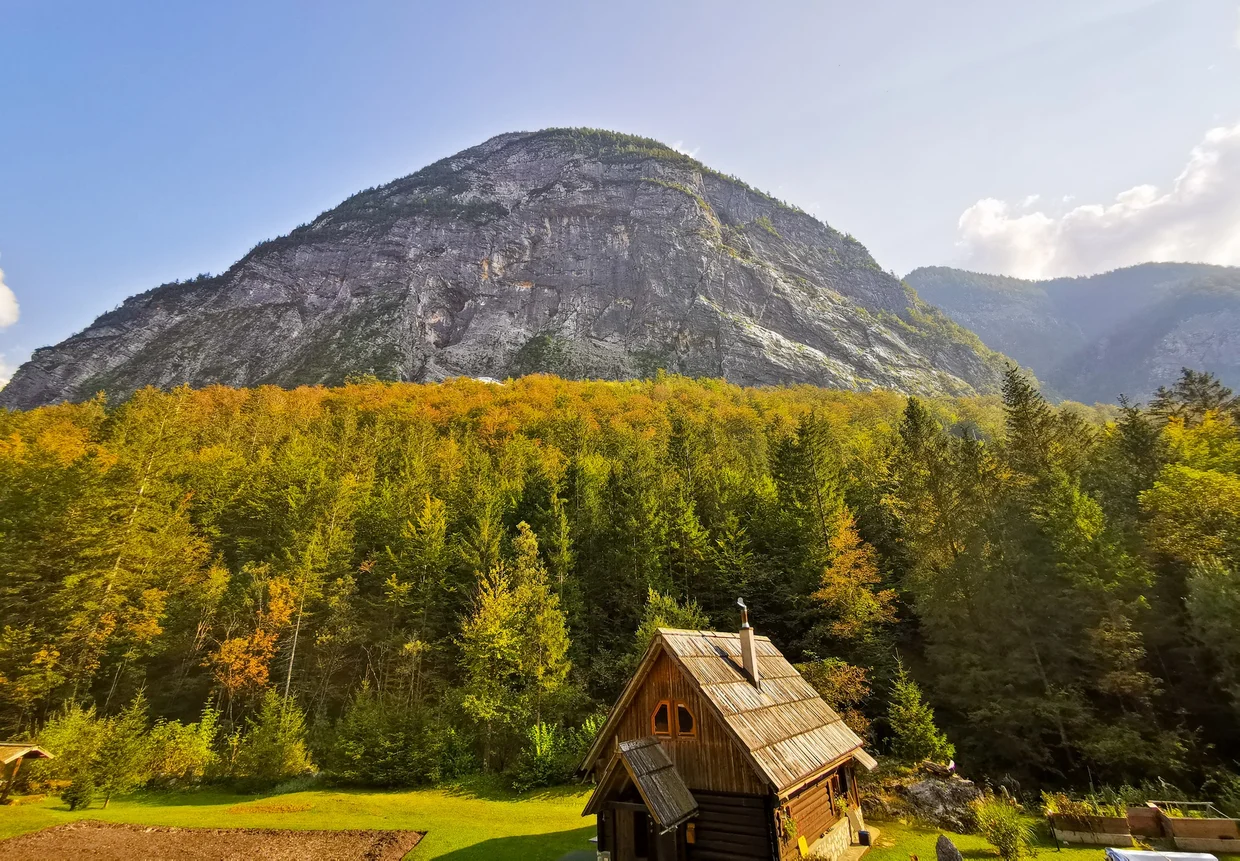
Bohinj is Slovenia's quieter lake. Larger than Bled, a longer drive from Ljubljana, and sitting inside the national park rather than next to it, Bohinj is the place people suggest once they find out you've seen Bled and weren't entirely convinced. The water's clearer, the surrounding mountains are higher, the mood is calmer, and the summer crowds are a fraction of what you'll find an hour down the road. A short hike from the lake takes you to the Savica waterfall, one of the river sources that feeds into the lake. A cable car from the eastern end goes up to Vogel, a ski area in winter and a high viewpoint in summer, looking back over the whole basin.
For hiking, the main thing to know is that the trail network is good, the huts work well and are cheap, the weather changes faster than you think, and you should never start a mountain walk without checking the forecast. Afternoon thunderstorms are normal in summer. Get an early start, aim to be off exposed ridges by midday, and the Alps will reward you for the effort.
Lake Bled and Vintgar Gorge
Two things sit together on most Slovenia itineraries: Lake Bled and Vintgar Gorge. They're a ten minute drive apart, they get packed with day trips from Ljubljana in summer, and they give you very different versions of the same general area. I'll get the critical thing out of the way first and the pretty thing second.
Lake Bled was, for me, a bit of a disappointment. I'll put that gently, because Bled isn't a bad place. It's a glacial lake with an island in the middle, a small baroque church on the island, a cliff-top castle on one side, and green forested hills all around. Seen from ground level on a grey day, which is what I got, it looks like a medium-sized lake with a church in the middle and a car park on the edge.

I walked around it, I took the standard photo, and I left feeling it had been oversold. The internet version of Bled, the drone shots with morning mist and perfect reflection, is a lot better than the in-person version you get if the weather and the light don't cooperate. Maybe a clearer day would've fixed it. It's fine, it's nice, it's definitely worth a quick stop if you're already in the area, but I wouldn't build a trip around it and I wouldn't tell you to drive three hours out of your way for it. Set your expectations a bit lower than the Instagram feed, and you'll enjoy it more.
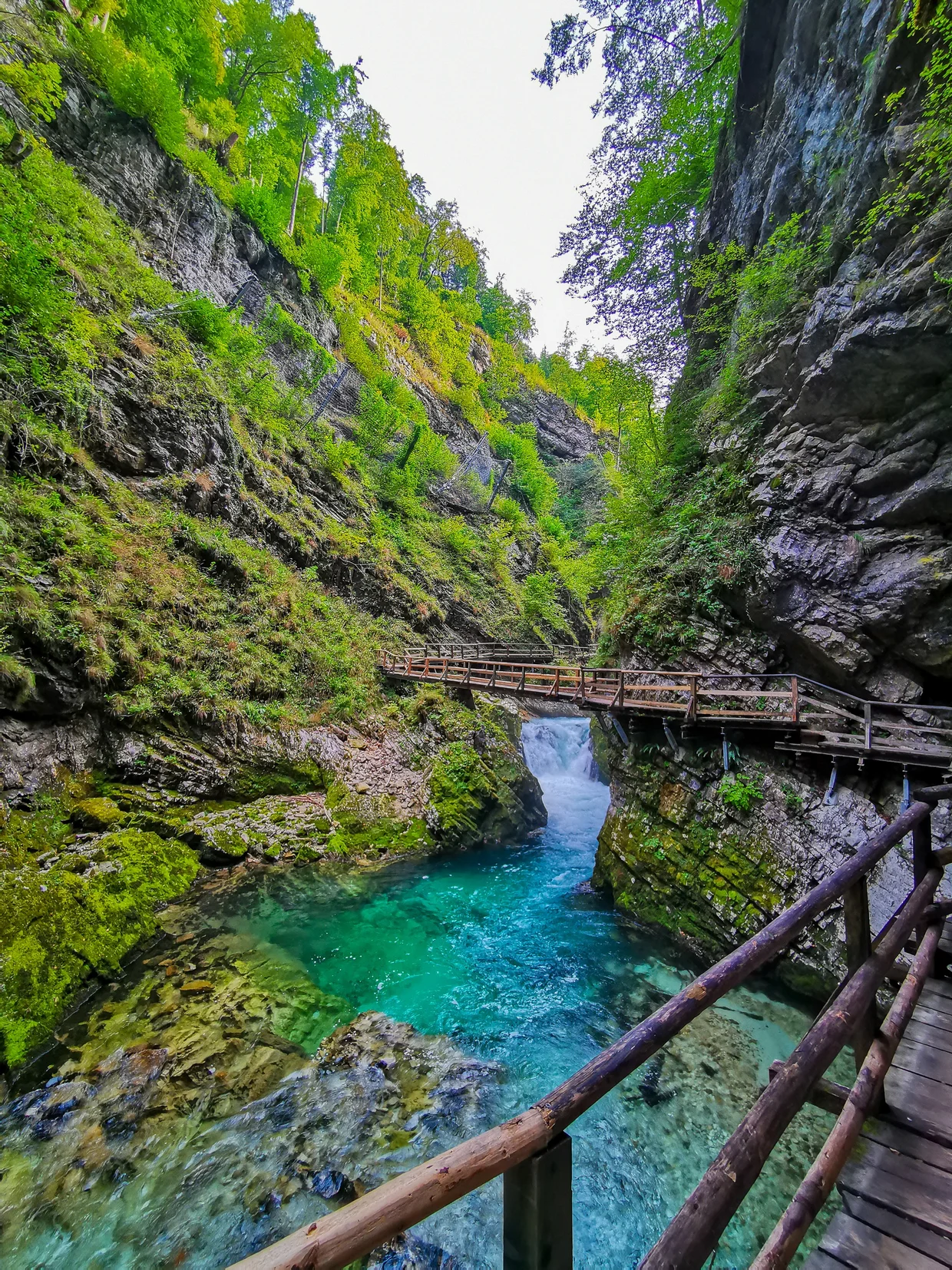

Vintgar Gorge, on the other hand, is the one I'd tell you to build a half-day around. The Radovna river has cut a narrow limestone gorge about 1.6 kilometres long, and a wooden boardwalk runs along the side of it, sometimes hugging the cliff and sometimes bridging over the water from one bank to the other. The water's the turquoise that looks edited in photos and is still the turquoise in person. The cliffs are covered in moss, the spray comes up off the rapids, and the whole path ends at a small waterfall at the far end.


You have to book a timed entry ticket in summer. They brought in the system a few years ago after the gorge got badly overcrowded, and it's made the experience noticeably better. Go early in the morning for the best light and the fewest people. The trail is flat, easy, and one-way for most of the length. You come out at the end near the waterfall and walk back to the entrance along a forest path that loops around.


If you've only got time for one of the two, pick Vintgar. If you've got time for both, do Vintgar first, drive over to Bled for lunch and a slow walk around the shore, and keep your expectations in check.
Best Base
Where to Stay
Ljubljana
Ljubljana is the logical anchor for a first Slovenia trip. The city itself is small, walkable, and pleasant, with a compact old town along the river, a castle on a hill, and a full range of accommodation from boutique hotels to hostels to short-term apartments. It also sits in the middle of the country geographically, which makes it the easiest base for day trips to Bled, Vintgar, Postojna, Predjama, and Škocjan, all of which are within an hour or so by car or bus. The old town and the embankment are where you want to stay: car-free, lively in the evenings, and surrounded by restaurants and cafés. The area around the train and bus station is fine too, cheaper, and convenient if you are arriving by public transport. You will walk most places. Anywhere within 15 minutes of Prešeren Square is a good pick.
The Soča Valley
If the Alps are the headline, the Soča River is the subheadline that the headline is jealous of. The Soča runs out of the Julian Alps on the west side and cuts a long valley south through the town of Bovec and down toward the Italian border. The colour of the water is hard to describe without sounding like a travel brochure, so the short version is: a pale, bright, slightly unreal turquoise, caused by fine limestone particles in the glacial meltwater, and it holds that colour for kilometres.


The valley is the centre of outdoor sports in the country. Whitewater rafting, kayaking, canyoning, zip lines, via ferrata, hiking, road cycling, and fly fishing are all happening along this one river in summer. You can book most of them on the day with operators in Bovec or Kobarid. The rafting season runs roughly from April through September depending on water levels.

Kobarid (Caporetto in Italian) is the historical stop in the valley. The battles of the Isonzo Front in World War I were fought in these mountains, and the Kobarid Museum is one of the better small war museums in Europe, which sounds like a low bar until you go in. The displays are clear, the maps are excellent, and the stories are the kind that stay with you. Upstream from the town, a short walk leads to the Kozjak waterfall, which drops into a cave-like amphitheatre and is one of the more striking single waterfalls in the country.
The best way to see the valley is by car. Start at the Soča River Viewpoint in the far northwest, up near the source below Vršič, then just follow the river south. You'll spot endless excuses to pull over: signposted walking paths (the ones around Trenta are the easy win, short loops that drop you straight down to the water, but they are more to the east), small parkings along the road, footbridges, and side tracks into the forest. Stop wherever a pull-off looks promising, walk ten minutes toward the sound of water, and the odds of finding something photogenic are high. Drift down toward Bovec and Tolmin at whatever pace the stops dictate.
What to Do
There are many things to experience, to see and to do in Slovenia. These are my personal highlights.

Vintgar Gorge

Soča Valley

Ljubljana Castle
See the full what to do in Slovenia guide.
Karst, Caves, and Cliffside Castles
The central band of Slovenia is karst country: limestone plateau, underground rivers, sinkholes, and a cave system that gave the word "karst" to the rest of the world. The name comes from the Kras region, just inland from the coast, and the cave systems here are some of the most developed in Europe.
Postojna Cave is the big one. Over twenty kilometres of passages, stalactites and stalagmites packed tight, and the tourist twist that you ride a small electric train into the cave system for the first couple of kilometres before continuing on foot with a guide. The scale inside is hard to overstate. The main hall is big enough to hold concerts, and it does. The formations are lit, the walkways are good, and the cave stays at a constant 10°C year-round, so bring a jacket even in summer.
Škocjan Caves, about an hour to the south-west, are the other main cave system. They're on the UNESCO list and they're the wilder of the two. The underground river passage is on a different scale: a canyon carved inside the mountain, with a bridge crossing the river at dizzying height and the roar of water below. No tourist train here. You walk the whole thing with a guide. If you only do one cave in Slovenia, I'd pick Škocjan over Postojna, but if you've got time for both, they pair well together and don't really overlap.
Željnske jame, near Kočevje in the southeast, is the opposite experience. It's an unattended cave system, no ticket booth, no train, no guide, just an entrance you walk up to and a torch you hopefully remembered to bring. The going can be challenging in places (uneven ground, low ceilings, water in parts of it), and it's not the right choice if you're looking for a polished tour. The upside is that you'll usually have the whole place to yourself, which is a very different feeling from queueing for the Postojna train.
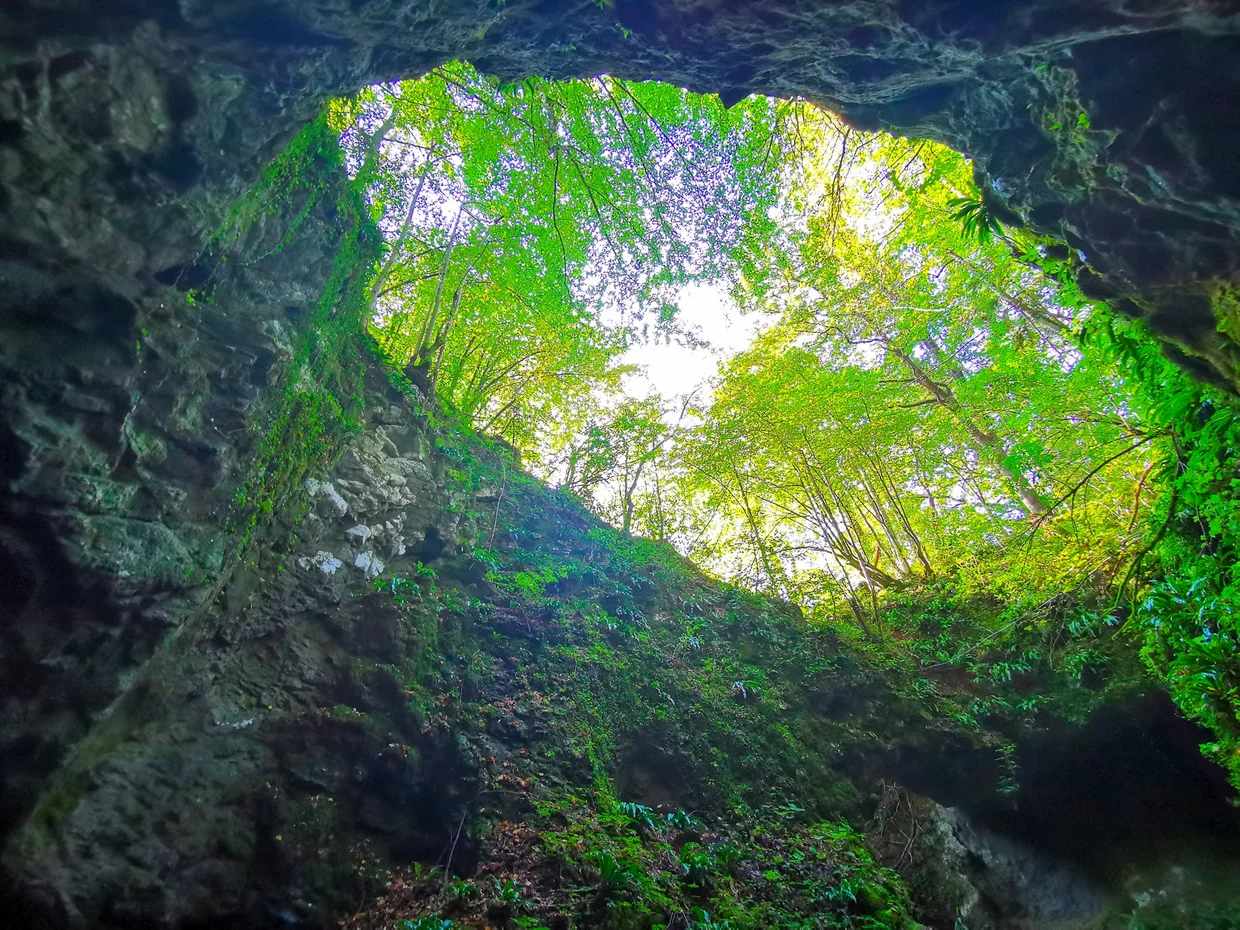


Predjama Castle is about ten minutes from Postojna. A medieval castle built into the mouth of a cliff cave, half stone and half rock, looking like it was carved out of the hillside rather than placed on it. Inside, the rooms extend back into the caves behind the facade. It's one of the most unusual castle settings in Europe, and the drive between Postojna Cave and the castle is short enough that you can combine them into a single morning.

A different kind of stop, worth knowing about: the Krka River valley, east of Ljubljana, runs through a gentle landscape of vineyards and small villages. The river itself has a series of low limestone cascades, a bit like a mini Plitvice, where the water runs over natural dams and pools between them. Quiet, easy to reach, and very different from the Alpine scenery in the north.
One spot worth knowing is the Kaskade na Krki in Dvor. It's not spectacular, so manage expectations, but it's a place to swim, there are a few springboards set up above the pools, and you can even scuba dive if you're keen, though I wouldn't expect anything too exciting under the surface.


Piran and the Coast
Slovenia has 47 kilometres of coast. That's not a typo. Forty-seven. Squeezed between Italy and Croatia on the Istrian peninsula, the country has the shortest coastline of almost any coastal country, and most of it is packed into four small towns. The best of them, by a clear margin, is Piran.

Piran is a Venetian-era fishing town that sticks out on a narrow peninsula, with a tight network of stone alleys, a main square (Tartini Square) surrounded by pastel buildings, and a hilltop church (St George's) with a bell tower you can climb. The Venetian influence is everywhere: the architecture, the layout, the red tiled roofs, the way the streets squeeze between tall walls and open suddenly onto small piazzas. If you've been to Venice or to any Croatian coastal town, you already know what to expect.


What makes Piran good is the scale. The old town is tiny. You can walk across it in fifteen minutes. The best thing to do is to get lost in the alleys, climb up to the church for the view, and eat at one of the seafood restaurants along the waterfront at lunch. Italian is still widely spoken here (Piran is officially bilingual Slovenian-Italian), and the food leans more Italian than Slovenian on most menus.


The other coastal towns (Izola, Koper, Portorož) are less interesting for short visits. Portorož is the resort town, with big hotels and a long beach. Izola is a small working fishing town. Koper is the main port. Of the four, Piran is the one that's worth a longer stop. A night or two here, outside the day-tripper hours, is one of the better slow moments you can have on a Slovenia trip.
Food
Slovenian food sits at a crossroads. The Italian side of the country pushes the cuisine toward pasta, risotto, olive oil, and cured ham. The Austrian side pushes it toward dumplings, stews, sausages, and pastries. The Hungarian side (in the far east) pushes it toward paprika and goulash. Locals eat all of it and call all of it Slovenian, which in a way is accurate.
The two dishes you'll see on almost every traditional menu are štruklji and kranjska klobasa. Štruklji are rolled dumplings, usually boiled, with fillings that range from cottage cheese to walnuts to tarragon. They come as a savoury side dish or a sweet dessert depending on the filling. Kranjska klobasa is the Carniolan sausage, a lightly smoked pork sausage with a protected geographical status, usually served with sauerkraut or mustard. Both are solid, filling, and easy to find.
Potica is the famous cake, a thin rolled dough with a filling (walnut most commonly, also poppy seed, tarragon, or honey) baked into a ring. It turns up at every celebration and is sold in bakeries everywhere.

Burek is the everyday one. A coiled pastry with a filling, baked until the top layers crisp up and the inside stays soft, sold at bakeries and takeaway counters on most streets. You'll see it with meat, cheese, spinach, or apple. It comes with a quiet controversy: a lot of Slovenians don't really see burek as part of proper Slovenian cultural food. It's a Balkan import, Yugoslav-era baggage, and plenty of people will tell you it belongs to Bosnia or further south rather than on a list of national dishes. That's a debate they can have amongst themselves. For me, sirov burek (with cheese/quark) was the best food in the country. Every. Single. Day.
The wine is better than its international reputation suggests, they say. Slovenia has three main wine regions: Primorska (on the Italian side, where Teran from the Karst region is the local specialty), Podravje (east, toward Hungary, best for whites), and Posavje (southeast, where Cviček is the traditional light red). If you're driving through the Goriška Brda hills on the Italian border, the wine-tasting stops along the road are some of the nicer ways to spend an afternoon in the country.
Cafés and bakeries are good everywhere. Coffee culture sits closer to Italian than to Austrian: espresso is the default, served fast, cheap, and well-made.
When to Go
Slovenia has four proper seasons, and the best window depends on what you want to do.
May to September is the main window. The Alps are open, the Soča is at its best, the coast is warm enough to swim from June onwards, and Ljubljana is at its liveliest. July and August are the busiest weeks, especially around Bled, Bohinj, and Piran, and accommodation prices climb. Afternoon thunderstorms are normal in summer in the mountains, so plan hikes for the morning.
May, June, and September are the sweet spot. The crowds are smaller, the landscape is green, and the weather is mostly cooperative. September is particularly good: the summer heat is gone, the mountains are still accessible, and the harvest is happening in the wine regions.
April and October are shoulder seasons. Variable weather, cheaper accommodation, quieter towns. The mountains can still have snow in April and are starting to get cold again by late October. Vintgar, Bled, and the main sights are open but running on reduced schedules.
Winter is ski season. The main resorts (Kranjska Gora, Vogel, Krvavec, Rogla) are smaller than the big Austrian and Italian resorts nearby but noticeably cheaper. Ljubljana in December is at its nicest, with a small and very walkable Christmas market along the river.
Know Before You Go
A few small things that make a trip to Slovenia noticeably smoother. Here are the first four, the full list covers 26.
- 1
It's one of the safest countries in Europe
Slovenia sits near the top of the Global Peace Index year after year. Walking Ljubljana at midnight, hiking alone in the Alps, or leaving a... - 2
Perfect for solo travel
Ljubljana is a compact university town with visible café culture, Piran is walkable end to end, and mountain towns like Bled, Bohinj and... - 3
Tap water is drinkable everywhere
Including mountain huts and remote valleys. A lot of Slovenian tap water comes straight from karst springs with minimal treatment. Bring a... - 4
EU, Schengen and Euro — no surprises
Slovenia has been in the EU since 2004 and adopted the euro in 2007. Borders with Italy, Austria, Hungary and Croatia are open or minimal....
Read the full know before you go Slovenia guide.
Getting Around
A rental car is the easiest way to see the country outside Ljubljana. Roads are in good shape, distances are short, and the places you actually want to get to (Vršič, the Soča valley, the coast, Predjama) aren't well connected by public transport. Fuel is at normal EU prices. You need a vignette (motorway toll sticker) for the highways, and rental cars usually come with one already attached, but check before you drive off.
Public transport is perfectly usable inside Ljubljana and between the main cities. The train network is limited but the buses cover most routes, and the main lines (Ljubljana to Bled, Bohinj, Piran, Maribor) are frequent enough not to need much planning. The Slovenian Railways app and website are in English and take card payments.
Cycling is a serious option for parts of the country. The Parenzana is a converted railway line running from Trieste through Istria toward the Croatian coast, passing through Slovenia on the way. The Soča valley has long-distance routes along the river. The country's flat eastern regions are also easy cycling territory.
Driving etiquette: speed limits are enforced, drivers are generally calm and law-abiding, and the alcohol limit is 0.5. Mountain roads are narrow and sometimes steep but nothing a normal rental car can't handle. Vršič is the exception and worth a dry day and some patience.
Costs
Slovenia is cheaper than Italy or Austria and more expensive than most of the rest of the Western Balkans. It's firmly in the middle of Europe on price: not a bargain destination, not shockingly expensive. The euro makes comparisons easy.
The prices shown here are meant as a rough guide and can vary over time. While I update exchange rates regularly, local prices are typically refreshed only when I revisit the destination.
Tipping is optional. Rounding up the bill or leaving around 10 percent at a restaurant is normal. Nobody chases you out if you don't.
Is Slovenia Safe?
Slovenia is one of the safest countries in Europe, and consistently one of the safest in the world by the Global Peace Index. Violent crime is very low, the political situation is stable, and the country is inside the EU and Schengen area. Walking around Ljubljana at midnight, hiking alone in the mountains, or leaving your bag on a café chair while you order at the bar are all things locals do without thinking about it.
What you actually want to plan for is the mountains, the weather, and a couple of natural hazards that come with a country that's more than half forest.
Solo Travel & Crime
Solo travel in Slovenia is about as easy as it gets in Europe. Ljubljana is a university town with a visible café culture, Piran is walkable end to end, and the mountain towns (Bled, Bohinj, Bovec, Kobarid) are used to solo hikers and cyclists passing through. Women travellers generally report feeling very comfortable here, including at night.
Petty theft exists in the usual places: the Ljubljana train and bus station area, the busier stretches of the old town in summer, and crowded spots around Bled and Vintgar in peak season. A zipped bag or a front pocket handles it. Outside the city centres, theft is uncommon enough that mountain hut culture runs on trust.
Scams barely register. Taxi meters run honestly, prices on menus match what you pay, ATMs work normally, and nobody is going to corner you in the old town with a fake petition. Official taxis in Ljubljana are metered, and Bolt covers most of the city if you'd rather skip the negotiation entirely.
Nightlife in Ljubljana and the coastal towns is relaxed. Metelkova gets lively late but isn't rough. Usual rules about watching your drink apply the same way they do anywhere.
Health & Environment
No special vaccines are required beyond the routine ones. Tap water is drinkable everywhere, including in the remote valleys and mountain huts, and a lot of Slovenian tap water comes directly from karst springs with minimal treatment. Pharmacies (lekarna) are easy to find in every town, well stocked, and the staff in cities almost always speak English. EU citizens can use the EHIC card. Private care in Ljubljana is modern and reasonably priced.
Mountain weather changes faster than it looks. Afternoon thunderstorms are normal in the Julian Alps in summer, and an exposed ridge in a storm is genuinely dangerous. Start early, check the forecast (the ARSO and Meteo.si apps are the local standards), and be off the high ground by early afternoon. Mountain rescue is excellent but expensive if you're not insured, so make sure your travel insurance covers hiking above a given altitude.
Ticks are the one thing that catches people out. Slovenia is forested, and tick-borne encephalitis (TBE) is endemic in parts of the country, especially the east and the lower-altitude forests. Lyme disease is also present. If you're hiking or spending time in meadows and forests between April and October, wear long sleeves, use repellent, and check yourself properly at the end of the day. A TBE vaccine is worth looking into if you're planning serious time in the woods.
Bears live in the southern forests, mainly around Kočevje and the Notranjska region. You almost certainly won't see one, because they avoid people. If you're hiking off the main trails in those areas, make noise and don't leave food near tents.
Driving is straightforward. Roads are in good shape, speed limits are enforced, the motorway network is clean, and the alcohol limit is 0.05 (effectively zero if you plan to drive). The one place to take seriously is Vršič and a few other high passes: hairpins, narrow sections, and in shoulder season the occasional patch of ice in the shade. A dry morning and second gear solve most of it.
Swimming in rivers and lakes is generally fine, but the Soča and other glacier-fed rivers are cold enough to shock you even in July. Cramp risk is real. Stick to designated swimming spots in the deeper pools, don't jump into anything you haven't looked at first, and remember that cave systems and karst sinkholes don't always have railings.
Things You might Need in Slovenia
Before heading to Slovenia, you can of course just wing it. Show up, see what happens, hope electricity is somehow universal.
Or you spend five minutes sorting the basics and avoid solving preventable problems on day one.
Slovenia is easy to travel, but your devices still won't charge themselves, your mobile data won't magically follow you across borders, and "I'll just get it there" tends to happen right when you're tired, hungry, and standing in front of a closed shop.
None of this is dramatic. It's just the small stuff that either works quietly in the background or becomes weirdly annoying at the worst possible moment.
So here are a few things worth setting up before you go.
InFlight Bluetooth
Tours and Tickets for Slovenia
Hotels in Ljubljana
Land with data already working
Set up mobile data before arrival so maps, rides, and messages work the moment you land.
Sort coverage before you need it
Medical costs and trip disruption are easier to handle when you're covered
Skip the rental counter upsell
Zero excess, theft, tires, and windows.
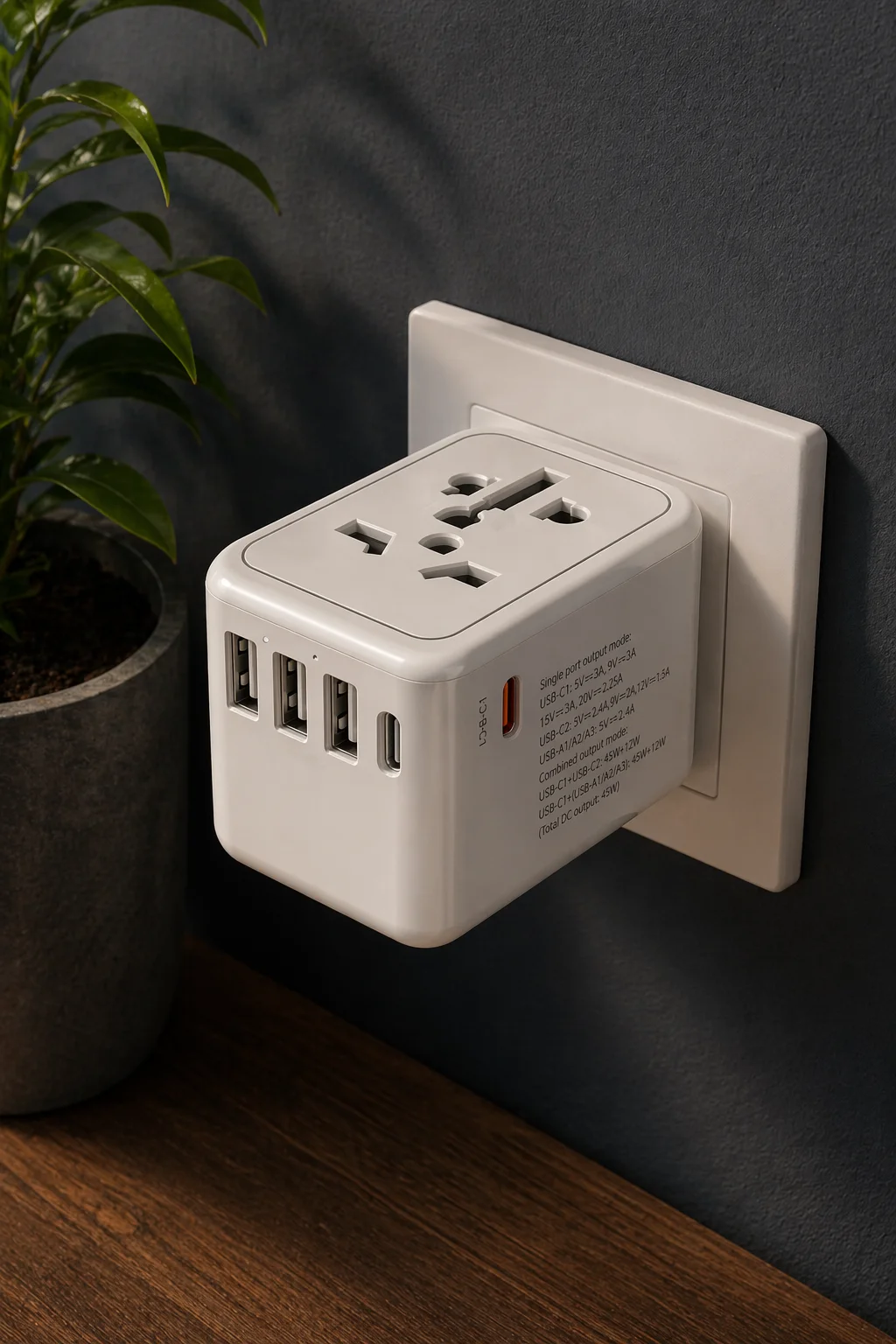
Plug Check
Do you need a plug adapter?
Compare your home plugs with the destination before you pack the wrong little brick.
Published April 2026.