This page is a seed in the digital garden. It will very likely be finished within the next two weeks. Until then, content may change, sections may be incomplete, and some details might still be missing.
Rental Car: When You Need One, When You Don't, and How Not to Get Done
Right, the big question: do you actually need a rental car?
You'll find loads of travel blogs telling you that hire cars are a hassle, a money pit, and totally avoidable. Some of that's true. Most of it isn't. The reality is that for a huge slice of trips, a rental car turns "fine" into "brilliant," and for a smaller slice, it's the only way you'll see the good stuff at all.
This page is the no-nonsense take. When you genuinely need wheels, when you genuinely don't, what to look at when you book, the insurance maze, the scams to spot a mile off, what your credit card actually covers, and whether you need an International Driving Permit (IDP) before you fly. Buckle up.
Do You Really Need One?
Short answer: probably, yeah. Long answer below.
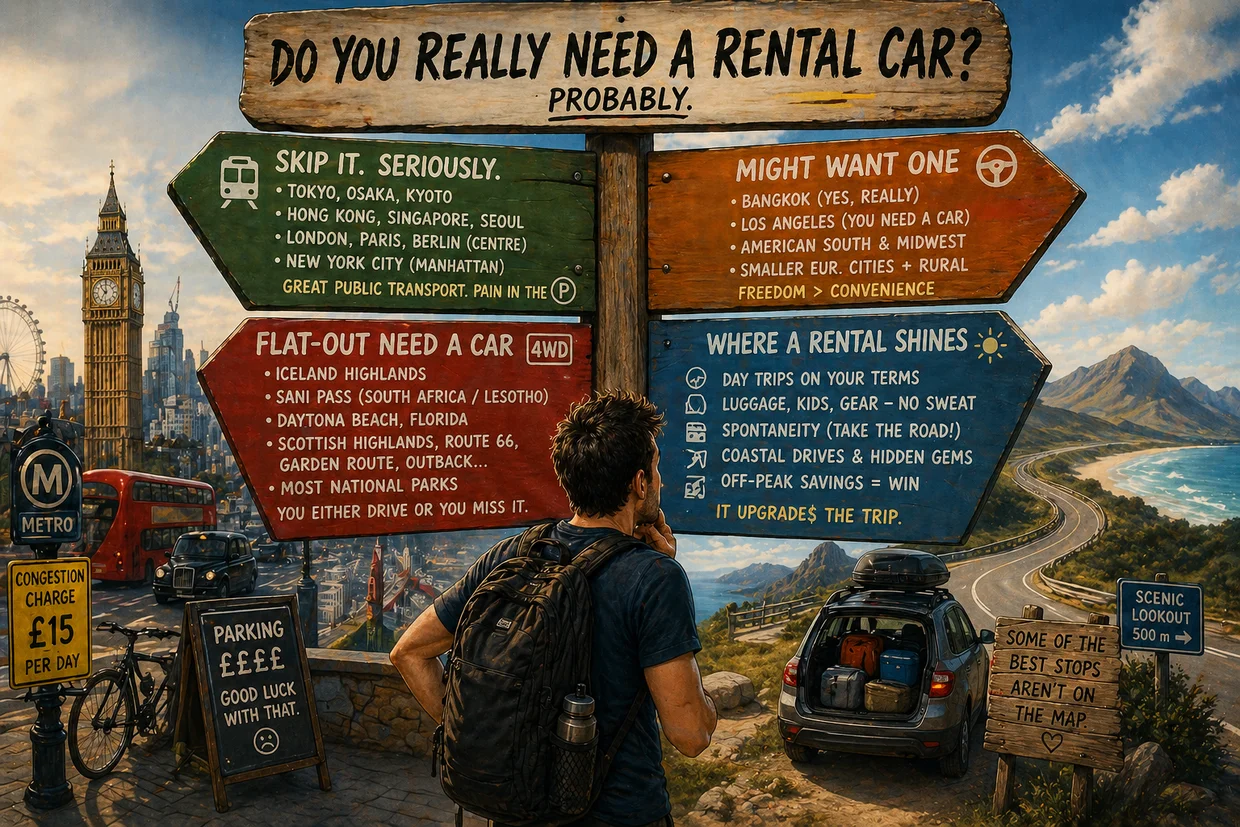
Cities where you can absolutely skip it
Some places, a hire car is a liability. You'll spend more time hunting for parking than actually using the car, and the public transport is so good you'd be silly to bother.
- Tokyo. Trains, metros, and JR run like clockwork. Roads are tight, parking is eye-watering, and rentals require a translation of your licence. Skip it. Same goes for Osaka, Kyoto, and most of urban Japan.
- Hong Kong, Singapore, Seoul. Top-tier transit, dense urban grids. Don't bother.
- London, Paris, Berlin city centre. Public transport solves it. The London congestion charge alone will ruin your morning.
- New York City (Manhattan). Parking starts at "are you joking?" and goes up.
Cities where you might actually want one (against the conventional wisdom)
This is where blogs get it wrong. Big city does not always mean no car.
- Bangkok. Sounds mad, right? But the BTS only covers a fraction of the city, traffic patterns are predictable enough to plan around, and getting between far-flung neighbourhoods or doing day trips out to Ayutthaya, Kanchanaburi, or the coast is genuinely faster and cheaper with your own wheels. Driving in the centre during peak hour is rough, but heaps of expats do it daily and reckon it's the only sane way.
- Los Angeles. Not really a debate, mate. You need a car. The "city" is fifty cities glued together by freeways.
- Most of the American South and Midwest. Public transport ranges from "limited" to "ha, no."
- Smaller European cities with rubbish rural connections. Brilliant trams, but the moment you want to leave town for a day, the bus comes twice a week.
Places where you flat-out need a car
Some destinations are not a debate. You either drive yourself or you miss it.
- Iceland's Highlands. The interior. F-roads. 4WD or nothing, and even then, only in summer. Without a proper rental, you're locked out of the most spectacular bits of the country.
- Sani Pass (between South Africa and Lesotho). A 4WD pass through dramatic switchbacks into the mountain kingdom. You can join a tour, sure, but a hire 4WD with the right border permission is the proper way to do it.
- Daytona Beach and the Florida coastline. Yes, you can drive on the beach. No, you can't do that in an Uber. The whole vibe of South Florida revolves around the car.
- The Scottish Highlands, the Atlantic Road in Norway, Route 66, the Garden Route in South Africa, the South Island of New Zealand, the Outback. No car, no trip.
- Most national parks worldwide. If there's a shuttle, great. If there isn't, a car is your shuttle.
Where a Rental Really Shines
Even when you don't strictly need a car, having one tends to upgrade the trip.
- Day trips. Heaps of destinations have one cracking day trip nearby that's annoying without a car. Train schedules don't match your sleep-in. Buses skip the cool stop. With a rental, you leave when you want, eat where you want, and turn back when you're knackered.
- Luggage and gear. Hauling two suitcases, a kid, a stroller, and a bag of duty-free booze across three trains and a tram is a special kind of cardio. Boot, bonnet, done.
- Spontaneity. The whole "let's just see where this road goes" thing only works if you're driving. Some of the best stops on any trip are the ones that weren't on the list.
- Rural and coastal stretches. Drive the coast, stop at every random viewpoint, eat at the dodgy seafood shack with the painted sign. You can't do that on a coach tour.
- Off-peak savings. Outside school holidays and big events, weekly rentals can be ridiculously cheap. Sometimes it's actually cheaper than four people doing trains for the same route.
You can do most stuff without a rental car. But "I could do it without" and "I'd actually enjoy it more without" are two very different sentences. Be straight with yourself about which one you mean.
Paperwork: Licence, IDP, Age, and the Boring Bits
Don't get caught short at the counter because of paperwork. This is the bit people forget, and it's also the bit where rental companies happily charge you a fortune at pickup if you turn up without it.
Your home licence
Bring it. The actual physical card or paper, not just a photo on your phone. Some countries also want the paper counterpart (looking at you, UK), or the secondary card.
International Driving Permit (IDP)
The IDP is a translation booklet. It's not a separate licence. It just says "this person's home licence is legit, and here's what it allows in fourteen languages."
Heads up: "IDP" isn't one thing
There are actually three different IDPs floating around, based on three separate UN conventions: the 1926 Paris convention (mostly retired), the 1949 Geneva convention, and the 1968 Vienna convention. They don't even last the same length of time: the 1949 Geneva version is valid for one year, while the 1968 Vienna version is good for three. Different countries accept different ones, and your home country usually only issues one or two of them. Which means the version your destination requires may not be a version your country can hand out. Check all three things before you book: which IDP your destination accepts, which one(s) your home country actually issues, and how long the one you're getting stays valid. If any of those don't line up, you've got a real problem, and "I'll just sort it on arrival" is not the fix.
- You usually need one in: Japan, China (limited usefulness, see below), South Korea, most of Southeast Asia, plenty of Latin America, parts of Africa.
- You usually don't need one in: most of the EU (if you have an EU licence), the US (if you have a UK, EU, Australian, NZ, or Canadian licence), Australia and NZ for short visits with most Western licences.
- It's basically useless in mainland China, where you actually need a temporary Chinese licence before you can drive. Hong Kong and Macao play by different rules.
The IDP is dead cheap and the application is quick. Get it from your home country's automobile association before you travel. They cannot legally be issued at your destination, no matter what some bloke at the counter tells you. If you forget, you've got a problem.
A cautionary tale, courtesy of yours truly
My first time in Japan, I was flying out of Hiroshima with a late evening hop back to Tokyo. The plan: get to the airport stupidly early, check in my bags, rent a car, and pop down to Ōkunoshima (the bunny island) for a few hours. Solid plan, right? I'd even managed to drop the luggage in about ten hours before departure, which felt like a small life win at the time.
The shuttle from the rental company picked me up at the terminal, off we went to the counter, paperwork was flowing along nicely, and then came the question: "may I see your International Driving Permit, please?"
Sure thing. Erm. It's in the backpack. The bloody backpack I checked in half an hour ago, which was now somewhere airside, on a conveyor belt, in a system that does not negotiate. No IDP, no car. No car, no bunnies. I spent the rest of the day pacing around the airport, watching planes, contemplating my life choices.
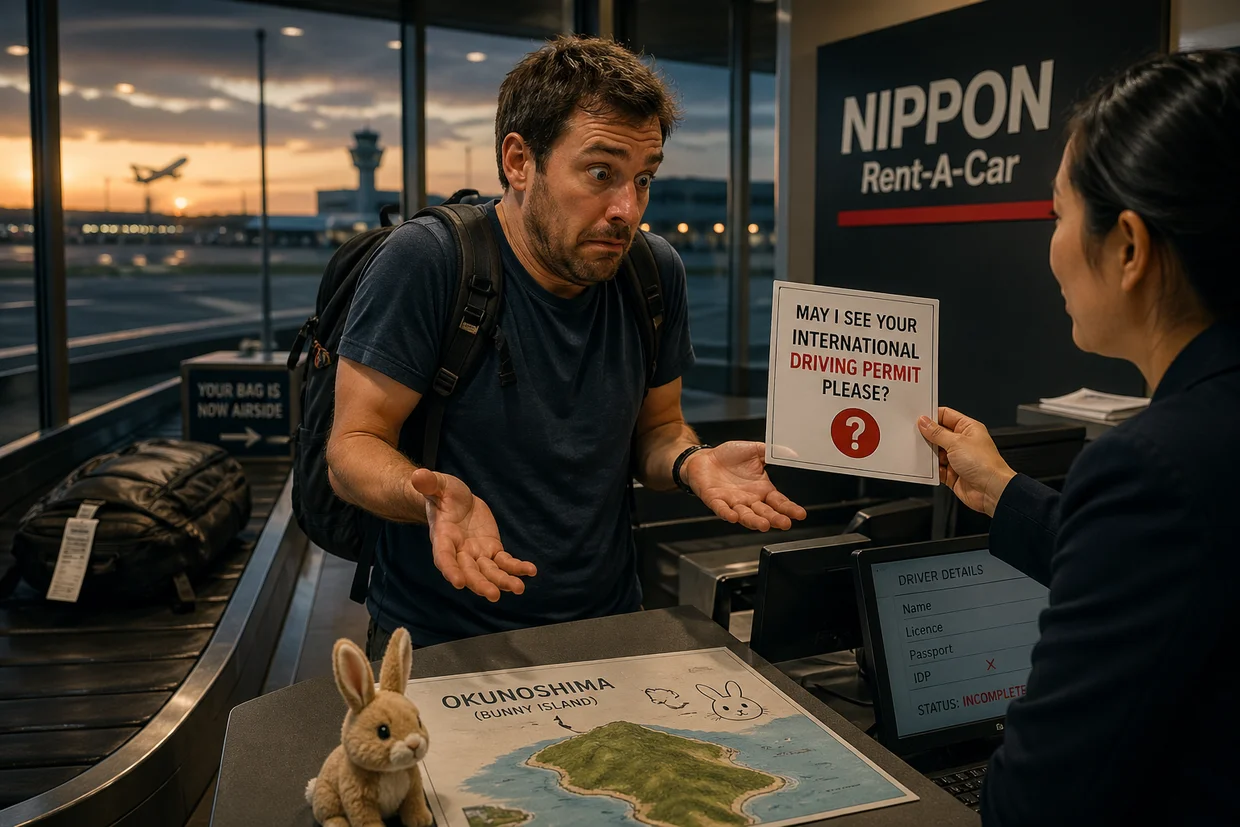
Pack the IDP in your carry-on. Or, better still, slot it into your wallet right next to your licence. Don't be me.
Age limits and young driver fees
- Under 25: expect a "young driver surcharge" of about 20 to 30 dollars a day in most places. Some companies won't rent to you at all under 21, and a few hold the line at 23.
- Over 70: some EU countries add a senior surcharge or restrict categories. Always check the small print.
Credit card in the main driver's name
This bit catches people out. Most rental companies will only take the deposit on a credit card, in the name of the actual driver. Debit cards are sometimes accepted but with a much higher hold or extra restrictions. Showing up with your partner's card and your licence is a one-way ticket to "sorry, can't help you."
Picking the Right Car
Don't just click the cheapest option and hope for the best. A few things to actually look at.
- Size. Smaller is almost always better in Europe, Japan, and old town centres. Streets get narrow fast, and the "spacious" SUV you booked won't fit through the gates of your guesthouse. In the US, Australia, or for road trips with bags, go bigger.
- Manual or automatic. If you can only drive an auto, book an auto. Outside the US and Australia, autos can be limited and pricier. In Europe and many parts of Asia, the default is still manual.
- Fuel type. Petrol, diesel, hybrid, full electric. EVs are tempting and often cheaper to "fuel," but charging on an unfamiliar route can wreck your day. Stick to petrol or hybrid unless you're confident in the country's charging network.
- Air-con. Always confirmed in hot countries. Some economy cars in Mediterranean rentals technically have aircon that sort of dies after twenty minutes in 38 degree heat. Read recent reviews.
- GPS or phone mount. The built-in GPS option costs a fortune. Just bring a magnetic phone holder for a couple of bucks and use Google Maps offline. Done.
- One-way drop-offs. Brilliant for road trips, brutal on the wallet. The drop fee can sometimes be more than the rental itself, so always check before you book.
- Mileage cap. Most rentals are unlimited mileage these days, but not all. If yours is capped, do the math on your route before signing. Going over the limit gets pricey quickly.
Insurance: The Bit Where Everyone Tries to Get You
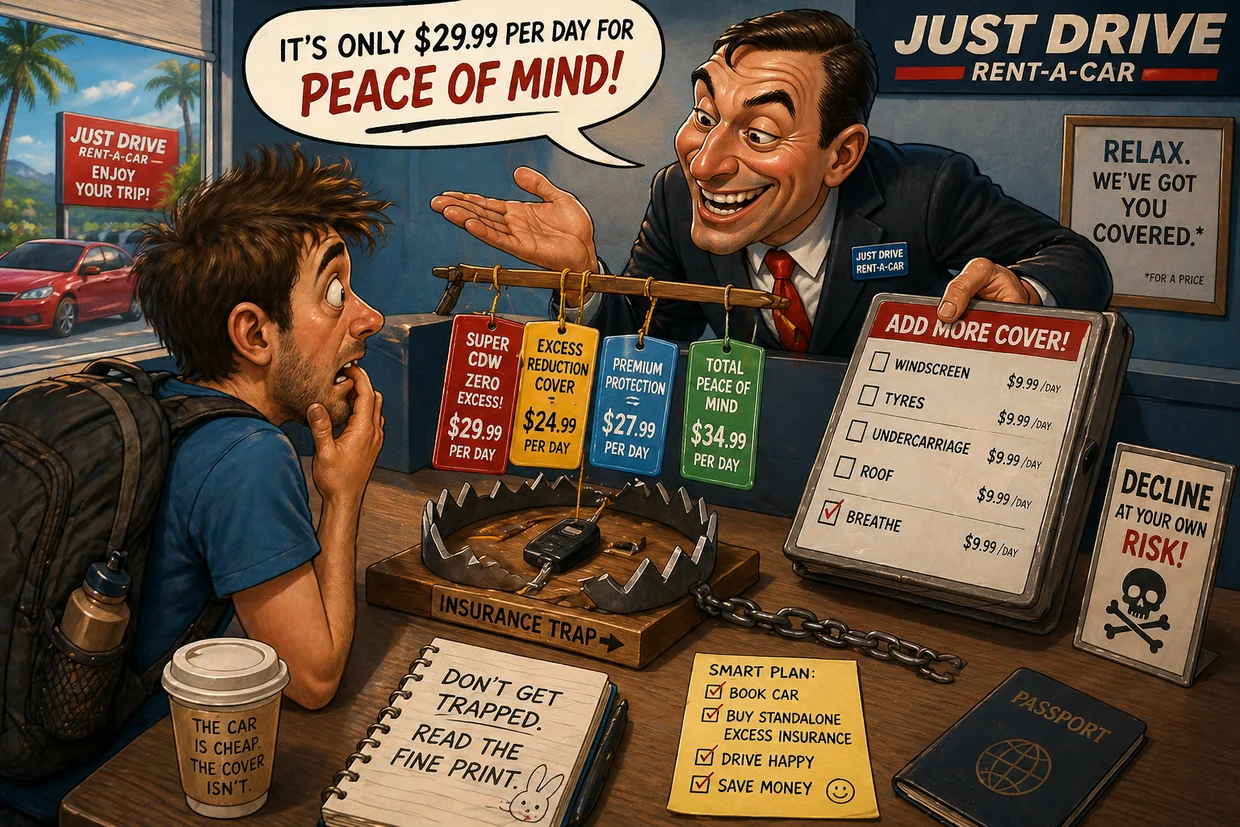
Insurance is where rental companies make the bulk of their money. The car at the counter is loss-leader cheap. The cover they push at pickup is where the margin lives.
The basics
- Third-party liability. Covers damage you do to other cars and people. Almost always included in the base rate by law.
- Collision Damage Waiver (CDW). Covers damage to the rental itself, but with an excess. The excess is what you pay out of pocket before insurance kicks in. Standard CDW excess can easily sit at 1500 to 2000 dollars.
- Theft Protection. Covers the car being nicked. Often bundled with CDW.
- Super CDW or "Excess Reduction" or "Premium Cover." Reduces the excess to zero (or close to it). This is what they really want to sell you at the counter, and it's usually marked up massively.
The smart way to handle it
Don't take the counter cover. Almost ever.
Instead, buy a standalone "rental car excess insurance" online before your trip. Outfits like Allianz, RentalCover, iCarHire Insurance, and a handful of others sell yearly policies that cover the excess on any rental, anywhere, for a fraction of what the rental company charges. You pay out of pocket if something happens, then claim it back from your standalone insurer. Your rental contract still shows you with high excess, but you're covered behind the scenes for cents on the dollar.
Important
- Tyres, windscreen, undercarriage, and roof are often excluded from the rental company's standard CDW. Standalone policies usually cover them. Check both.
- Make sure your standalone insurer covers the country you're driving in. Some skip Mexico, parts of Africa, or specific Eastern European countries.
- Always keep all receipts and photographs for any claim.
If you don't want to faff with standalone cover and just want peace of mind, take the full counter package once and call it a day. Just know you're paying premium prices for it.
Credit Cards: The One That Pays Off
Some credit cards include rental car insurance as a perk. If yours does, you might not need to buy any extra cover at all. But the details matter.
Primary vs secondary cover
- Primary cover pays out first, before any other insurance. You file directly with the card. No claims on your home auto policy, no rate hikes.
- Secondary cover only kicks in after your other insurance has paid. Useful, but limited if you don't have other rental coverage to begin with.
Most cards offer secondary. A few good travel cards offer primary. Read the actual terms, not the marketing page.
Cards known for solid rental cover (check current terms before you rely on them)
- Chase Sapphire Reserve and Preferred (US). Primary cover up to the cash value of most cars.
- Amex Platinum (varies by region). Often primary in the US, secondary elsewhere. The optional "Premium Car Rental Protection" add-on is available cheaply in the US.
- Mastercard World Elite, Visa Infinite (varies by issuer). Often include rental cover, sometimes primary, sometimes secondary.
- Many premium European cards. Include some level of rental cover, but always with country exclusions. Read the policy.
How to actually use it
- Pay for the entire rental on that specific card. Not partial. Not split. The whole thing.
- Decline the rental company's CDW at the counter. (Third-party liability stays, that's separate.)
- If something happens, document everything: photos, police report if required, receipts, statement from the rental company.
- File with the card issuer within their deadline (often 20 to 60 days).
The deposit hold
Even with great cover, the rental company will whack a hold on your card for the deposit. This is normal. Numbers vary from a couple of hundred bucks to over a grand depending on the car. The hold drops off a few days after you return the car. Plan for it, especially if you're tight on credit limit.
Not every card gets accepted
Quick gotcha that bites your wallet: not every rental outfit takes every card. Some won't touch Amex (the merchant fees sting them). Some refuse debit cards entirely. Some refuse both. And the ones that play this game often won't tell you in the booking flow. The big chains in major airports tend to take whatever, but smaller offices, certain countries, and late-night arrivals can be a different story.
Carry at least two different credit cards from two different networks (Visa and Mastercard is the safe combo). If you're rolling with one card only, double-check the rental company's accepted-cards policy before you book. The wrong assumption here can ruin a trip before it's even started.
Another cautionary tale
Late evening arrival in Romania. The shuttle picked me up at the terminal and dropped me at the rental office. The rep asked for my card. Visa: declined by their system. Mastercard: same. Amex: politely refused. My debit card? "Sure, sir, but only if you take our full insurance package." About 30 euros a day on top of the rate. There was no other rental open at that hour, no public transport running, no Plan B. What should have been a budget trip turned into the most expensive rental car I've ever had.
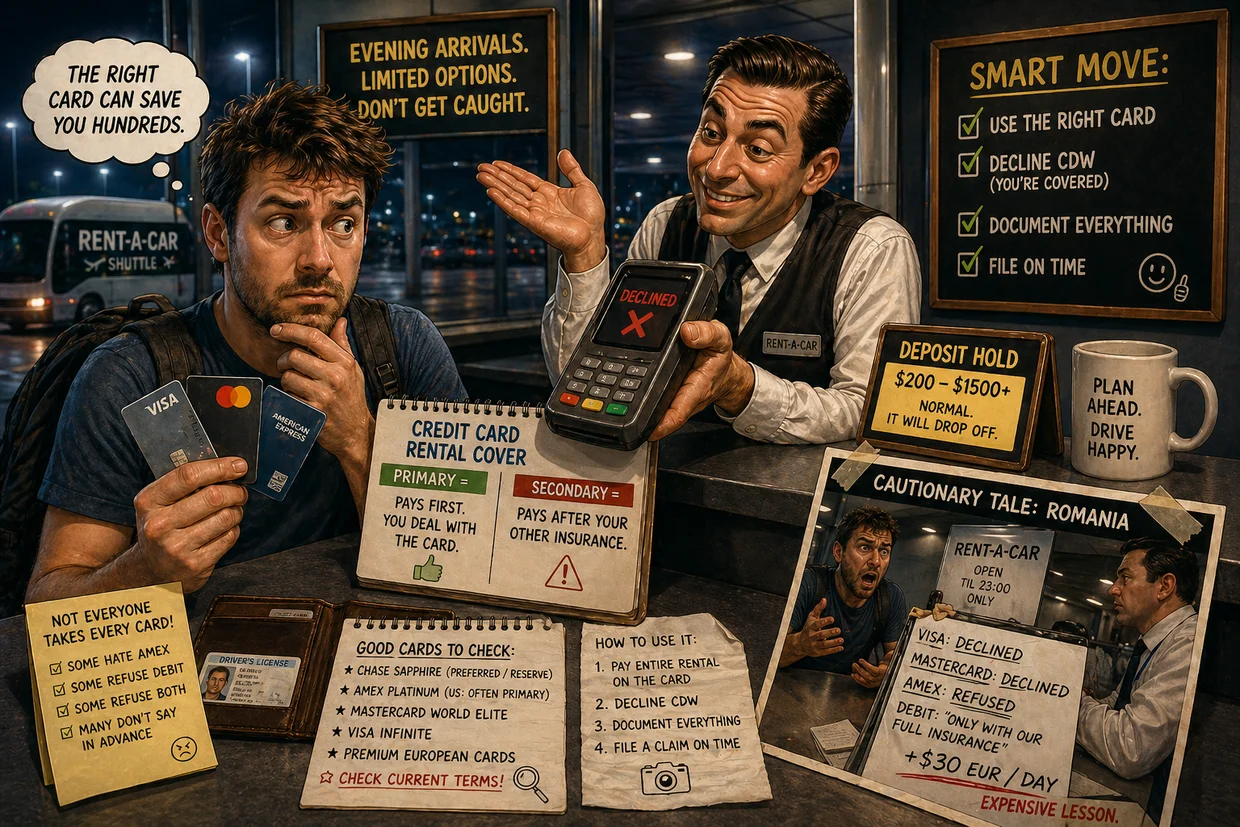
The lesson: if a counter is suddenly very keen to "just put you on our insurance instead," that's not coincidence, that's a script. Bring backup cards, and if you smell setup, walking away (even at midnight, even if it's a bit dramatic) is sometimes cheaper than agreeing.
Scams to Spot a Mile Off
Most rental companies are above board. But some locations and a few sketchy local outfits will absolutely have a go at you. Watch for these.
- The "free upgrade" trap. "Mate, the car you booked isn't here, but I can upgrade you to this beauty for just an extra 15 dollars a day." Eight out of ten times, the original car is sitting in the lot. Ask politely but firmly for the car you booked. If they insist it's "unavailable," ask for the upgrade at no extra cost (you booked a category, they have to honour it).
- Phantom damage at drop-off. You return the car, the rep finds a "scratch" you swear wasn't there, and suddenly there's a 400 dollar charge appearing on your card three weeks later. Counter this with thorough photo and video evidence at pickup AND drop-off, time-stamped. More on that below.
- The fuel "convenience" trick. "Don't worry about refueling, we'll just charge you our flat rate." That flat rate is two or three times the petrol station price. Always refuel before drop-off and keep the receipt.
- Mandatory "extras." Some sketchier outfits add items at pickup that "you must take" to drive in this country. Child seat, GPS, additional driver. Almost none of it is mandatory. Push back. If they won't budge, ask for everything in writing and walk away if it smells off.
- Currency conversion at the counter. "Would you like to pay in your home currency?" Always say no. Pay in the local currency. The "convenience" exchange rate is usually 5 to 8 percent worse than your card's standard rate. (This also happens at hotels.)
- Pre-paid fuel. Sounds fair, isn't. You pay for a full tank up front, and any fuel left in the car at drop-off is just gifted back to the rental company. Always pick "full to full" instead.
- Toll surcharges. Some companies charge huge admin fees for processing toll violations months later. If you're driving through toll routes, ask up front about the policy. Use the rental company's electronic toll system if it's reasonable, or pay tolls yourself in cash where possible.
Pickup and Drop-off: Cover Yourself
The single most important habit: photograph and film the car like you're a forensic investigator.
At pickup
- Walk a full lap of the car with your phone, recording video. Narrate the date and the rental company name out loud.
- Photograph each panel, each wheel, the windscreen, the roof, the underside of bumpers, the boot floor, the dashboard reading (kilometres and fuel level).
- Open the boot, photograph any spare tyre and tools.
- Sit inside, photograph any visible damage or wear.
- Cross-check every existing scratch and dent against the rental agreement's pre-existing damage report. If there's a mark on the car that isn't on their sheet, get it added before you drive off the lot.
At drop-off
- Repeat the entire process. Ideally before the rental rep is involved.
- Get the rep to physically inspect the car at handover and sign off. Don't drop the keys in a box and leg it. That box is a scam waiting to happen.
- Keep your fuel receipt time-stamped from a station near the drop-off.
It feels paranoid. It is paranoid. It also saves you 400 dollars roughly twice a decade, and it costs you nothing.
One last cautionary tale
Even bulletproof documentation isn't a guarantee. If a rental outfit really wants to charge you, they'll find something the camera missed.
My one and only run-in happened in Malaga. The rep walks up to the car at drop-off, takes the key from my hand, sticks it into the door lock, and announces "oh, the lock is broken, someone must have tried to break into the car." Yeah, sure. Someone. Because everyone uses the metal key on a remote-opening rental car. No rental company has ever, in the history of rentals, tested the physical door key at handover. Neither do I, neither do you. A quick search online turned up several other travellers reporting the exact same scene, from the exact same company, in the exact same city.
My credit card's rental cover paid out without a fuss, but the whole thing reeked of scam from the second she pulled the key out. The takeaway: photos and video help a lot, but they can't help with "damage" that gets manufactured in front of you at drop-off. If you've got primary cover on a card, lean on it. If you don't, fight the charge in writing and dig online for similar complaints tied to the same office. Patterns matter, and a chargeback dispute backed by other victims' screenshots is a very different beast from one person's word against the rep's.
Published April 2026.